


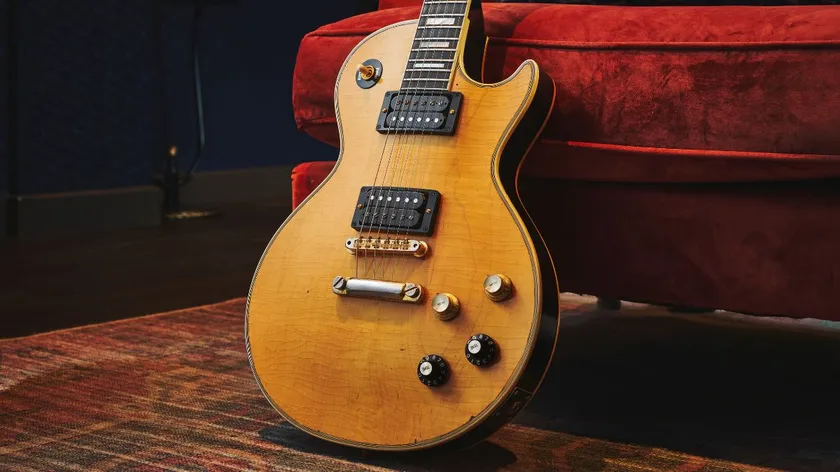


In the 71 years since the Fender Stratocaster came to market, the electric guitar recipe has hardly changed. Save for the introduction of fretboard radius and multi-scaling, the fingerboard has also remained largely conservative.
Undoubtedly the recipe has been a success, but it’s still fundamentally flawed: it's near-impossible for traditional fretboard to ever be completely and utterly in tune on every fret.
True Temperament fingerboards are designed to address that, promising perfect intonation across every single note and chord. Steve Vai, Plini, and even Ronnie Wood are converts, but does the science translate into a playable reality, or is it all hyperbole?
Fixing flaws
“When Leo Fender designed the Stratocaster, it was not to make the perfect instrument,” says True Temperament’s Anders Nickalsson. “He wanted to make a product to mass-produce. It's not based on precision.”
Indeed, Mattias IA Eklundh, an advocate since 2008, says it’s a mathematical impossibility to intonate every note with the traditional system. The crooked frets of True Temperament show you where on the fingerboard notes actually lie.
“We're eliminating the beating between two notes,” Nickalsson explains. “That means you get better sustain. It takes seven minutes to make each fret from Swedish stainless steel. When we bring in precision we can take the guitar to the next level.”

What the players say
An innovation is only as good as its endorsees, and this one certainly has its disciples. Vai for one feels it makes a radical difference. “I immediately knew True Temperament was onto something extraordinary,” he says. “The intonation is stunning – chords resonate with a purity and balance that feels almost vocal, and the entire neck comes alive with a new level of musical accuracy.”
For Scar Symmetry’s Per Nilsson, TT has “changed how I write, how I phrase, even how I listen.” Fellow Strandberg player Plini found the improvements to be “noticeable with wider chords, especially when recording.”
Nickalsson remains on a personal mission to win players over. “Over the summer, Plini was hiking in Scandinavia, so we built him a travel guitar. He told us it was the best guitar he'd ever played. The acoustics Nuno Bettencourt used on the new Extreme album are TT, because they’re perfect for chords,” he adds.
“Suddenly, Ronnie Wood shows up with one of our guitars. When Kirk Hammett auctioned his guitars recently, there was a Strandberg with TT. We didn't know! Sometimes things travel very naturally.”

Change the narrative
While off-the-shelf TT guitars do exist, they are still rare. Cort and Strandberg’s models remain the biggest examples of industry commitment to the cause. “Cort is also making for Ibanez and Fender,” Nikalsson says. “It could be a gateway.”
Plini's representation – given that he's already helped change the narrative on headless guitars, is a prime example of the mission. “We evaluate a brand by its roster,” Nickalsson acknowledges.
But there’s an elephant in the room: why don’t we see more TT guitars on stages? “We have 200 of the best guitarists playing TT, but they don't want to jeopardize their endorsements,” Nickalsson explains.
Which makes the hard sell that little bit harder.

Out with the old, in with the new
True Temperament is at a tipping point. Early hype has led to some ringing endorsements, and with replacement parts now available, the firm is targeting the wider community.
Ready-made necks are currently available for Stratocasters and Telecasters only, while lone-standing fingerboards accommodate an array of scale lengths and string counts, nylon acoustic guitars and basses.
In an effort to separate fact from fiction, I got hold of a neck, converting my old, rarely used Squier Strat. I hoped to give it a second life – but I soon found that installing a neck isn’t for the novice.
They arrive sans tuners and nut. The nut socket is flat, rather than curved, meaning Fender drop-in nuts won’t fit, and the string spacing can be a head-scratcher. It’s not a fun and easy DIY project for a rainy day, a la JHS's Notaklön pedal – you're best leaving it to a professional.

Prices for replacement fingerboards start from $440, and necks are circa $800. Plus, there’s the cost of the additional parts and labor – the latter for me was $235, including installation of the neck, tuners, having a bone nut made from scratch, and setup. That’s a stumbling block.
But does it make a difference?
Tried & tested
True Temperament is certainly winning me over. I’m finding that complex chords bloom brilliantly, the guitar’s sustain is markedly better, and it’s imbuing a new confidence in my playing; everything sings with more conviction.
On recordings, its note clarity – even with cheap, rusted pickups – is a breath of fresh air. My ideas are better showcased, and I’m actually starting to wish I had a better Strat to have pimped.
Getting used to it is quick and painless too. In the band room, when doubling up parts with my co-guitarist’s Gibson Explorer, there isn’t a painful discrepancy between our guitars when we both strum the same chord. Mine just sounds a little nicer.

The differences are more nuanced than jaw-dropping. In the hands of a session player it could be revolutionary – but the perks for the hobbyists do little to justify the price.
It’s worth debunking some of the comment-section conspiracies. You can play in any key, you can bend to your heart’s content, and you can tune it however you’d like with your preferred string gauges. In fact, it shines in open tunings that hinge off resonating open strings. The only restrictions I see are the ones every guitar has, and so a proper setup is paramount.
Tuning is trickier. Only the A note works with a chromatic tuner, which means I have to find that note on each string to tune – it’s not the end of the world, but it might be something that really irks.
And while Sonic Research Turbo Tuner ST-300 has a TT setting, you’ll have to scour eBay for one, as it’s been discontinued.

Should I get one?
Arguably, TT could make a beginner’s playing journey easier as they’d sound better from the off – but in reality it’s a specialist item that needs greater momentum to truly take off.
More big-name endorsements may tip the scales, leading brands to capitalize on the trend, as evidenced by the current offset hype. That will mean greater accessibility, tuner advancements and even better prices. Without it, TT remains inaccessible to most players.
Mass-produced guitars will almost definitely never pivot. The production costs are far higher, meaning you aren’t going to get a $100 guitar with TT any time soon.
As a concept, it works brilliantly – but it needs the rest of the industry to back it; and right now, that’s an “if”, not a “when”.
- For more information, head to TrueTemperament.com.

