




Nels Cline has looked back on his love affair with the Fender Jazzmaster – an electric guitar that won his heart despite the fact it had once been considered the ugly duckling of the guitar world.
It is hard to believe it nowadays, but in the not-so-distant past the Jazzmaster was once considered a flop. Fender’s unveiled the now much-loved offset guitar design at NAMM 1958, and yet it didn’t quite take off at the time.
It had to wait for the alt-rock revolution, when the likes of Sonic Youth’s Thurston Moore would pick up the Jazzmaster and its shorter-scaled sibling, the Jaguar, as cheap beater guitars to take out on the road (and to accommodate all those alternate tunings).
Nels Cline of Wilco can remember the days before the Jazzmaster was cool. And speaking to Guitar World’s Paul Riario, he admits that even he didn’t understand them when he was a kid.
“When I was in junior high, high school, nobody played these guitars,” says Cline. “They were completely derided. And, in fact, the man whose name keeps coming up, Bill Watts, he for a while in high school, had a Jazzmaster, and I remember thinking, ‘Why? What are you doing?’”
But few electric guitars remain a flop forever. All it takes is for one or two musicians to pick them up, hear their sound in them, and then create a buzz about them. Watching Television’s Tom Verlaine play them, and the rise of Sonic Youth, Cline had an epiphany. This turned him onto the offsets.
He got a Jaguar first, picking up a ’66 vintage model from an ad in The Recycler. “I didn’t really know the difference between the two,” he admits.
When he got his first Jazzmaster, though, that’s when he caught the bug big time. It wasn’t just the look (though they did look cool), it was the creative potential from having all that extra string length behind the bridge and the floating vibrato, and it was the feel of it, too, that sealed the deal.
“The thing about it is not just strings behind a bridge, but when I picked it up, the Jaguar, I immediately felt comfortable,” he says. “So string length behind the bridge, the whole body shape, neck profile, everything.

“It's super comfortable. And then having tremolo, it’s very important to me. I realized that, even though I have all these guitars at this point – which is ridiculous – that, if I don’t have a tremolo of some sort and string length behind a bridge, the guitar’s not gonna get used very much, in my case.”
But the Jazzmaster had more to give. Not only did it present Cline with a comfortable platform to express himself on – the wobble from the tremolo, all that extra strength length – but it was a tough old beast, too. It invited him to play it harder in a way that other electric guitars did. The vintage Jazzmaster in his hands had been through the wars and was still standing.
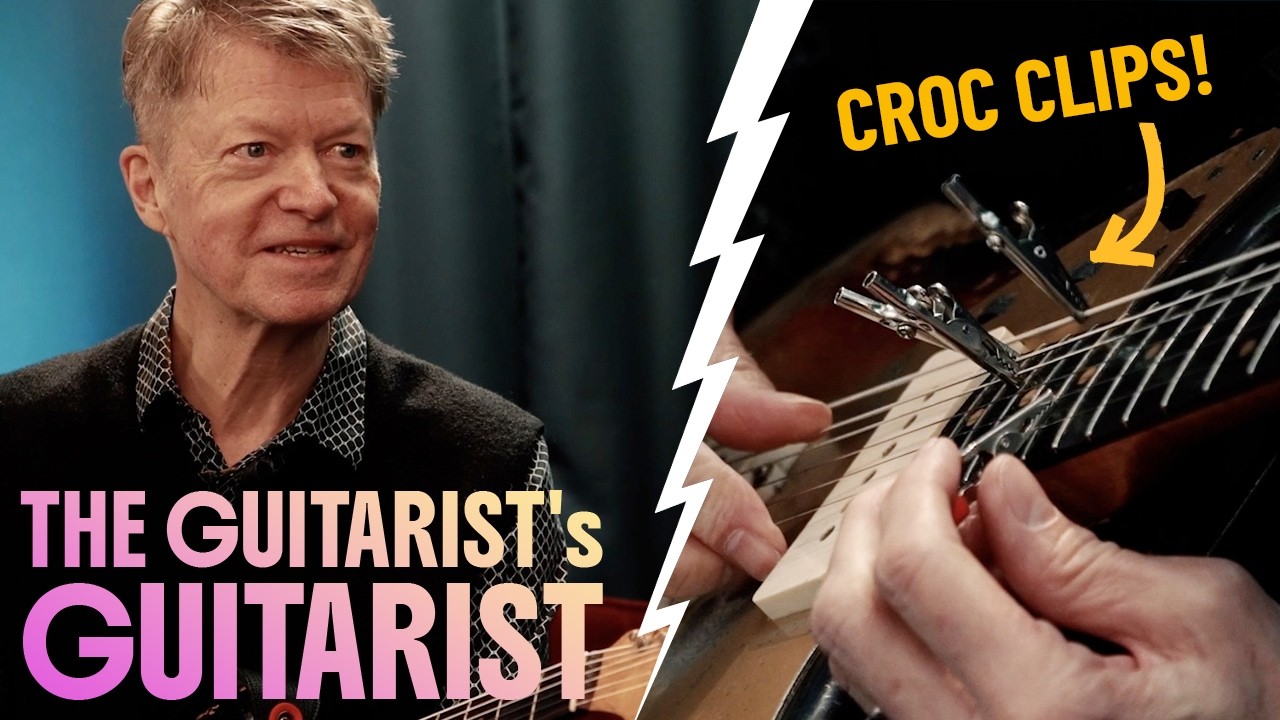
“This one was once broken in half, not by me, and reglued,” says Cline. “I got it in Brooklyn at Southside [Guitars], this one. This is probably the most I ever paid for a Jazzmaster, because I bought it 15 years ago, when things had changed.
“My main one, the one I bought for Mike Watt, that was $800. I remember thinking, like, ‘Oh, God, so expensive!’ You can see it’s distressed but my point is it can take it. A Les Paul can’t take it. Gibsons, in general, I’m just gonna destroy the neck. I don’t play all my guitars this hard but this guitar can do anything… You can see it’s distressed, but it can take it.”
And that’s a priceless quality in a guitar. You can check out the full video with the Wilco guitarist above, in which he gives us a tour of his pedalboard, talks all things tone, and recalls the life-changing phone call when Jeff Tweedy asked him to join Wilco.

