


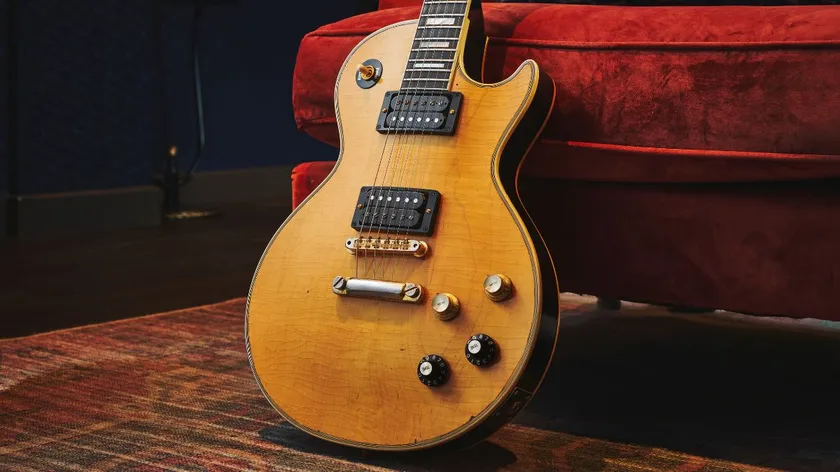


In this edition of Bought & Sold we have the pleasure of Mike Vennart's company, a treat not only because we are great admirers of his work with Oceansize, Biffy Clyro and Empire State Bastard et cetera, but in this conversation – a life in guitars, if you will – we rarely get a southpaw player's perspective.
Given how ill-served left-handed players are, Vennart has nonetheless put together a very cool collection. Here he talks first guitars, buying advice, and admits he's still waiting for the vintage electric guitar of his dreams.
What was the first serious guitar you bought with your own money?
I was lucky enough that I’d started playing when I was really young, so my mum got me a couple of really great guitars, namely a Squier Strat. It was a Japanese Squier Strat, which I still play to this day. It’s just an awesome piece of gear. After that, I was gifted a guitar by Fender.
But the first guitar that I made a point of purchasing was a Fender Jazzmaster – because in 2008 or thereabouts, it was just not possible to get a left-handed Jazzmaster in this country. Even though I had contacts at Fender, they told me, ‘No, man, you might as well be ringing Ibanez; we just don’t make left-handed Jazzmasters.’ So I had to go to Fender Japan, have them build it and send it over.
And to this day, it’s one of the best guitars I own. It’s just so versatile. I put a P-90 in the bridge and I can play heavy stuff with it, I can play really jangly tiny chords with the neck pickup. It’s a whole lot of guitar and I love it. I use it a lot.
What was the last guitar you bought, and why?
I bought a Shergold Masquerader, a British guitar brand from the ’70s, and I’m a huge Cardiacs fan and I’m actually now in the fucking Cardiacs! So I bought this because several members of Cardiacs played Masqueraders and I thought it’d be a cool thing to have. I don’t think I’m gonna use it on stage with Cardiacs – that might be a little bit too much of a homage, really.

What’s the most incredible find or bargain you had when buying guitars?
Over lockdown, I’d accumulated a ton of air miles and, obviously I couldn’t use them, so I changed them into points and bought a Godin 5th Avenue on eBay for like 350 quid. It’s not my usual kind of guitar at all, but it’s got class, and I can kind of get away with using it at acoustic shows, even though it’s not really acoustic.
It makes me feel a certain way, it’s got a beautiful sound, and it’s nice and easy to play. But I fucking hate playing acoustic guitar. I can’t think of anything more boring [laughs], so this thing brings the best out in me – I can get a lot of inspiration out of this guitar. It’s got one single P-90 in the neck, and that’s all it does. It’s fantastic.

What’s the strongest case of buyer’s remorse you’ve had after buying gear?
I don’t know if I’ve ever really had that. Everything I’ve bought is stuff I’ve known for sure I wanted and made sure it was the right thing to get. I’ve bought a couple of guitars that I ended up spending a fortune modifying, trying to get them to work correctly [laughs]. But, ultimately, I try not to buy guitars off the internet because I need to play them first, you know?
I can tell within one minute of playing a guitar whether or not I think it’s any good or not. And it’s kind of slim pickings for me as a left-handed player. I get excited when I see a good-looking left-handed guitar – I have to try it out. But if it ain’t speaking to me, if I can’t feel a song in it straight away, then I put it down and don’t think about it again.
But there are some guitars that I’ve bought over the years that I just have no choice but to buy them. I’ve got a 1978 Fender Strat right here… it weighs more than any Les Paul I’ve ever played [laughs]. It’s kind of ugly; it’s like a sunburst with a black scratchplate. It’s really nothing to look at, but it plays beautifully and it sounds great. So I just had to buy it, and that’s probably the most expensive thing I’ve ever bought. I think it’s like 2,400 quid or something.
![Empire State Bastard - Harvest [Video] - YouTube](https://img.youtube.com/vi/S5Xjku-dYJ8/maxresdefault.jpg)
Have you ever sold a guitar you now intensely regret letting go?
Not as such. I had a Butterscotch Tele and I tried everything to make it playable and fun. I put new pickups in it; I just did all this stuff, but I could never work out why I wasn’t feeling it. I don’t know what it was… it kind of sounded just like a banjo. It didn’t resonate at all. I think maybe the two pieces of wood just weren’t friends with each other.
And now, every so often, somebody will get in touch and say, ‘Hey, did this used to be your guitar?’ And I’ll see it and I’ll think, ‘Fuck, I used to love that thing, but it never loved me back.’ Obviously, now somebody’s put a humbucker in and an EverTune bridge and all kinds of mods, but it’s still the one that I’m like, ‘I used to love gazing at that thing, but it just sounded like shit’ [laughs].
What’s your best buying tip for anyone looking for their ultimate guitar?
It’s always gonna be the Japanese Squier Strats from the 1980s. I mean, I’ve got two of them and one of them is my all-time dream guitar! I’ve put a few mods on it, you know, you’ll probably need to change the pickups and you’ll probably need to change the tuners.
But if you’re just getting into playing guitar and you want something that’s going to make you feel good, and make it as easy as it can be, then the Japanese Squier Strats will become part of the fabric of your playing. I honestly think that they’re as good as any Strats you can buy. And they’re going up in value, I think, so they’re kind of hard to catch these days. But fuck, they’re amazing! I love them.
![Mike Vennart's guitars [L-R] ’80s Japanese Squier Strat, 1978 Fender Strat, Shergold Masquerader, Godin 5th Ave, Fender Jazzmaster](https://cdn.mos.cms.futurecdn.net/fuBhCm8wNDsGomtchBiheG-1200-80.jpg.webp)
What were you looking at the last time you looked in a guitar-shop window or online?
Every so often, this left-handed 1952 Les Paul shows up on the internet, and I’m like, ‘Oh my God, have I got any millionaire friends out there who wanna just buy me this thing?’ I do have a fantasy that one day I’ll be able to own a guitar from 1976, my birth year, but I’m wary of buying anything off the internet without playing it first.
And most Fenders and Gibsons from the ’70s are probably going to be absolute dogs, you know? There was sketchy quality control in those days, so a 1976 anything is gonna be a very risky purchase. But I have a particular hankering for an early ’70s Strat, a hardtail. They just seem to have such a beautiful resonance and that bell-like chime thing that I’m obsessed with.
If forced to make a choice, would you rather buy a really good guitar and a cheap guitar amp or a cheap electric guitar and a top-notch amp?
Oh, man, that is a nightmare because I can completely contradict myself both ways on that! Ultimately, I need a guitar that feels great – and you can get a guitar that feels great for not too much money. That is absolutely possible. You could build your own guitar for not too much money, you know?
But in terms of amplifiers and cabinets, a lesson I need to keep learning is that it’s primarily about the cabinet. You need to make sure you’ve got the right speakers, but with amps, I keep buying them [laughs]. I keep changing brands and I keep circling back to the same one, which is an Orange Retro 50. It’s just five knobs and the truth: no bullshit, no effects loop, no attenuator, just an incredible, thick British ‘Plexi’ sound. It’s awesome.

If you could only use humbuckers or single coils for the rest of your career, which would it be and why?
Single coils, because I could get a really beefed-up single coil for the bridge. In fact, what I use on most of my Strats is a single coil that’s kind of overwound to hell. When you kick the dirt in, it sounds heavy and it really chugs like a humbucker. But then, what I want in the neck is always going to be a single coil – always.
I just find that, although I love a humbucker in the bridge, a humbucker in the neck position is often too woolly for me. It’s cool for solos and sounding like Slash and all that stuff, but a humbucker in the neck is just too hot. I can’t quite get out of it what I want.
Mike’s Go-To Rig
For Biffy, I’m using Laney amps – I’m using a Laney Supergroup because I’m a big Tony Iommi obsessive. I had to try getting more headroom because, for Biffy, right now, I’m using a lot more reverb and modulation. I needed a much cleaner signal than I was getting out of my previous amps.
For Biffy, right now, I’m using a lot more reverb and modulation. I needed a much cleaner signal than I was getting out of my previous amps
For guitars, I have a PJD Custom Saint John. It’s got Wide Range [style] humbucker in the bridge and a Jazzmaster pickup in the neck. I’m also using a Rigby custom [T-style] that’s got Filter’Trons in it. Then I’m using a Les Paul Goldtop Standard and the Gibson Tony Iommi SG with P-90s, which sounds raunchy and ballsy but cleans up really sweet.
Pedals-wise, I’m using a Klon clone; that’s my main distortion and it just absolutely articulates. I’m also using a green Big Muff [Pi V7 Green Russian], and I’ve just ventured into the world of Line 6 pedals – I’m using the HX Stomp for modulation and reverb.
I have the Boss DM-101 [Delay Machine] for my echo stuff. For the time I was in Oceansize, my echoes were the Boss DM-2, which I just think is the king of all delay pedals. But the Boss DM-101 gives all this incredibly ambient, beautifully washy delay – and it’s tap tempo as well, so I was like, ‘I gotta have this thing.’ It’s just incredible.
- This article first appeared in Guitarist. Subscribe and save.

