





Guitar World Verdict
The Strymon BigSky MX is a worthy successor to arguably the most popular reverb pedal ever made. It’s not just a quick rehash either, with entire engines being rebuilt to improve the quality, and the addition of running dual algorithms seriously expanding the sound-sculpting possibilities. Despite the huge depth, it’s incredibly easy to edit and adjust sounds, which is the real strength of this pedal. It’s a worthwhile upgrade for anyone who already owns a BigSky, as well as a potentially huge boon for players who want a wealth of top-quality reverb tones at their fingertips.
Pros
- +
Studio-quality reverb tones.
- +
Tactile controls make it easy to dial in sounds.
- +
Two algorithms in stereo great for studio work.
- +
Screen is legible in any light.
- +
Durable chassis that will put up with abuse.
Cons
- -
Will be too complex for some players.
- -
Still no preset editing on the companion app.
You can trust Guitar World Our expert reviewers spend hours testing and comparing guitar products so you can choose the best for you. Find out more about how we test.
What is it?
It’s been a few years since the Strymon BigSky MX was released, so it’s about time we got around to reviewing it. Successor to arguably the most popular reverb pedal of all time, the MX looks to build on the success of the original, adding more sounds, more processing power, better connectivity, plus loads more.
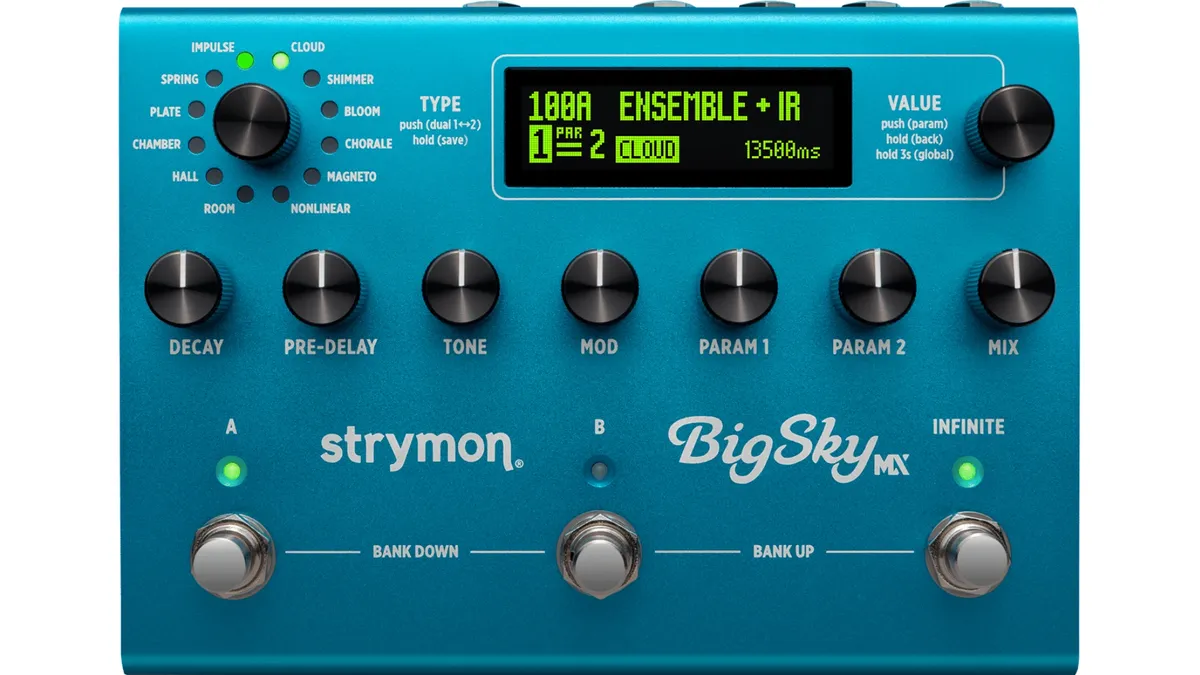
The headline here is that you can now run two reverb engines simultaneously, whether that’s in series, parallel, or with each engine panned separately. The MX also significantly increases the power to do this, replacing the 366 MHz SHARC DSP chip with an 800 MHz tri-core ARM processor.
The impulse and chamber engines are fresh additions to the lineup, but it's not just new stuff that's been added. The spring, plate, hall, room, and shimmer engines have been rewritten from the ground up, with many of the other returning sounds getting additional functions and enhancements. The ability to load custom impulse responses up to 10 seconds long adds a lot of potential flexibility, and it ships with 22 stereo IRs as stock.
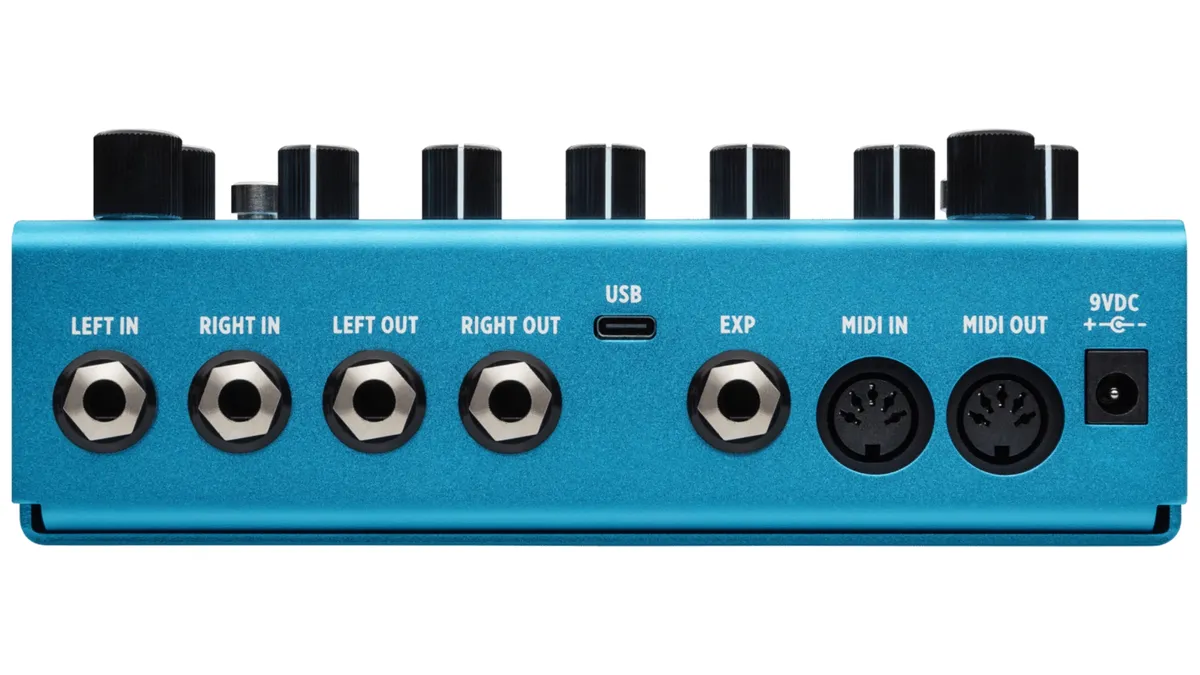
The footswitches have had some slight changes, with a dedicated infinite footswitch, while the A and B footswitches can now be set to toggle each reverb engine independently. It has USB-C, bringing it firmly into the future versus the original, which required a MIDI-to-USB adapter to use the Nixie companion app. It can also do MIDI over USB-C, TRS, or the traditional 5-pin DIN connection.
Specs
- Launch price: $749 | £699 | €699
- Type: Dual-engine reverb workstation
- Controls: Type, Value, Decay, Pre-Delay, Tone, Mod, Param 1/2, Mix; 3 footswitches (A, B, Infinite)
- Features: 12 reverb algorithms, dual reverb engines (Series/Parallel/Split routing), 10-second stereo impulse response loading and editing, Nixie 2 editor software
- Connectivity: Stereo in/out, MIDI in/out (5-pin DIN), USB-C (MIDI, editor, firmware updates), EXP jack (expression pedal / MultiSwitch / TRS MIDI)
- Bypass: True bypass (electromechanical relay) or buffered bypass, selectable
- Power: 9VDC, center-negative, 2.1mm, 500mA minimum
- Dimensions: 172mm x 127mm x 48mm (7" x 5" x 1.87")
- Weight: 800g
- Options: N/A
- Contact: Strymon
Build quality
Build quality rating: ★★★★½
Despite the workstation moniker, it’s not actually as big as you think it might be. The MX is slightly wider than the original BigSky but only just, and it weighs well below a kilo. It’ll take up the same amount of space as two and a bit Boss stompboxes by my reckoning. It’s not tall either, offering a relatively low-profile platform that won’t stick out too much alongside other pedals.
All of the parameter control knobs offer a nice, firm travel and feel robustly applied to the chassis. The endless encoders for selecting reverb engines and adjusting certain values, on the other hand, are a lot softer in their response.
There’s no ratcheting to the engines, which are instead dictated by an LED light, and when I turn slowly, it takes a second or two to move to the next option. The push-in function of each encoder is nice and tactile, but personally I’d like a little more resistance when turning them.
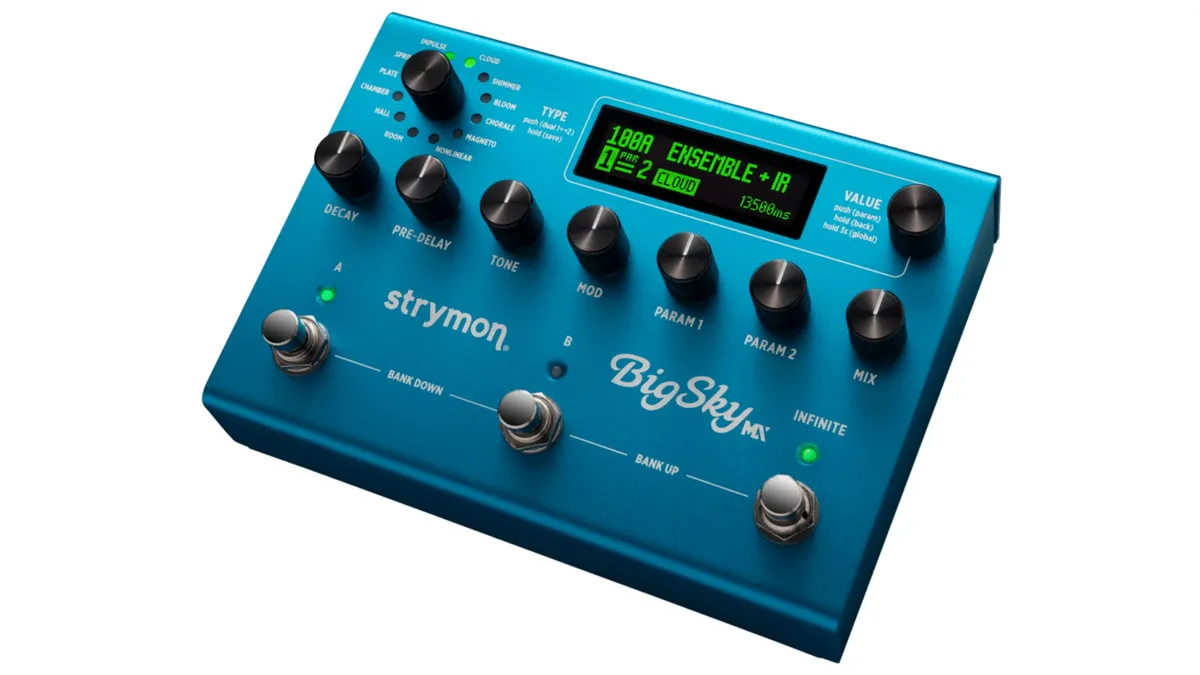
One thing I didn’t enjoy was the white text on the blue background. Great when playing on a dark stage, but at some angles could be difficult to read with the overhead lighting in my home studio. No such issues with the screen, which works brilliantly in any light thanks to the contrast of green on black.
The footswitches feel very robust, and they click quietly when I press them in. There’s no reason to suspect it’s any less durable than the original BigSky, which has graced players’ pedalboards for a good thirteen years and counting.
Usability and features

Usability and features rating: ★★★★½
I’m easily able to dial in those most important controls
To test its stereo capabilities, I plug the BigSky MX into my Universal Audio audio interface and started by seeing how easy it is to navigate the pedal without resorting to the manual. At the other end of my guitar cable is the Sire S7 HSS S-type.
Moving banks is handled by the ‘value’ encoder or by pressing the A and B footswitches to bank down, or the B and Infinite footswitches to bank up. The presets stay disengaged until you click one of the A or B footswitches, which could be quite handy for live players who want to tee a fresh sound up without necessarily engaging it. If you leave the pedal for too long, it engages a screensaver function that scrolls the preset across to prevent burn-in.
Due to the seven parameter-specific knobs on the chassis, hands-on control is an absolute breeze. Any time I want to change something about the preset, I’m easily able to dial in those most important controls with a quick turn of a knob. A handy up arrow marks where the knob was originally set to, should you want to go back to the original sound.

Pressing the value encoder opens up further settings, allowing me to change the low end, size, diffusion, output level, pan, and loads more options. It’s all quick and easy to change, and it's nice that Strymon has kept the way you interact with the pedal the same as the original.
Holding the ‘Value’ encoder down unlocks the global settings for the pedal, where I can get even more granular. Things like the display mode for the screen, screen brightness, MIDI settings, expression settings, spillover, and even the footswitch LED brightness are accessible here.

Downloading the Nixie 2 companion app, I’m surprised to find there is still no preset editability, despite the pedal having launched several years ago. The only real use for the software is for loading third-party impulse responses or adding new presets, so if you prefer doing your editing on a computer, there’s currently no option for it. Strymon hasn’t said when this is coming, but they have promised it will be part of a future software update.
Sounds

Sounds rating: ★★★★★
In order to test the stereo capabilities, I route the outputs to inputs 1 and 2 of my interface, then load a couple of clean amp simulations in Pro Tools and pan them hard left and right. Scrolling through the presets, I come across the ‘Drippy Spring’ setting. It’s a delightful tone, perfect for surf rock noodling and tremolo picking on the middle position of my Strat-style guitar.
It’s easy to see why the cloud engine got its own pedal when I switch to the ‘Silverscreen’ preset. It manages to be washy and atmospheric without drowning out your core playing, ideal for ambient players who want that huge reverb sound but still need to keep their original guitar tone clear in the mix.
The shimmer engine tracks brilliantly and allows me to select basically any harmony I can think of, including tritones. It stays on point even with complex chords and non-linear harmonies, and I can add two different harmonies at once when running dual engines, making it a very flexible tool for some soaring tones that coalesce beneath whichever note I’m playing.

The presets are remarkably good at balancing the wash of reverb whilst still keeping the attack when I strike the strings.
The chorale engine is similarly superb, providing a lush undertone for pretty much any kind of sound. Riffs with prominent drone strings ring out with clarity, all underpinned by the soaring or impending (depending on what I'm playing) synth pad-like sounds.
The magneto engine is an interesting one. On the face of it, it's actually tape echo emulation, but at higher diffusion settings it blurs the line between echo and reverb. It’s cool but feels slightly out of place initially. It really comes into its own when I pair it with another reverb in dual mode, which results in some incredible sounds as I feed the delay tails into the reverb algorithms.
There are so many sounds here that it’s not possible for me to list them all within the constraints of this review. But the main takeaway I got is how good they are at not completely overpowering your playing. The engines can all do this with the right mix setting, of course, but the presets are remarkably good at balancing the wash of reverb whilst still keeping the attack when I strike the strings.
Verdict

Its real strength, though, is in how refreshingly easy it is to dial in the sounds
The Strymon BigSky MX succeeds in delivering some spectacular reverb tones that will cover all bases, whether it’s a classic room tone or you want huge waves of ambient wash that drown your guitar completely. The sheer quality of the sounds is unbelievably good, up there with anything Line 6, Neural, Eventide, Boss, or any other manufacturer is putting out there, and it's easy to see why the BigSky has been such a popular pedal for such a long time.
Its real strength, though, is in how refreshingly easy it is to dial in the sounds. There is no companion app with preset editing for the BigSky MX at the time of writing this review, but I didn’t miss it at all. A lot of pedals like to hide functionality behind an app these days, so having all the controls on the front of the unit is a breath of fresh air. For those who do prefer doing their tweaking on the computer, the immediate lack of app editing could be a deal breaker.
Is it overkill for a lot of players? Absolutely, and especially when you consider the price point is well north of $600. If you just want one or two reverb sounds, then this pedal would likely be wasted on you, and some players could easily get lost in option paralysis instead of just concentrating on their playing.
Guitar World verdict: The Strymon BigSky MX is a worthy successor to arguably the most popular reverb pedal ever made. It’s not just a quick rehash either, with entire engines being rebuilt to improve the quality, and the addition of running dual algorithms seriously expanding the sound-sculpting possibilities. Despite the huge depth, it’s incredibly easy to edit and adjust sounds, which is the real strength of this pedal. It’s a worthwhile upgrade for anyone who already owns a BigSky, as well as a potentially huge boon for players who want a wealth of top-quality reverb tones at their fingertips.
Test |
Results |
Score |
|---|---|---|
Build quality |
Very well put together, great screen, writing can be hard to read in some lights |
★★★★½ |
Usability and features |
Surprisingly easy to use and jam-packed with features |
★★★★½ |
Sounds |
Some of the best reverb algorithms I’ve ever laid ears on |
★★★★★ |
Overall |
The ultimate reverb workstation for all kinds of players |
★★★★½ |
Also try

Hands-on videos
Secret Weapons

Andertons

Chords of Orion