





Guitar World Verdict
Still the reverb/tremolo pedal to beat, the Flint V2 updates an already world-beating two-in-one that has little to prove in this day and age. It's good enough for some of the most particular toneheads on the planet, and it's good enough for me.
Pros
- +
The best reverb and tremolo algorithms found on a pedal of this kind.
- +
Easy access to dial in amazing effects.
- +
MIDI compatibility for the V2, as well as stereo input switch.
- +
Can mix and match effects as you see fit.
Cons
- -
Will need to get into the weeds with MIDI if you want presets.
- -
Secondary controls are quite hidden.
- -
Quite pricey – but it will be worth the investment for many.
You can trust Guitar World Our expert reviewers spend hours testing and comparing guitar products so you can choose the best for you. Find out more about how we test.
What is it?
Strymon is to the reverb pedal world what Gibson and Fender are to electric guitar. There is no brand out there that commands such a stake in this space; there is no equal to its influence. And for good reason. I can’t even begin to imagine the number of pedalboards the boutique effects pedal specialist has found itself on across the globe.
It isn’t just reverb, of course. The US pedal maker also specializes in delay, modulation, drives and more. But its 'verb pedals almost sit in a category of their own. The BigSky MX is the premium reverb workstation to beat. The smaller BlueSky tops best reverb pedal lists across the internet.
And then there’s the Flint. Strymon's twofer ambient pedal that has become the first-choice reverb-tremolo solution for players across the globe. It's almost laughable how many big-name players have – or have had – it on their pedalboards over the years.
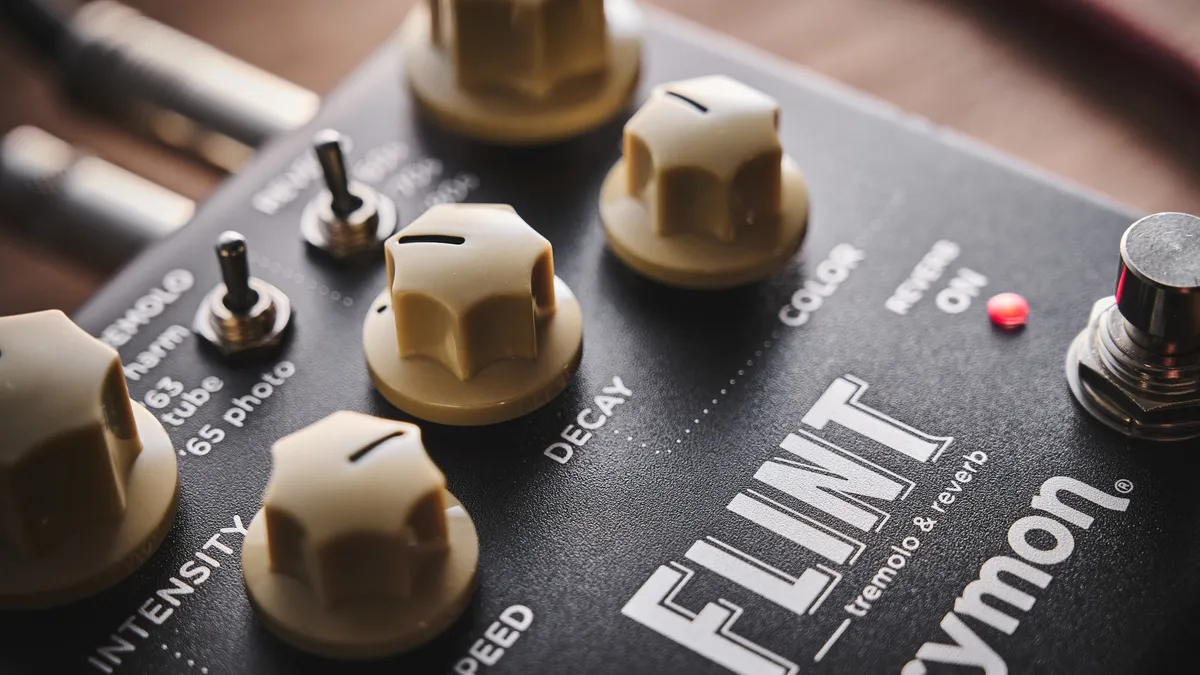
John Mayer, Noel Gallagher, Billy Corgan, Gary Clark Jr., Graham Coxon, Chris Shiflett… the list goes on. For Mayer fans in particular, it is one of the most crucial components of his rig.
All of that is to say, the Flint is a very popular pedal, one that has stood the test of time thanks to its tonal superiority and foolproof functionality. But it’s got its fair share of competition. After all this time, does its latest iteration still hold up to scrutiny?
Specs
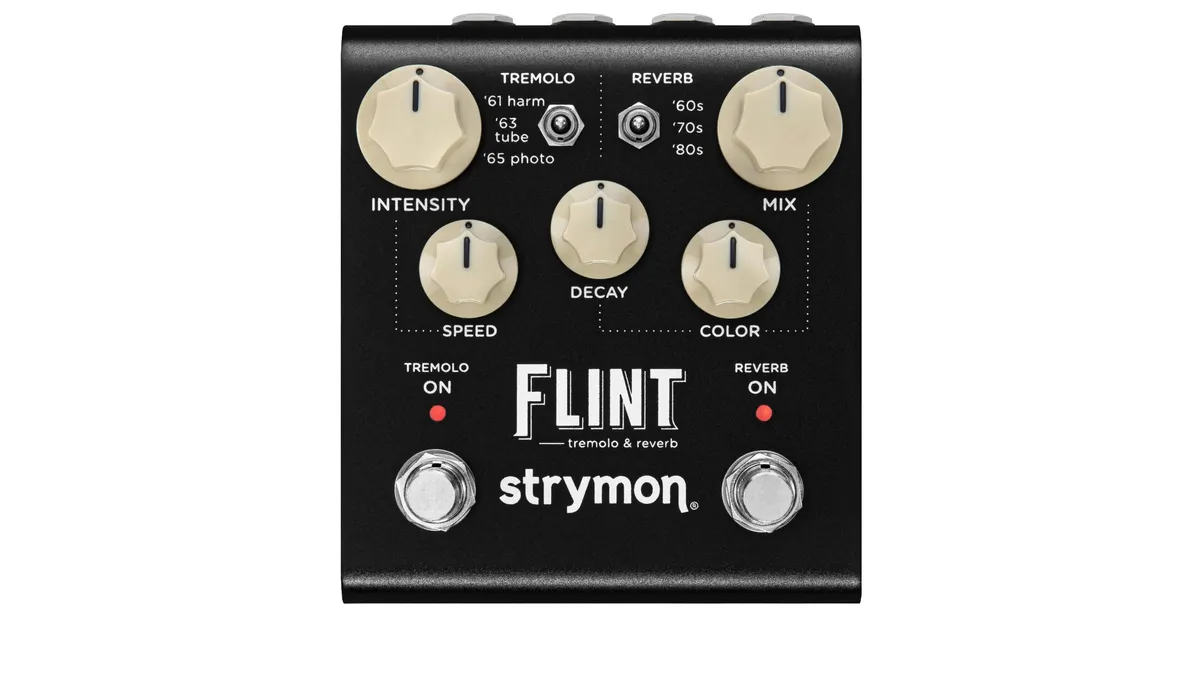
- Launch price: $349 | £315 | €369
- Type: Reverb and tremolo pedal
- Origin: USA
- Controls: Tremolo on/off footswitch, Intensity, Speed, three-way toggle switch | Reverb on/off switch, Mix, Decay, Color, three-way toggle switch
- Features: MIDI, Stereo/Mono Input, USB-C, Stereo Out, Class A JFET TRS stereo input
- Connectivity: 1/4" Stereo/Mono Input, L and R Stereo Output
- Bypass: True
- Power: 9V DC center-negative, 300mA
- Dimensions: 101.6mm (W) x 114.3 mm (D) x 44.5 mm (H)
- Weight: 1.1lbs (0.5kg)
- Contact: Strymon
Build quality
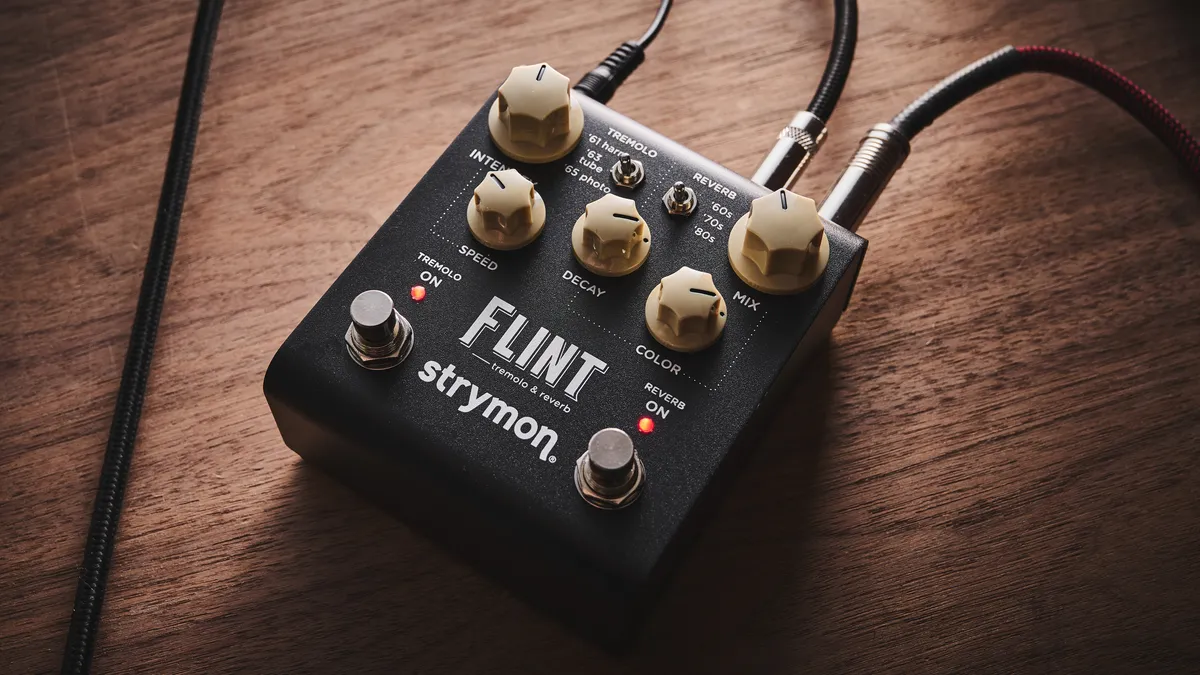
Build quality rating: ★★★★★
The phrase ‘it’s built like a tank’ gets bandied about far too easily these days, but we should make an exception for the Flint. I wouldn’t recommend testing this theory, though.
Now, this is a review of the V2 – which I have spent plenty of time with – but before that I’ve had the V1 on every permutation of my pedalboard over the past two years. Therefore, I can say with some confidence that I’ve found it to be one of the most hard-wearing workhorse pedals money can buy.
I’ve had it on pedalboards big and small, and dragged it to venues of all shapes and sizes. Granted, it’s not the stompbox in my rig that has the highest stomps-per-night ratio, but it’s never shown any signs of weakness or any chinks in the armour.

What’s more, the robust box-like chassis has a nice brushed-aluminum finish that feels well equipped to protect the circuits inside. The toggle switches are firm with an authoritative ‘snap’ between modes – safe from any accidental switches when tweaking the innermost knobs – and the parameters all have a healthy sweep with a nice amount of resistance.
Between the V1 and the V2, the build quality and overall components are the same: top-notch. The looks is clean and classic – a Strymon calling card – and it all comes in a tidy package that, while not exactly on the small side, doesn’t take up too much pedalboard real estate considering the two effects it hosts. And any space you might sacrifice will be worth it.
Usability and features

Usability and features rating: ★★★★½
If the sight of a BigSky MX gives you cold sweats, the Flint is an excellent entry point into top quality Strymon effects
Another reason why the Flint has stood the test of time is because of how intuitive it is. If, like me, the sight of a BigSky MX gives you cold sweats, the Flint is an excellent entry point into top quality Strymon effects.
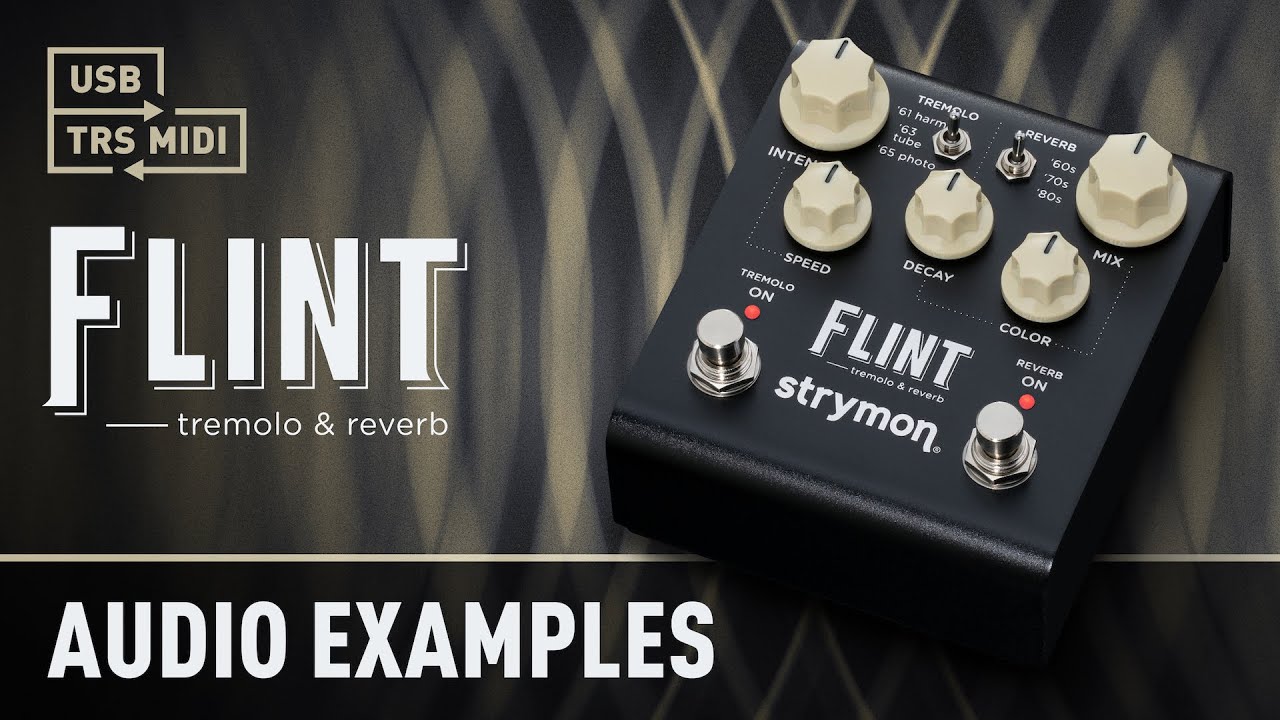
The reverb and tremolo effects get their own sides. On the left, you get a bypass footswitch for the tremolo, along with a three-way voice toggle and controls for Intensity and Speed. On the right, reverb has its own bypass switch, another three-way toggle, and Mix, Decay and Color parameters.
On the face of it, that’s all you need. For some, that might be limiting. But the V2 added MIDI connectivity, meaning you can save and store up to 300 presets that can be recalled using an external MIDI controller.

It can be a faff to set up, and for players (like myself) who try to avoid MIDI at all costs, the lack of any onboard preset slots is a bit of a shame. Regardless, normal operation is so easy you could practically do it in your sleep, so as long as your changes aren’t too drastic, you could probably get away with doing it on the fly.
There are also some secondary controls worth noting hidden away, including Pre-Delay, Tap Division, and Boost/Cut. To access these, you need to either press and hold both footswitches, or engage Live Edit mode by holding a single switch.
It can be a pain if these secondary functions are key to your tone, and it's not the most intuitive layout for them. Some additional tagging on which knob does what would be helpful here.
Sounds

Sounds rating: ★★★★★
The nice thing about the Flint is that, thanks to the independent toggles, you can mix-and-match any reverb and tremolo combo you like
Naturally, Strymon pedals excel when it comes to sound. And there are plenty of excellent reverb and tremolo tones to unpack here. For my money, you won’t find a twofer reverb/tremolo pedal that sounds better.
The V1 and V2 share the same core effects algorithms, but with hardware differences around them that I will get to. On the right side, you get ‘60s Spring Tank Reverb, ‘70s Electronic Plate Reverb and ‘80s Hall Rack Reverb, while the tremolo gives you ‘61 Harmonic Tremolo, ‘63 Power Tube Tremolo and ‘65 Photocell Tremolo. The nice thing about the Flint is that, thanks to the independent toggles, you can mix-and-match any reverb and tremolo combo you like. The V2 also lets you determine the order of effects.
On the reverb side of things, the Flint can be used as a ‘set it and forget it’ end-of-chain or effects loop ’verb, or you can have fun with it and move between modes depending on what you need.

I used the Flint when I played at Portman Road Stadium, and the thought of those reverbs still gives me goosebumps
I’ve done both, and the Flint can do them easily. At first, I used it similar to how Mayer did: locked on the ‘60s reverb mode, with Decay and Color around noon and Mix just below. With that, you get a no-nonsense, solid spring-style reverb reminiscent of vintage tube amps. It’s digital, but it could fool anyone, with a lovely three-dimensional dynamic feel that escapes some lesser reverb pedals.
The tremolo I initially used for subtle lead lines, again similar to how Mayer deploys it. Intensity around noon, speed around nine o’ clock, just for a tone tonic that can thicken and add a bit of character and personality when you need something to stick out in the mix. Lead lines, for example, or jangly melodies that would otherwise fall flat.
When I went ampless and started using the reverb in my Nano Cortex, I then deployed the Flint in a more ambient role, leveraging the experimental tones you can get from the reverb and tremolo effects.
Namely, I moved to the ‘80s Hall setting, cranked the Mix and Color, and used it for soundscaping: textural parts and atmospheric pads that sounded absolutely incredible in the mix. This is how I used the Flint when I played at Portman Road Stadium in the UK with a band, and the thought of those reverbs still gives me goosebumps. It filled the 30,000 cap venue absolutely magnificently.
The Color control really comes into its own when you give it freedom, too. When it’s bumped, you get a darker vibe that almost gives your chain a bit of grit. It affects the decays, so when your reverb time is bumped, you get this irresistible break-up that filters out in an incredible musical way.

You can really crank the controls to get into gnarly, choppy territory
The tremolo can get more involved, too. As well as those aforementioned subtle warbles, you can really crank the controls to get into gnarly, choppy territory. Dime the Intensity and it will make you feel seasick, such is the responsiveness of the control. Up the Speed and it could give you whiplash.
Again, I’ve followed the Mayer school of thought, but I’ve also paired it with fuzz pedals and overdrives for more bit-crush-y, shoegaze-y tones. Granted, it’s not easy switching between all those different effects without a MIDI controller, but it’s nice to have those options. There's also the option of using the Strymon MiniSwitch ($49, sold separately) to recall a favourite setting and switch between that what's dialed into the Flint at the time. You can also tap in tremolo speeds with it too. If that appeals, you'll just have to make extra space on your pedalboard as well as your wallet.
For this V2 version, Strymon also adds a Mono/Stereo input signal switch. A bit of a gamechanger, especially for players like myself, who somewhat struggled with the V1’s placement, given the fact it had a sum-to-mono input. Not ideal, especially when you’re running it alongside stereo effects beforehand – like I would with choruses and ping-pong delays.
I should also mention the premium analog JFET input circuit of the V2, which is said to offer improved responsiveness to your playing. An A/B test with both shows there’s certainly a distinction there, with a great receptiveness to dynamic playing – particularly when rolling back the volume on your guitar.
Verdict

The market leader for a reason
It’s easy to see why the humble Strymon Flint has played a starring role in John Mayer’s rig for such a long time, and become the go-to reverb/tremolo pedal for players across the world. As a standalone reverb pedal, you’d be hard pressed to find three better algorithms in one unit. Pair that with three wholly distinct tremolos, and the ability to match them as you see fit, and it really is a winning formula.
Sometimes, the simplest solutions are often the best, and while the Flint V2 did introduce some very handy features – MIDI compatibility, USB-C connectivity, and a stereo input switch – it would probably have retained its title without them. That said, as an avid fan of the V1, I’d definitely be looking to make a permanent switch to the V2.
It’s one pedal that has never left Mayer’s pedalboard and except for some very minor cases, I doubt it will ever leave mine.
Guitar World verdict: And still the reverb/tremolo pedal to beat, the Flint V2 updates an already world-beating two-in-one that has little to prove in this day and age. It's good enough for some of the most particular toneheads on the planet, it's good enough for me.
Test |
Results |
Score |
|---|---|---|
Build quality |
Tank-proof chassis and a premium feel that will fill you with confidence on any stage |
★★★★★ |
Usability and features |
MIDI for the V2 is a big plus, but it's easy to get top-tier tones without them. Some of the added features aren't obvious to access though. |
★★★★½ |
Sounds |
World-beating reverb and tremolos fit for the biggest stages of them all |
★★★★★ |
Overall |
It's the most popular reverb/tremolo pedal on the market for a reason. You can't get any better for what it is. |
★★★★★ |
Also try

Hands-on videos
Strymon
Mike Hermans
Andertons