


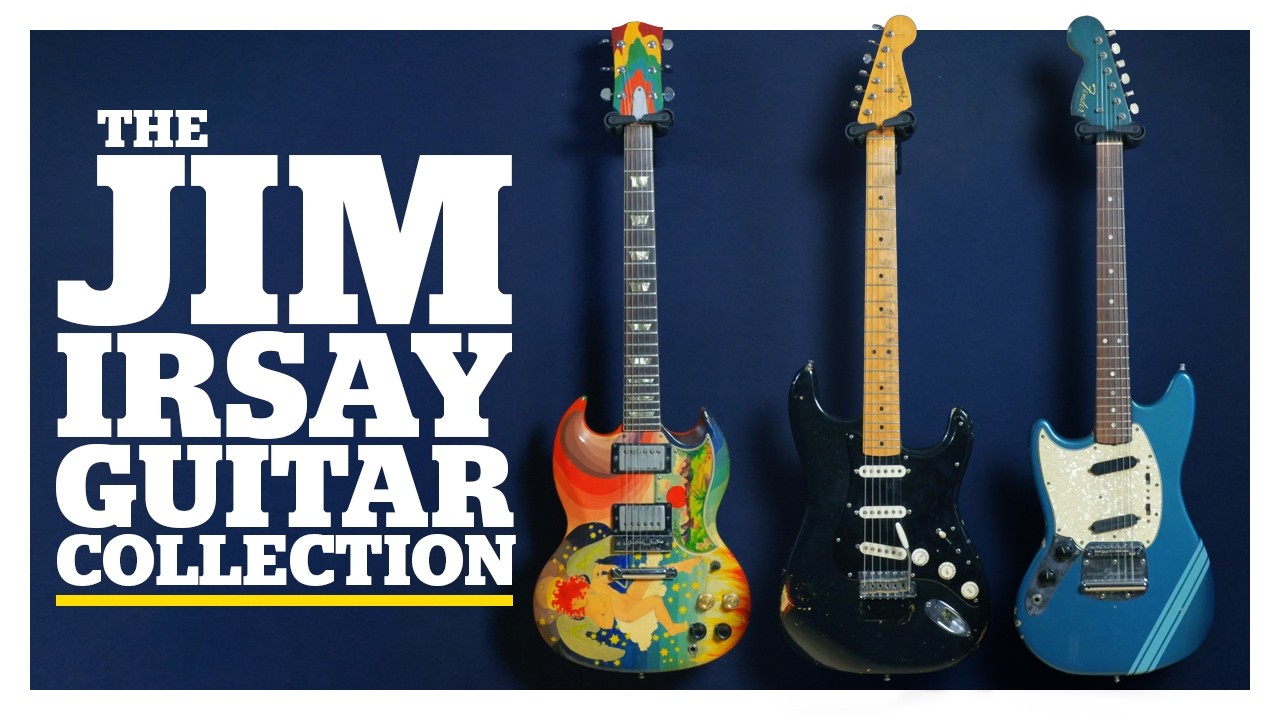
For many, this is the Nirvana guitar, made iconic by its appearance in the video for Nirvana’s Smells Like Teen Spirit. This week, it sold for $6,907,000 at the Jim Irsay Collection: Hall of Fame auction.
Forever associated with offset Fenders that were typically modded for extra output by various means, Kurt Cobain opted for a student model for that historic video performance, sporting the so-called ‘Competition Stripe’ that marks it out as a 1969 instrument.
However, a closer examination of its parts reveals a more complex story that reflects how Fender made guitars in the mid- to late 1960s after CBS bought out Leo Fender, especially its rarer left-handed instruments.
“So the neck is in fact dated 1966 and it is marked ‘Special’,” Amelia Walker of Christie’s observes. “The left-handed necks [from that period of Fender’s history] typically say ‘Custom’ or ‘Special’ because they were so seldom made and used. So they often had older necks [in storage] that they then would put on slightly later-dated guitars.
”The pots are ’66 as well. But that’s logical because, again, they would just reach into their box of [correct-spec] pots and grab whatever was in stock. But the Competition Stripe was definitively a ’69 thing and serial number is also ’69, so we’re calling it a ’69-made guitar with an earlier neck and earlier pots,” she explains.
Guitar historian Tony Bacon adds some further context on the slightly tangled story of Fender’s student model electrics: “The Mustang was the third model in Fender’s early line of budget ‘three-quarter-size’ electrics. It was launched in 1964 to join the Musicmaster and Duo-Sonic, which had appeared eight years earlier, and was in effect a two‑pickup Duo-Sonic with vibrato bridge.
Those two earlier models had 21 frets on a short 22.5-inch (571.5mm) scale, but from ’64 they were offered optionally with longer 24-inch (610mm) scales and 22 frets – and the new Mustang, too, was available in either style. The Mustang stayed on Fender price lists until 1981.


“In 1969, Fender offered a new finish option for the Mustang,” Tony explains, “and called the result the Competition Mustang. It had contrasting ‘racing’ stripes and came in three striking variants – Burgundy (pale blue stripes on a darker blue body); Orange (red stripes/orange body); or Red (white stripes/red body) – with the headstock finished to match the body colour. They lasted in the Fender line into the early ’70s.
He had various mods done to this Mustang, including a Duncan single-coil-size humbucker swapped in at the bridge as well as a Gotoh Tune-o-matic-style bridge, with the tailpiece bar flipped
Amelia Walker
“Around 1990, Kurt Cobain bought a blue (Burgundy) left-handed 24-inch scale Competition Mustang. It became a favourite, alongside a Jaguar, and was seen prominently in the video for Smells Like Teen Spirit. He had various mods done to this Mustang, including a Duncan single-coil-size humbucker swapped in at the bridge as well as a Gotoh Tune-o-matic-style bridge, with the tailpiece bar flipped.
“Further into the early ’90s, Kurt ordered 10 left-handed Mustangs from Fender, planned to be delivered in batches of two, in Fiesta Red or Sonic Blue finishes (in other words not Competition models). Reportedly, only six were supplied before Kurt’s untimely death in 1994. He played several, with similar bridge and pickup mods, though often with a regular-size humbucker at the bridge.
“Around the time of his death, Kurt was developing a hybrid Jaguar/Mustang, and Fender would release the result as the Jag-Stang in 1996 – aptly described in the company’s promo material at the time as ‘a collision of contemporary features fused together to create a combination of Jaguar and Mustang’.”
- Christie’s auctions The Jim Irsay Collection: Hall of Fame starting 12 March. For more information on the four-part sale series, visit Christie’s.
- This article first appeared in Guitarist. Subscribe and save.

