




Guitar World Verdict
It’s not perfect, but the Steelyjam Delta Junior offers something truly unique, which is hard to come across these days. The resonant aluminum body really adds something to the sound, and it looks amazing as well. Overall, the guitar is well put together with a little bit of work needed to get it playing perfectly, and despite the initially scary-looking neck joint, upper fret access is superb. The P-90 delivers a range of versatile tones that can cover most bases, although some players may find it limiting.
Pros
- +
Surprisingly resonant aluminum body.
- +
Double cutaways offer excellent upper fret access.
- +
Great range of tones from the single P-90.
- +
Very playable neck profile and well-balanced on a strap.
Cons
- -
Some will find the single pickup limiting.
- -
It needed a setup to get it playing perfectly.
You can trust Guitar World Our expert reviewers spend hours testing and comparing guitar products so you can choose the best for you. Find out more about how we test.
What is it?
In the age of S-types and T-types, it’s not all that often you come across a guitar that feels totally different from anything else. Yet that’s exactly what we’ve got on our hands today with the Steelyjam Delta Junior. With a hollow body carved not from an exotic tonewood, but laser-cut and CNC-machined from everyday aluminum.
Steelyjam is a two-person Belgian operation, helmed by Arthur Devreux and Jean-Baptiste Demarcin. The initial concept of the steel body guitar was first conceived in 2005, but it wasn’t until 2022 that aluminum replaced the steel construction. Now, there’s a selection of shapes and series, all combining aluminum bodies with wooden necks. The Delta is part of the company's raw hand-brushed Junior range, alongside the Alpha and Junior.
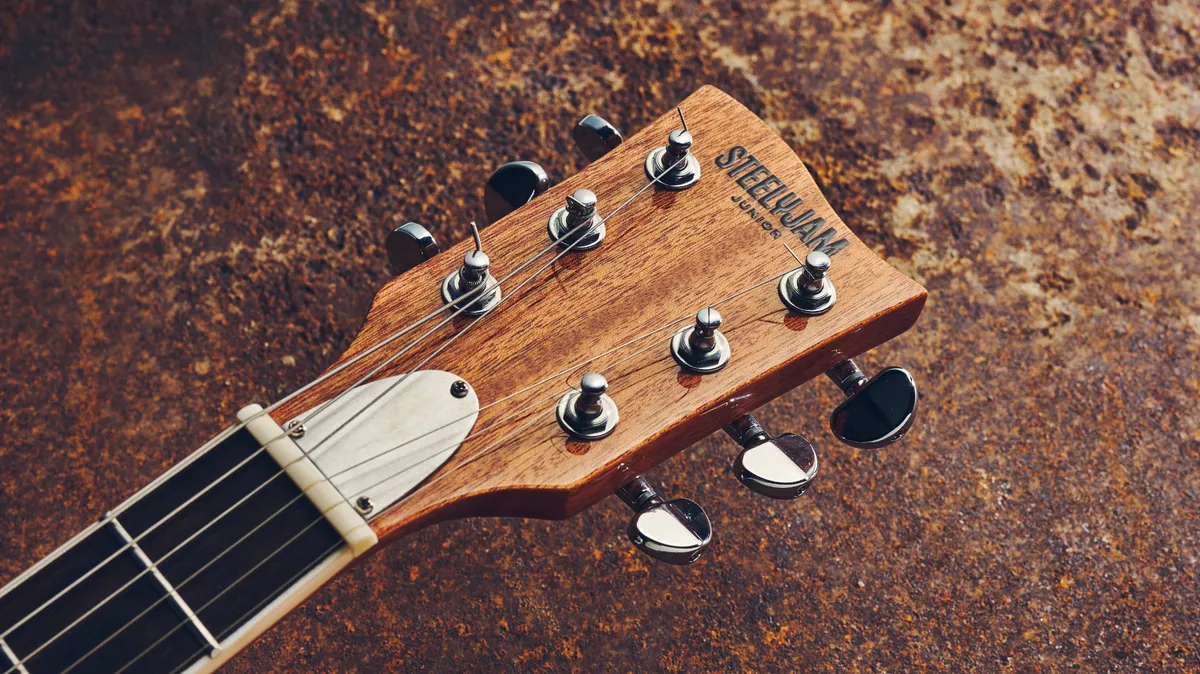
The body itself is hollow aluminum, made via CNC machining and laser cutting into a welded structure. This gives the guitar an extremely stable construction, resistant to humidity and temperature changes. It also creates a Faraday cage, which shields the interior from electronic interference. In theory, that means no 60-cycle hum from the single P-90 pickup.
The neck is African mahogany with a modern ‘C’ profile, while on the front face there’s a rosewood fretboard with a 12-inch radius. Acrylic trapezoid inlays complete a much more traditional neck setup. It’s a 24.75-inch scale with a bone nut, and atop the headstock are Steelyjam’s standard tuning machines.
At the opposite end, we have a Steelyjam standard hardtail bridge with six saddles and a pair of chrome knobs for controlling volume and tone. A single Steelyjam P-90 pickup completes the electronics lineup. Everything is wired to a Steelyjam universal wiring board that takes plug-in components, meaning no soldering is required if you need to swap parts.
Specs
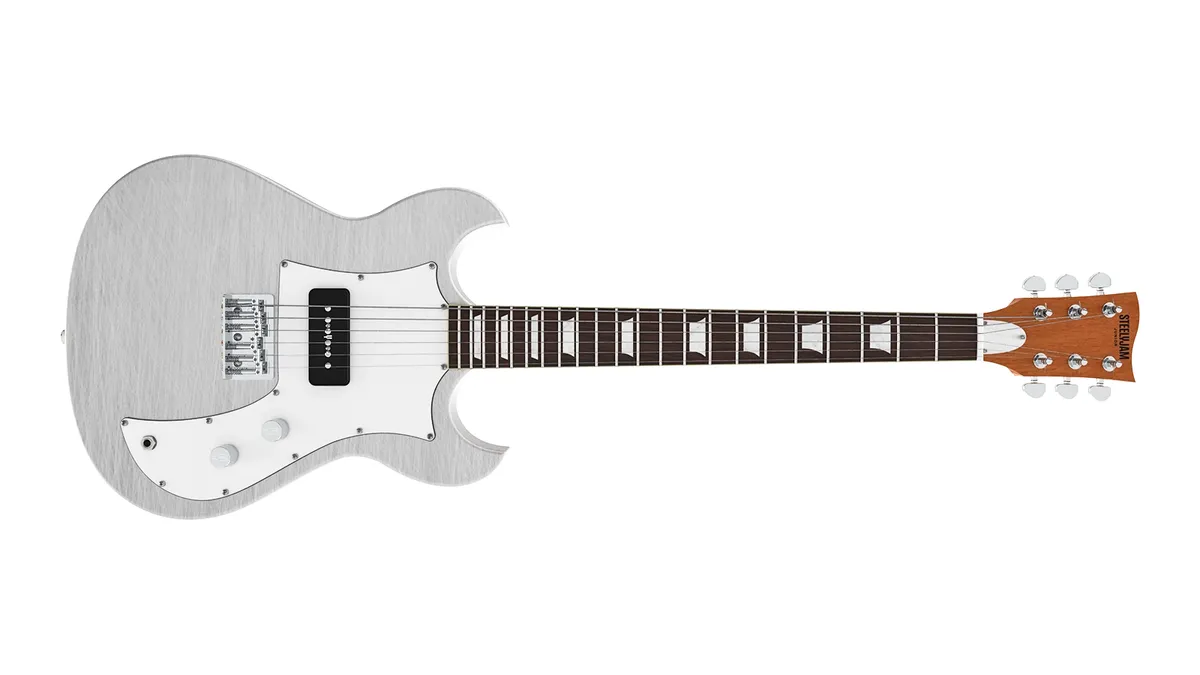
- Price: $1,060 | £850 | €985
- Made: Belgium
- Type: Six-string electric guitar, hollow aluminum body
- Body: Aluminum, hollow body construction, CNC-machined and laser-cut, raw hand-brushed finish
- Neck: African mahogany, Steelyjam Modern "C" carve, high-gloss varnish, bolt-on, dual-action truss rod
- Fingerboard material/radius: Rosewood, 12" (305mm) radius, acrylic trapezoid inlays, black side dots
- Scale length: 24.75" (629mm)
- Nut/width: Bone, 1.65" (42mm)
- Frets: 22, medium jumbo
- Hardware: Standard hardtail bridge, standard 16:1 ratio tuning machines, nickel/chrome finish, chrome control knobs, and 4-bolt neck plate with "Y" logo, white 2-ply pickguard
- String spacing at bridge: 54mm
- Electrics: Single Steelyjam P-90, master volume, master tone, Steelyjam Universal Wiring Board V.01 (solderless PCB)
- Weight: 7.1lb / 3.2kg
- Left-handed options: Yes, in the same raw hand-brushed finish
- Finishes: Raw hand-brushed (only finish available in the Junior series)
- Case: Steelyjam deluxe gig bag included, plus a certificate of authenticity, three Steelyjam picks, a 3m angled instrument cable, and Elixir Optiweb .010-.046 strings fitted
- Contact: Steelyjam
Build quality

Build quality rating: ★★★★☆
With the Steelyjam Delta Junior out of its plush gig bag, I’m really taken aback by the design of the body. The raw, scratched aluminum looks like the surface of some far-away planet, unable to protect itself without an atmosphere. It certainly got a lot of appreciative comments at band practice and when I shared it on my Instagram.
It’s surprisingly lightweight considering a large portion of it is made from metal. Comparatively, for a single-pickup guitar it’s similar to the average. The body itself appears to be completely hollow, which I ascertain by knocking on the surface of it. It’s got quite a thin response when I tap, giving the impression that the metal is machined very thin.
The edges are smooth all over, and nowhere do I find even a hint of sharp metal. Unsurprisingly, it’s very cool to the touch, so be wary pressing it against you when going shirtless like John Frusciante or wearing a crop top à la Kiki Wong.

One thing that stood out to me during the visual inspection is how large the neck joint is. It’s a thick bit of wood attached to a thick bit of metal with no comfort carves, plus a strap button and neck plate, making it look very blocky indeed - more on which in the playability section. If I’m being picky, the edges of the fretboard could be given a light sanding, but it doesn’t hinder the playability.
Overall, it’s a very well put together instrument. The knobs offer a very firm travel, which I’m a big fan of, and the hardware is neatly applied with the exception of the tone knob that’s ever so slightly askew on my review model. With the raw aluminum body, there’s no need to hide any finish blemishes, because it’s all part of this instrument’s vibe.
Playability

Playability rating: ★★★★½
Despite my qualms about the neck joint, there’s absolutely no hindrance to the playability of the guitar
My first opportunity to properly play the Delta Junior is at band practice, so I hook a spare guitar strap on and play through our usual set. Despite my qualms about the neck joint, there’s absolutely no hindrance to the playability of the guitar. It’s got that SG-style upper fret access, delivering unfettered access to all 22 frets.
It comes fitted with 10-46 electric guitar strings on, but the Gibson-style scale makes it feel very slinky when played. It doesn’t take long for me to start flying around the fretboard, and it’s really easy to bend full tones and more. The medium jumbo frets offer that nice middle ground of giving me something to push against when bending up, while still letting me feel the wood.

The saddles of the bridge have a lot of exposed screw sticking out the top, which can feel slightly uncomfortable depending on where I place my hand when palm muting. I stop noticing it after a while, though. The placement of the P-90 does also mean I have to adjust where I pick slightly, as it’s quite close to the strings and I end up accidentally whacking it during more frenzied strumming moments.
Sounds

Sounds rating: ★★★★☆
At band practice, with the Steelyjam going through my pedalboard and into my Orange Rocker 32 tube amp, I’m very enamoured with the sound of the guitar. The P-90 feels very high output, and manages to cut nicely through my typically effects-laden sound. I do notice when I strike the low string there’s a little bit of buzzy, farting-out type noise, which I suspect is due to how close the pickup is to the string. I only notice it on the clean stuff, but store it for later on.
The clarity is fantastic from the pickup overall, and although the strings are a little too anaemic for my taste, I have great fun ladling it with fuzzed-out synth pedals, sweep echo, and my typically heavy right hand. It cuts through the full mix nicely without me having to adjust my existing setup, which is geared for a Telecaster.
With the Steelyjam in my home studio, I’m able to put it under the microscope and learn more. I start by playing it unplugged. It’s got an almost semi-hollow type sound played this way. It resonates really nicely acoustically, although it’s not as loud as my Gretsch. You won’t be playing it around the campfire, but it’s got enough for noodling sans-amp on the sofa to not sound totally dead like a typical solid body.
Plugging into my audio interface alongside Line 6’s Helix Stadium Native, I set about examining the sound of this pickup. That farting-out sound rears its head again, and with more time on my hands I determine it is due to the P-90 being too close to the strings.
Annoyingly, I can lower the treble side of the pickup significantly more than the offending bass side (I am unable to turn the screws any more), so although I mostly fix the problem, it still appears when I strike the strings really hard on a clean amp model.

I slacken the strings, take off the pickguard, and examine further
Curious as to what might be causing the problem on a deeper level, I slacken the strings, take off the pickguard, and examine further. Inside the cavity, full of fluffy white acoustic wool, I find the pickup is sitting on some height adjustment foam, and beneath that, the pickup screws go into a block of wood.
Presumably it's the wood preventing the bass side from going down any further, as both screws are the same length. Unfortunately, I get close to stripping the screw trying to get it to sit at an equal level with the treble side. I manage to eradicate the issue by raising the string height at the saddle, which gives it enough clearance to resonate freely when I attack with my pick.
Continuing with my clean tone test, the single pickup delivers a lovely mid-range tone with a little hint of that natural acoustic resonance running underneath. It’s not as pronounced as you’d find with a classic semi-hollow guitar, but it adds a little extra something to the tone of the Delta Junior.
Is it noiseless? Well, not entirely. It’s certainly less noisy than my single-coil-equipped Strat, but I can hear some noise when I get the P-90 really close to the screen of my laptop. On a clean amp, it’s hard to hear, but there’s noticeable noise when I switch to an Orange emulation and stick a fuzz pedal in front of it.
With a heavy amp engaged, I run into the limitations of the single pickup. For palm muting and single-note licks, there’s a nice clarity when I ladle on the gain. For those slower, doomy power chords, however, it’s lacking in low end, which is where a neck pickup would come in handy. You can pay more (from £1,830) for the Delta Standard, which has a neck pickup.
There's also not much give in the volume knob, which doesn't clean up all that well, and gets duller as I turn it down. The placement of the P-90 slightly away from the bridge gives it a bit more roundness, which means it can cover punk, rock, blues, and anything shy of the really heavy stuff. It sounds really great for a stock pickup, but more dynamics from the volume knob would make it much more versatile.
Verdict

The Steelyjam Delta Junior instantly took me in with its unique look, but it was the sound and playability that sold it for me. It’s exciting coming across something genuinely original in a world of copies, and it’s executed really well here. The tones from the stock P-90 are fantastic, and paired with the resonant body, offer some good versatility despite just having a single pickup.
The issues with the low E that needed resolving could just be bad luck
The issues with the low E that needed resolving could just be bad luck, but it was disappointing that I couldn’t just remedy it by lowering the pickup height via the screws. I can also see that the single pickup configuration will naturally be limiting for some, particularly if you like a more bass-heavy guitar tone.
Guitar World verdict: It’s not perfect, but the Steelyjam Delta Junior offers something truly unique, which is hard to come across these days. The resonant aluminum body really adds something to the sound, and it looks amazing as well. Overall, the guitar is well put together with a little bit of work needed to get it playing perfectly, and despite the initially scary-looking neck joint, upper fret access is superb. The P-90 delivers a range of versatile tones that can cover most bases, although some players may find it limiting.
Test |
Results |
Score |
|---|---|---|
Build quality |
Really nicely put together, with a couple of niggles |
★★★★☆ |
Playability |
Very playable neck profile and upper fret access is awesome. |
★★★★½ |
Sounds |
Capable of a good variety of sounds, but limited by the single pickup. |
★★★★☆ |
Overall |
A genuinely unique guitar that does something different from the rest. |
★★★★☆ |
Also try
Hands-on videos
Steelyjam Guitars