


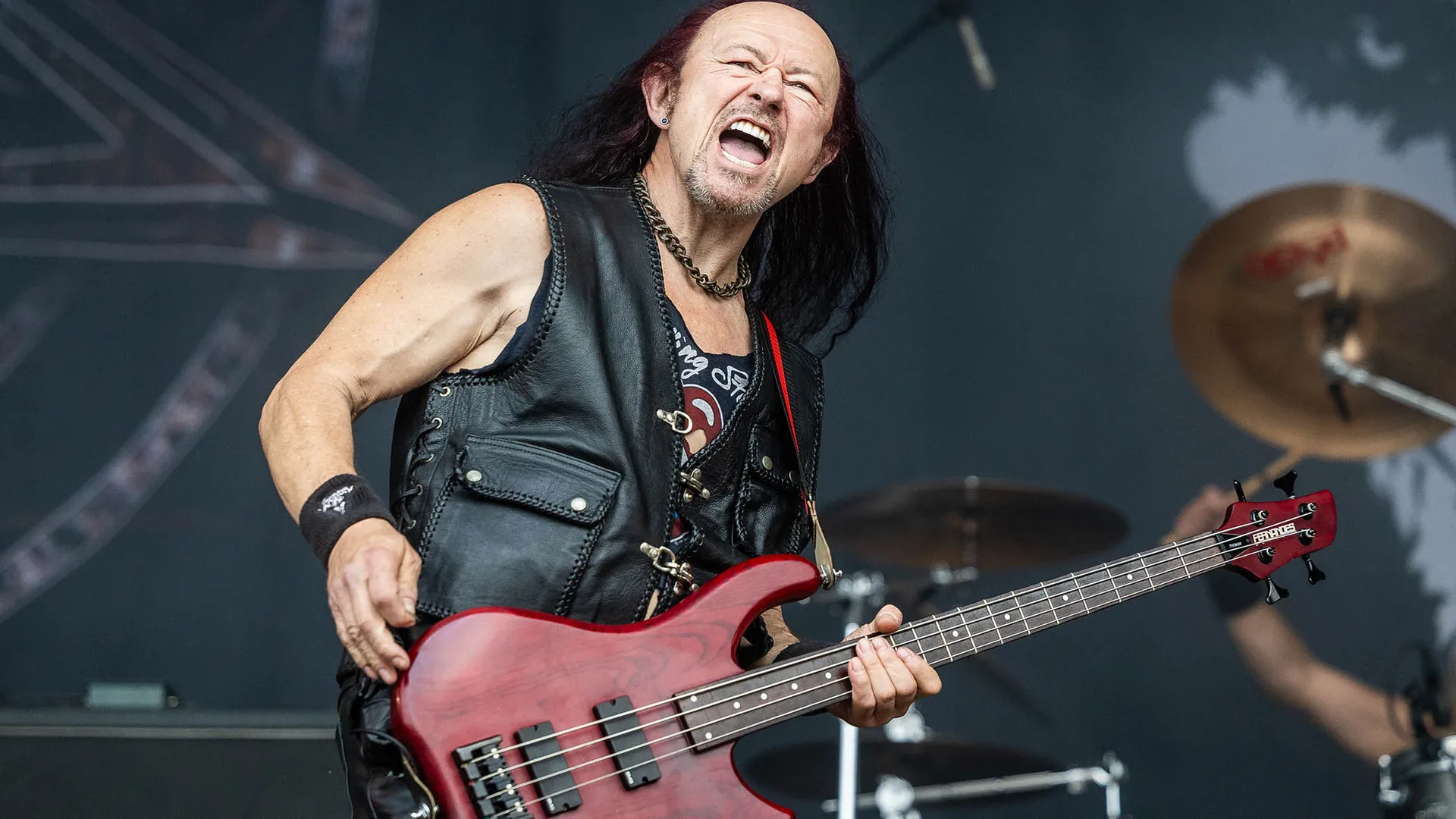
Heavy metal was already in full cry when Conrad ‘Cronos’ Lant and Venom got started, but they were the ones to give it a push, to pour gasoline on the fire, and to take it to new extremes.
“If Black Sabbath were Frankenstein, Venom are the Evil Dead,” said Cronos, speaking to Guitar World in 2015.
Cronos could never understand why Ozzy Osbourne would call out for God to save him. He would never take the Left Hand Path. Ozzy would sing about Satan but – as the song goes – Venom would be in league with him.
As bassist and vocalist, Cronos would lead Venom from the front. Their fundamentalist metal ethos needed a sound that it couldn’t be housetrained. Technicality and all that was a distraction. Cronos wanted chaos. And he got it.
“I decided I would be the evil bastard. But the music had to be evil, too,” he said. “So, while all these other groups would get to their lead breaks and play these pretty little leads, I wanted to have divebomb solos and guitars crashing against amplifiers and all this madness.”
Venom were formed in Newcastle, England, in 1979. Cronos was just 16 when he started on electric guitar. It was only when bassist Alan Winston got the heebie-jeebies and quit the band just five days before a show that Cronos switched codes and moved to bass.
Cronos played bass guitar like he played the electric, plugging it into his Marshall, cranking it up, playing the root notes and hoping for the best.
“Something magic happened. It sounded fucking amazing,” he said. “So I said, ‘Fuck it, I’m the bass player now!’”
In the early days, Venom would rehearse every week in a Methodist church they rented for £5, playing Judas Priest, KISS and Black Sabbath covers, and setting off the pyrotechnics that soon be their calling card. They’d pull in a few hundred metalheads to watch them rehearse.
Clive Archer, a long-haired ghoul who went by the stage name of Jesus Christ, was on vocals, Jeff ‘Mantas’ Dunn was on guitar, and Tony Bray, aka Abaddon, played drums. Archer looked the part in corpsepaint but his time was numbered.
The story goes that Mantas and Abaddon heard Cronos sing Live like an Angel (Die like a Devil) and wanted him to front the band. Other accounts say Archer was leaving anyway. Either way, it was a hinge moment for metal history. The man who would become extreme metal’s godfather and popularize the phrase ‘black metal’ was now at the mic and he was a force to be reckoned with.
Like many of music’s great pioneers, Cronos had a certain entrepreneurial acumen. He was working as an assistant engineer and tape operator at Impulse Studio, in Wallsend, not far from Newcastle, when he was asked to help record a bunch of local bands to capitalise on the rise of NWOBHM.
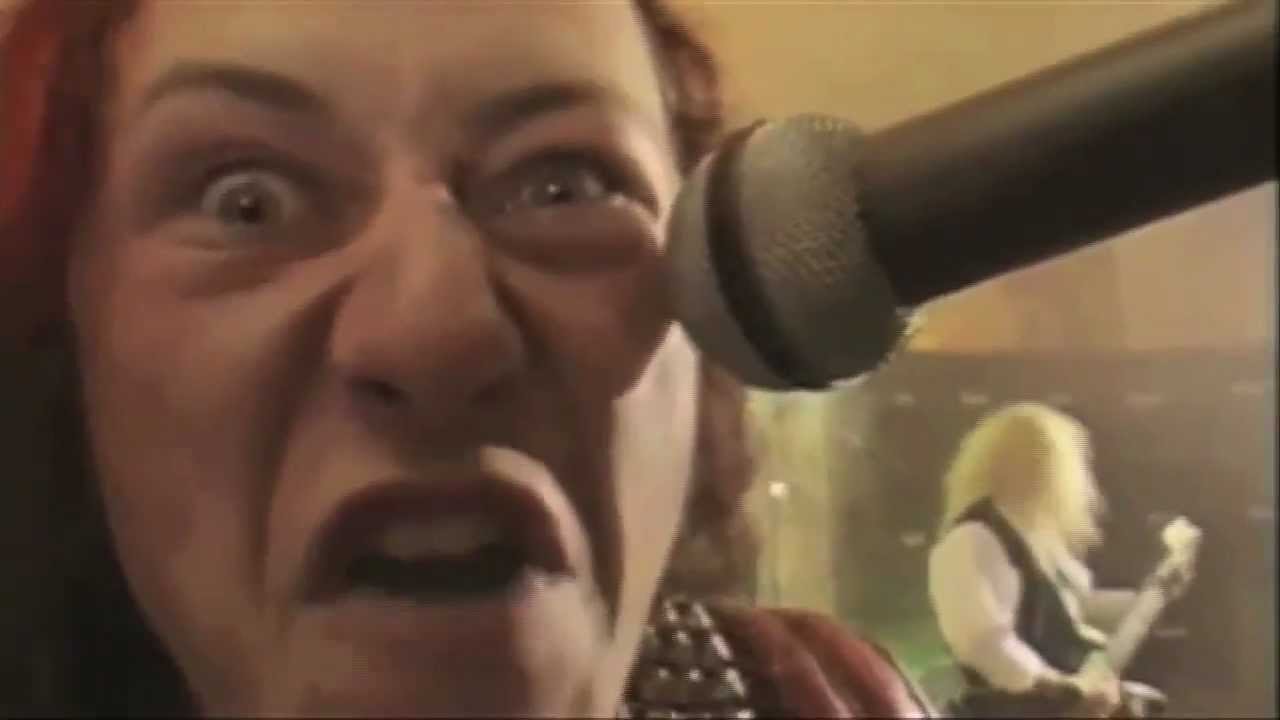
There was an urgent new sound and Impulse Studio’s owner, David Wood, also owned Neat Records wanted in on the action. Cronos did his bit. But he wanted some studio time for himself.
With studio engineer Mickey Sweeney oversubscribed, working all hours, Cronos would help out, and asked Sweeney to return the favor. He got Wood to give him some studio time but he paid for it.
“I ended up washing cars, sweeping the stairs and cleaning the toilets just to get that day in the studio,” Cronos recalled. ‘But we got to go into the studio and put down the stuff we had.”

Venom cut their Demon debut in April 1980, their six-song £50 Demo in October. They sounded rough but they had a vision. Neat released In League With Satan as a 7” single in April ’81, introducing Baphomet as a the band’s trademark, and put out their debut album, Welcome to Hell, in December.
Venom had arrived, much to the horror of critics. The production was horrible, and yet it is hard to understate its influence; lo-fi audio hideousness would become a production ideal for the black metal scene that Venom would influence.
Tracks like Witching Hour and Sons of Satan gave extreme metal form. Slayer, Anthrax – all of the main players in the thrash scene – would eat this stuff up. Norwegian black metal pioneers Mayhem took their name from Mayhem with Mercy.
But Cronos and Venom were just getting started. Their sophomore album, Black Metal, was the one. It sounded better, not pristine. That frenzied energy that Cronos got from punk was writ large as this super-evil Motörhead tore out the speaker.

“Lay down your soul to the gods rock ’n’ roll” came the refrain of the title track. Venom now had a record that was just as wild as their stage show. Black Metal was the album that became the genre, that became the text that informed metal’s underground subculture. It was the source.
“People credit us with starting a movement and all, but the truth is I think it was inevitable,” said Cronos, speaking to Guitar World in 2008. “Punk had died. Metal was lame. There could only be one new way to do this – for metal bands to get some fucking balls again.”
It was inevitable that Cronos would become a musician. He grew up in a musical household. His uncle played bluegrass. There was always musical instruments kicking around, and he, his sister and two brothers, were encouraged to pick them up and make some noise – not that tracks like Countess Bathory and Buried Alive were their thing.
“I knew I was doing right by my music when I found out that my parents hated it,” he said.
Venom caught heat for their use of Satan as their muse. The PMRC took exception to 1985’s Possessed. But then so did Cronos. He called Possessed “unrehearsed bollocks.”
He was refreshingly honest about his missteps. Cronos acknowledged that pulling a high-concept Rush/2112 move on 1984’s At War With Satan was too much for some fans – but isn’t that the point of being extreme, to have the audacity to give us a 20-minute black metal track that took up the entire Side A?
“Let the joyous celebrations of Hell begin”, indeed.
A band so extreme was bound to come apart at the seams. As inevitable as Cronos saw Venom’s emergence, so too was its lineup changes. Cronos was the one constant.
But then he was a something of a renaissance man, with a wicked sense of humor. Was he entirely serious when he said he died his hair with henna to be like Kate Bush, whom he was a superfan of? Probably.
He was no pushover. When Combat Records sent a production team to record Venom at Studio 54, and offered no contract, Cronos took an axe off the wall and cut the power cables. “One of the things we found out early on was that, in this business, if you let somebody rip you off, then it’s a free for all,” he said. “And you just didn’t do that to Venom.”
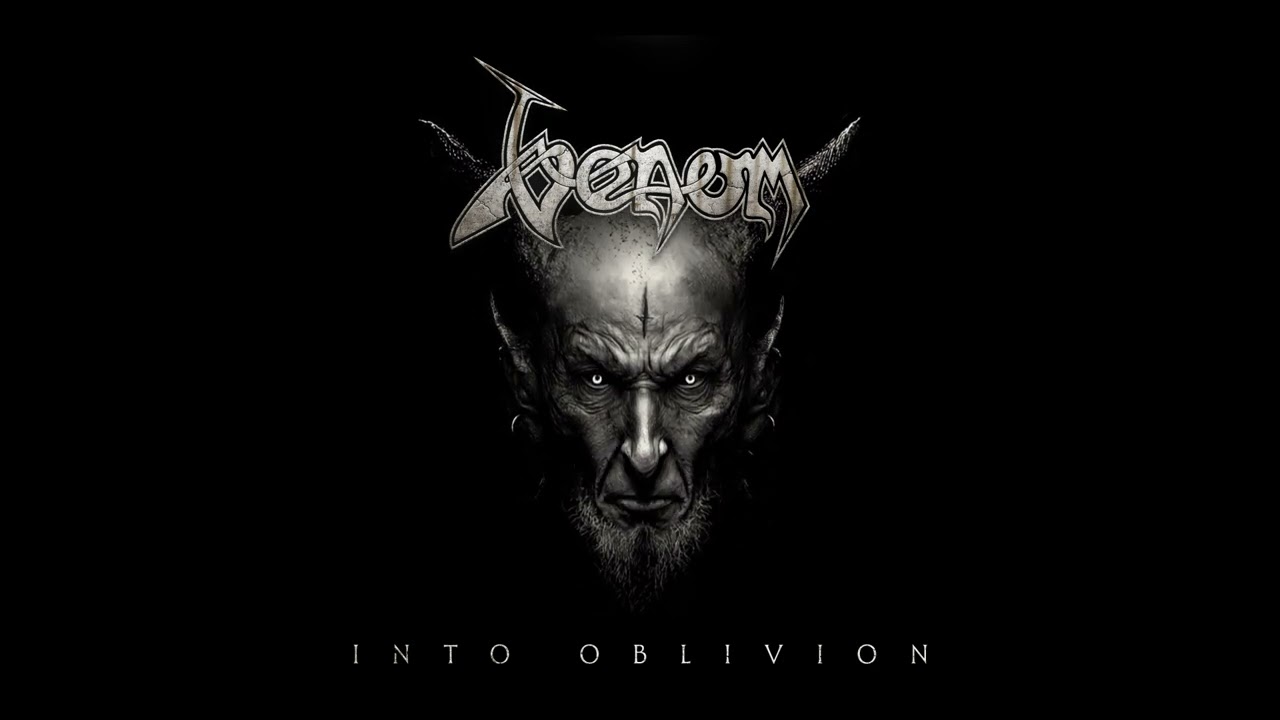
Cronos was many things. He became a fitness instructor in the ‘90s. He was a birdwatcher. He launched his eponymous solo project in 1990, and after reanimating Venom for a second time in 2005, he kept it going, releasing their 16th album, Into Oblivion, via Noise/BMG in May. He cultivated Carolina Reapers and Naga chili peppers. But ultimately he was free. That’s why he had no time for religion.
![Venom – Live at Hammersmith (1984 Full Concert) [Remastered Full HD] - YouTube](https://img.youtube.com/vi/BQVj3C20s0A/maxresdefault.jpg)
“My philosophy is this: you’re born and one day you’re in a box, and what you do in between is your own choice,” he said. “And to live by a dogma that tells you that you can’t do this and you can’t do that is one of the most absurd things I’ve ever heard.”
His death on October 1st, aged 63, invites discussion of his legacy. To give Cronos credit for black metal is almost to undersell his and Venom’s influence. He once described black metal as “all of the metals” and that’s his legacy.
“It’s always nice to hear that we came up with the phrase ‘black metal,’ but I get a lot more pride from seeing just how much metal is out there now,” he said.
“When I realized that there are so many millions of people around the world who also like that style of music, well, that’s just the most amazing thing in the world to me.”

