


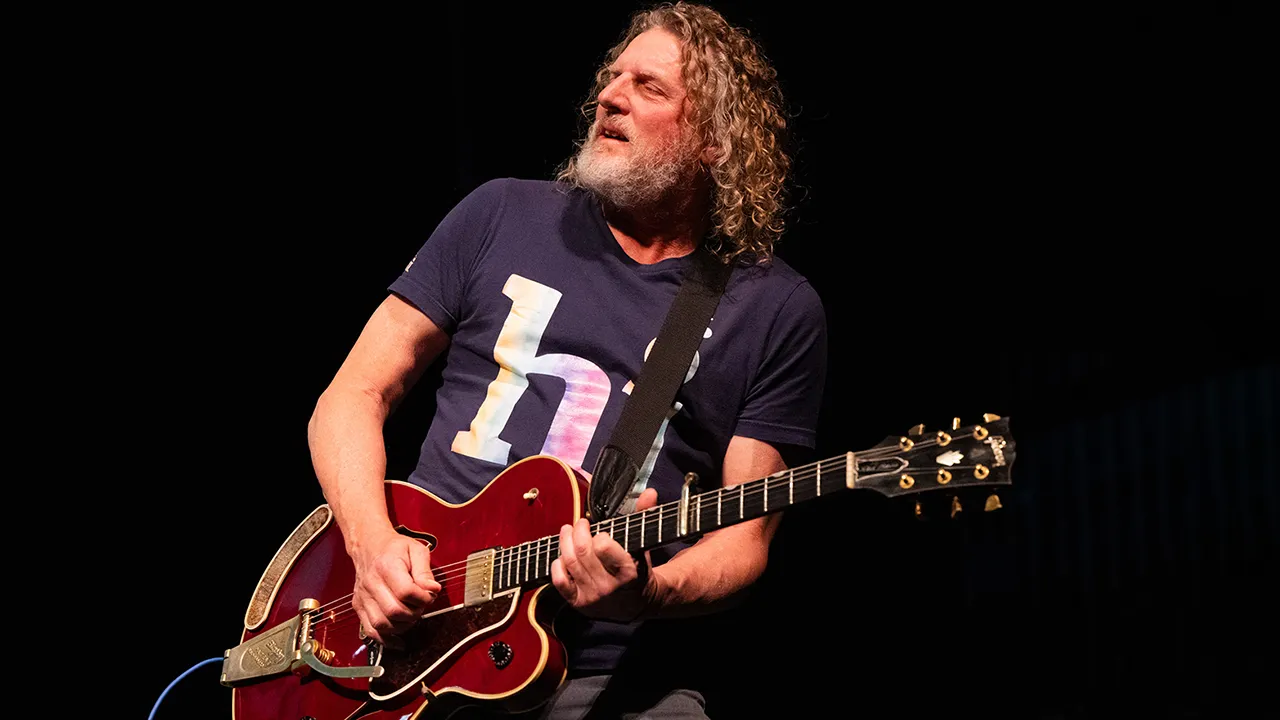
Guitar heroes came in all shapes and sizes in the ‘90s. Mark Bryan might not have riffed as heavily as Cantrell, slung Superstrats like Morello, or oozed sex appeal like Navarro, focusing instead on good old-fashioned songwriting and a humble attitude on Hootie & The Blowfish hits like Let Her Cry, Hold My Hand, and Only Wanna Be with You.
“I remember saying we would have been happy if we could just sell out clubs all over,” Bryan says of their 1994 breakthrough success, Cracked Rear View. “We had no idea what was coming. It made me want to get better in order to live up to it – I was so green when we hit. I did a ton of woodshedding and songwriting, since I didn’t have a real job!”
That commitment made him the writer, player, and producer he is now with Hootie and his own band, The Screaming Trojans. “I started a home studio; it’s still evolving to this day,” he says. “Rather than try to expand my sound on just guitar, I built my studio with instruments I learned to play, like ukulele, mandolin, lap steel, and banjo.”
His current focus is his new label, Stone Point Records. And though they’re on the sidelines, Hootie & The Blowfish are still very much a thing.
“If you told me when I was young that I’d spend my entire adult life doing what I love, with some of my best friends, I would have told you. ‘That sounds like a dream come true,’” he says. “I’m still living the dream.”
What inspired you as a young player?
I grew up in Maryland, just outside of Washington, D.C., in the ‘80s. Danny Gatton was the local guitar hero, but I was too young to ever see him. Hardcore punk and go-go were raw scenes in the city; they definitely influenced how I expressed myself through music.
But I was this awkward jock from the suburbs – I had no idea who myself was. Then, when I was around 13, I heard My Generation, arguably the first punk rock song of all time, on the King Biscuit Flower Hour radio show. There was something in the energy of that song that I had to follow.
Pete Townshend became a major influence, not just as a guitar player but also composer. So did Jimmy Page, Jimi Hendrix, Eddie Van Halen, Mark Knopfler, Bruce Springsteen, and all the heroes I discovered listening to rock radio. Once I got to college it was The Edge, Peter Buck, and Paul Westerberg.
![Hootie & The Blowfish - Only Wanna Be with You (Official Music Video) [HD] - YouTube](https://img.youtube.com/vi/Ln6WQqRDrCo/maxresdefault.jpg)
What got you going toward being a professional musician?
I was in a high school band with Dean Felber from Hootie, called Missing in Action. I had the same cherry Gibson Les Paul Standard that I still play today. I played it through a Peavey Deuce that had channel switching.
How did you meet Darius Rucker, leading to the formation of The Wolf Brothers?
We lived in the same hall in Moore Dormitory at USC. We would put a boombox in the showers before going out, and that’s where I first heard his voice. I had my shitty Ovation acoustic at school with me. We started figuring out songs we both knew, like Take It Easy, Feelin’ Groovy, Sail On, Sultans of Swing, Family Tradition… yes, Hank Jr. – and Rocky Raccoon!
When Hootie formed, what was your vision from a guitar perspective?
Dean was the obvious choice on bass, and he also decided to attend USC, so Darius moved in with him in the dorm to make sure he would show up to shit. Dean and I would teach Darius chords and he quickly got pretty good.
For a long while, I thought we’d grow as a rhythm-lead guitar team, but Darius was more interested in singing – he’s happy to just strum along on songs he feels comfortable with.
What were the first songs you wrote, and what gear were you using on the demos that got you signed?
The first two Hootie demo cassettes actually had all of the hits from Cracked Rear View on them. I was playing my Les Paul through a Mesa Boogie Mark III at the time, but it got stolen soon after. So I bought the Mesa Boogie .50 Caliber head that I still use on tour today. I’ve played through both Marshall and Boogie cabinets live, but producer Don Gehman’s Marshall cab is the one you hear on Cracked Rear View.
How did your amp get stolen?
We had a practice space in a warehouse that we shared with other bands. Someone decided to remove my Mark III head and Marshall cabinet. I was really upset – I had to save for long periods of time in order to afford gear in those days.
We knew who did it but there was no way to prove it. I even went to his house and asked his mother to let us look in his music room. She told me to eff off or she’d call the cops. I told her, “Go ahead, call ‘em!”
After we won the Grammy, Eddie Van Halen gave me a big hug, and we all just hung out. He was so sincere
I couldn’t find another Mark III head, but I found a Mark III combo 1x12; it’s hot, but just not the same. I ended up falling in love with the .50 Caliber, and I added a Tube Screamer for what would have been the middle channel on the Mark III. That’s still my live sound with Hootie.
What do you remember about making Cracked Rear View?
I used my trusty ’73 Cherry Les Paul Standard, my new-at-the-time Gibson Tennesseean hollow body, my ’69 walnut-stained Gibson ES-335, and my buddy Steve Lipton’s Fender Telecaster. I mostly played through my .50 Caliber Boogie head, connected to Don’s vintage Marshall cab. He also had an early ’60s Gibson J-45 acoustic that we used.
![Hootie & The Blowfish - Let Her Cry (Official Music Video) [HD] - YouTube](https://img.youtube.com/vi/1aVHLL5egRY/maxresdefault.jpg)
Where did you get the ’73 Les Paul?
I bought it for $500 in high school from my friend Bijou Khan. Jimmy Page was obviously the inspiration – I strapped it low. I never made any mods.
What can you tell us about making Let Her Cry, Hold My Hand, and Only Wanna Be with You?
We came up with the accompaniment for Let Her Cry during soundcheck at the Brewery in Raleigh while we were hung over! Darius was excited about playing us the song he’d written after he got home from the bars early that morning. I think we were playing it the way you hear it now by the third time we went through it.
Hold My Hand was the first song Soni [drummer Jim Sonefeld] brought into the band when he joined. I remember sitting on the college bedroom couch in my senior year and coming up with that high inversion part while he strummed the chords – all three of ‘em!
I came up with the riffs for Only Wanna Be with You on my 4-track and gave it to Darius to write lyrics. We were playing occasional shows with Dillon Fence at the time, and it has a similar rhythmic bounce to one of their songs, but with a double-time strum pattern. It was more like Pinball Wizard or something. It’s really fun to play, and we added some mando to the recording.

Cracked Rear View was a huge hit record. Did Bob Dylan coming after the band over Only Wanna Be with You catch you off guard?
We got clearance to use the Dylan lyrics in Only Wanna Be with You, but they still came after us on a technicality, which was kind of surprising. I sure wish they’d have handled it the way Tom Petty and Sam Smith did [when they settled a rights dispute over Smith’s 2014 song, Stay With Me, and its similarity to Petty’s Won’t Back Down]. We could have made Bob Dylan a writer on the song. But that’s all past now.
At the height of Hootie’s fame, did you get the chance to meet any of your heroes?
I think we have another great album in us, maybe our best yet
I met Eddie Van Halen – or ‘Shredward,’ as the guitar player from Ugly Kid Joe called him. He couldn’t have been cooler. We shared a dressing room at the Grammys, and after we won he gave me a big hug, and we all just hung out. He was so sincerely humble for a guy who was maybe the greatest on the planet. He was genuinely excited for us that evening, and I’ll never forget it.
What led to Hootie’s hiatus?
We’d done five albums and about 20 straight years of touring. It was time for a break; we were even doing Darius’ first country single on our last tour. I’ve always made solo albums out of the songs we don’t use on Hootie albums – not because I was after a career as a solo artist, but because I wanted to give those songs a life that they wouldn’t have otherwise.
You reunited and put out a new record, Imperfect Circle, in 2019. What’s the latest, considering Darius has been hinting at retirement lately?
He always says stuff like that! I think he is still enjoying it. I think we have another great album in us, maybe our best yet, since we have a way of saying things now that we never could have had when we were younger.

