




“The drama and chaos of Courtney Love and Hole are infamous, but to me it all felt familiar,” writes Melissa Auf der Maur in her newly released memoir and homage to the ’90s, Even the Good Girls Will Cry.
Like all great memoirs, Auf der Maur vividly encapsulates the pivotal moments that saw her transcend from DIY venues in Canada to joining Love and co. in front of 65,000 people at the UK’s Reading Festival in 1994. It all happened mere weeks after the tragic deaths of Hole bassist Kristen Pfaff and Kurt Cobain – and that’s just the first chapter.
“I found comfort in the chaos. My upbringing was the perfect training ground to be in a rock band and immersed in the world of Courtney. Despite how new I was to the band, I fitted right in,” she continues.
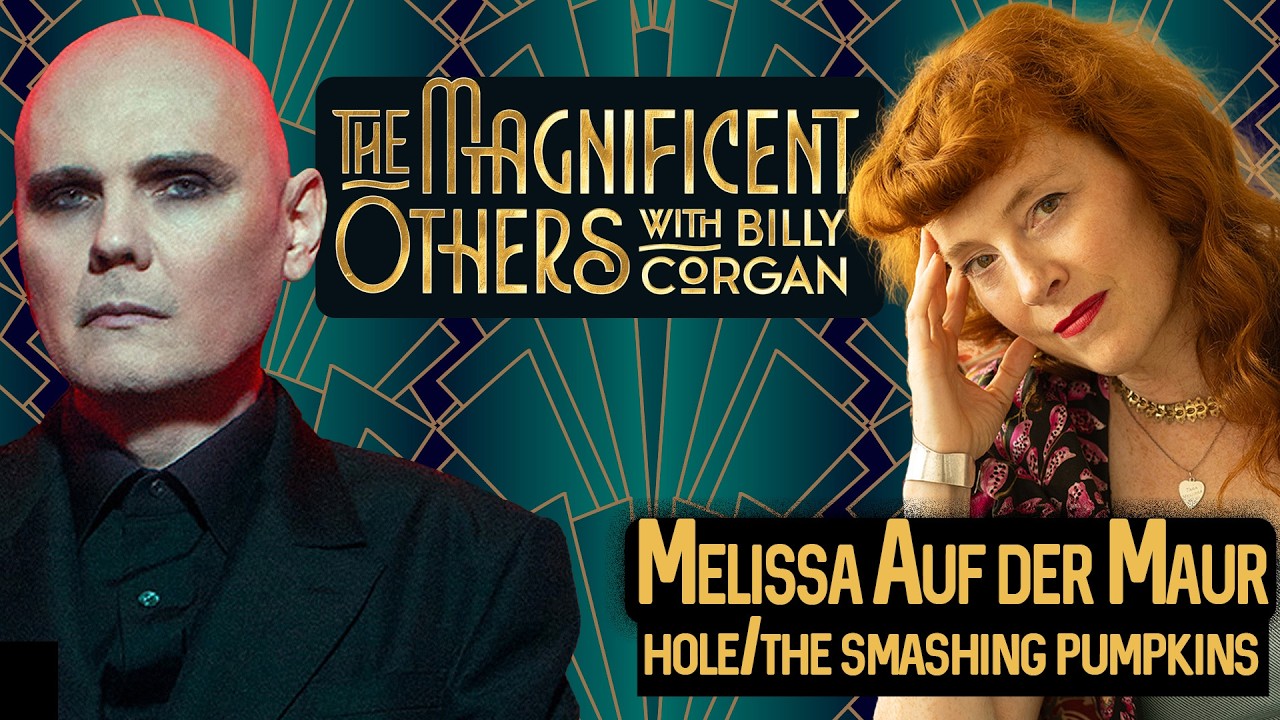
Indeed, Auf der Maur's grunge Cinderella story depicts a series of full-circle moments: her encounter with Billy Corgan at a low-lit punk venue in her native Montréal – and her becoming absolutely enthralled with the Smashing Pumpkins' music – led to a recommendation to join Hole, and later, the Pumpkins as their touring bassist, before she plunged into a solo career at the turn of the millennium.
“There's a reason why the introduction to my book, which is the Reading Festival, is [called] ‘Through the Looking Glass,’” Auf der Maur tells Bass Player, as she dials in from a room lined with photos – vignettes from those heady days.
“It was David Lynchian, Alice in Wonderland… I just stepped into another dimension. I went from a tiny town to a global stage with grief and chaos and death and everything.”
In the book, you describe feeling chosen by the bass. What was it about the instrument – its physicality and frequency – that felt like destiny rather than a practical decision?
When I was awarded Female Bass Player of the Year by Gibson, in the limo ride on the way [there], I started writing my acceptance speech, and that's when I came up with [the idea that] the bass is the mother of all instruments. So in my acceptance speech, I described the bass as the glue and the connector.
The bass is the connector that connects the singer to the drummer, to the audience, to the rhythm, and to the melodies, all at the same time… The place in which the bass sits in any music, not just rock music, but especially dance music or even jazz, the bass brings you on a different kind of journey. It brings you on a feeling journey. You fucking feel the bass.
Geddy Lee has a TV show called Are Bass Players Human Too? [and] he came to Hudson [New York, where Auf der Maur currently lives]. At the end of the visit, I was like, well, ‘Bass is so easy. That's why I picked it up.’ And he looked at me, he's like, ‘Well, that's a secret. Don't tell anyone.’ But he also said, ‘Bass isn't easy for everybody.’
I then realized, even during all my years in Hole, when it was clear that I was so young and had only played six concerts in my life, I played the bass, and didn’t make a mistake. When I joined the band, I only had five days to rehearse with them, and people say, like, ‘How did that happen?’ I was like, ‘I don't know. It was easy.’ So I feel my way through a song.
What did bass playing give you that the other art forms didn’t?
It entirely connects me to a deep way of feeling human connection, because the best of bass is when you're playing with a drummer and playing with a band and playing in front of an audience – that is the magic.
Me alone in a room with a bass; it means absolutely nothing to me. It does not please me nor make me feel anything. That’s my relationship to the instrument – it’s to connect with human beings.

How did you come across your first bass?
I had borrowed basses from older men. I was a DJ, a cassette DJ, at the local dive bar where all the older guy musicians worked with me. And I started plugging into their amps with their instruments.
Then, one day, the guys just said, ‘Hey, it’s time to get your own bass. You're turning 21, you've been borrowing all this time. Let's go find you a bass.’ And so they brought me to this second-hand shop. We walked into this giant music room. It just called me. She had the same color as my hair.
I said, ‘What about this? Is this a good one?’ They're like, ‘Oh yeah, you know, vintage Squier Precision, made in Japan, high quality…’ And then I said, ‘Great, my father, I'll just tell him it's my birthday present.’
My father [Canadian journalist and politician Nick Auf der Maur], who is a very adventurous, courageous, weird person, was having lunch, and I said, ‘Can I have $500 for this bass for my birthday? I'm turning 21.’ That was the bass I played in Hole until I was sponsored by Fender.
I picked up the bass because I wanted to be part of the movement of radical noise-making for my generation. So I felt at home. I'm like, this is where I belong
You joined Hole amidst unimaginable grief. How did you manage to adapt to the circumstances?
A switch flipped, and I was just the exact same person, but in a completely different environment. I was not raised in a suburban, boring family. I was raised by radical people who did radical things.
When I saw the Smashing Pumpkins and Hole play in 1991, when I worked as a ticket girl, and I saw both of them play in front of 20 people, I knew what was happening.
The world was changing, and something huge and magical was happening for my generation. I picked up the bass because I wanted to be part of the movement of radical noise-making for my generation. So I felt at home. I'm like, this is where I belong.
I was not a drug addict [but I was] watching what money and fame did to all these fragile people who were already, for the most part, coming from broken families and didn't have love and support, so their band and their community and their generation and the stage and the audience were their only family. I adapted very quickly because I understood what was happening.
I was watching what money and fame did to all these fragile people who were already, for the most part, coming from broken families and didn't have love and support, so their band and their community were their only family
What gear were you using during that time?
I only ever played the same thing, an [Ampeg] SVT tube amp – with the drive knob, not without. I had been playing a vintage one that was one of the boys' back home. I only ever borrowed until I joined Hole, so I knew what I wanted to buy when they bought me my amp – it's an SVT Pro tube head and SVT cabinet. My Fender Precision, Boss tuner pedal… that is it.
I didn’t use any distortion until later, when SansAmp made these cool distortion pedals. I also love phaser and chorus. I didn’t use anything else. [More recently] Geddy gave me all of his [signature] pedals, so I have some Geddy Lee pedals.
How did your sense of rhythm evolve once you locked in with Hole drummer Patty Schemel?
Patty and I played really well together. We [even] had a little side project when Courtney was becoming a Hollywood movie star – it was called Constant Comment. It was harder to adjust to [Smashing Pumpkins’ drummer] Jimmy Chamberlin. Me and Patty were easy.
By the time I was playing with the Pumpkins, it was a much more complicated catalog with a very complex drummer. Jimmy is a jazz-prog drummer. He's crazy cool. The sound of the Pumpkins is so Jimmy. So that was an interesting adaptation because Jimmy, like jazz drummers, does not play to a click. Patty's actually very tight. She's very, very rhythmically solid. Jimmy is like a wild animal.
It's like you're following this wild creature through two-hour sets of changing songs every setlist, and it took so long for me to figure out, ‘How do I keep up with this dynamic band?’ Because Jimmy is also following Billy, and Billy speeds up, and it's like this weird machine.
But when I did Billy's podcast [recently], I learned something about myself musically that I've never learned before. He told me about my specific pocket, which I knew nothing about. I'm on top of the beat. I’m ahead. I'll take it as a compliment, because [Led Zeppelin’s] John Paul Jones and [John] Bonham, who are one of the most famous rhythm sections, Bonham is behind, and Jones is above. I guess I naturally sit on top of the drums.
What are your memories of writing the bassline for Celebrity Skin? It’s unusual for a bassline to follow the vocal melody.
I don't remember anything. I'm very, very proud of my bass playing on that album, because I had so much time, because some of those songs, we'd be playing for hours and hours and hours.
You just play for Courtney to find her lyrics. She's someone who needs to be screaming to find the whole song for like 20 hours, so as a rhythm section, you're sitting there just playing in a loop over and over and over. So I had a lot of time to find melodic licks.
We were brought to see a Fleetwood Mac rehearsal with the producer, Michael Beinhorn [renowned producer who worked with the likes of the Red Hot Chili Peppers, Soundgarden, Hole, and Ozzy Osbourne]. I was not a Fleetwood Mac fan because I'm more of a heavy, visceral rock fan, but I recognized being in that room watching the drums and bass, [their tracks] could be seen as simple, airy songs, but this is not simple.
What they are doing, the complexity of it when you step back, when you do a melodic line, when you open it up, when you push it… Through just one sitting and watching that rhythm section, it opened my mind to the power of less is more, but also [that] minimal changes make huge impacts on a song.
Billy Corgan famously recommended you to Courtney, and you later joined the Pumpkins. I'm curious how your dynamic with him changed across all these chapters of your life…
Our bond started when we discovered we were both born on St Patrick's Day. We're both pretty tripped-out hippie people that get a little romantic and convoluted and [are all] about the stars and destiny and astrology… He's a trip of a guy, and I am a trip of a girl, I guess, and so I think our relationship reflects this ebb and flow. Sometimes he feels like a soulmate, and then sometimes he's a total stranger.
What did you learn from him about bass playing?
I learned how to be an incredible bass player. Learning that catalog and playing 183 shows with those incredible players totally defined me as a bass player. I was a good bass player, and I am proud of my Celebrity Skin work, but oh my God… I mean, it changed my level of musicianship forever and opened my repertoire of understanding what my hands can do.
My solo records most certainly were expanded by having to learn that catalog and play it with them. So I always say the Pumpkins was my “Master’s in Music”… just phenomenal music training.
How did that impact on your solo career?
Living in the shadow of my grunge parents, Courtney and Billy, who made me, who found me out of nowhere… it was a complex and exhausting shadow to come out from under.
I made those solo records myself for myself, even though I put one out on Capitol [Records] and one on Roadrunner [Records]. I paid for them myself, because I was not going to let other motherfucking people tell me who I am or what I'm going to do and be.
It was done in protective force fields of independence so that I could explore, authentically, what it is to be me, alone, as the captain of the ship. So those two albums were completely self-exploration.
Especially my first record, being able to work with [Queens of the Stone Age’s] Josh Homme and [record producer] Chris Goss… I got to invite the people I admired the most. John Stanier from Helmet, one of my favorite drummers ever… having my favorite drummers play on my solo record was pretty much the coolest thing a bass player could ever do.

From its title to its content, your book, and, by extension, your career, have a feminist overtone. Did you feel a strong sense of responsibility in that respect when you were playing in Hole and Smashing Pumpkins?
The people from the record industry realized that the money is with the women, the money is with the girl fans. They turned the whole music industry, the pop music industry, into a female-led [industry].
Billie Eilish, I think, is a woman you couldn't even invent in the ’90s, because she's a product of a new world where, actually, women can be empowered and protected from a horrible system. She's a product of a new world, of a very special kind of world that didn't exist for women [before].
My mother, which I write about in the book, she wanted to change the way women were. She raised me, saying over and over, ‘No man should ever define a woman. You have to be your own person. Do not be defined by a man.’ So that's how I was raised, and that's what I did.
I felt a responsibility to continue what my mother had started. I just saw myself as a continuation of new feminism, and it still has to happen right now. I got very nervous in the past 10-20 years watching, well, rock music dying. So then, visceral, strong women kind of died and went more into pop.
Billie Eilish is a woman you couldn't even invent in the ’90s, because she's a product of a new world where, actually, women can be empowered and protected from a horrible system
It was a rare moment in the ’90s where women were being given a bridge into a very male form of expression, and it was so fucking powerful. [Nowadays] there's Picture Parlour, Wet Leg… of course, there are tons of women playing guitar. Thank God. But there was a dead moment there, between this and that, there weren’t any. When I was putting out my solo records, all of a sudden, I was the only woman on the bill again.
There’s this beautiful description in your book of the bathroom stall at Reading Festival as a liminal space – transitioning pre-fame Melissa into a public-facing bass icon. Looking back at that life-changing moment now, what would you tell 22-year-old Melissa?
I would tell her that she's doing it all right. It is her who has the answer. No-one in the future outside of her has the answer. The greatest thing I learned writing this book is that I already knew what I was and who I wanted to be.

I had all the tools, and I began to realize that my 22-year-old self was a teacher to me now. So I would basically tell her fucking follow your wildest dreams, listen to the craziest ideas you have in your head, and trust yourself.
I've already been everywhere in my life and back, and I'm just trying to ride the right wave to have meaningful experiences and share something of my perspective and my love of life with other people so that I can have good energy in my lifetime.
- Melissa Auf der Maur's memoir, Even the Good Girls Will Cry: My 90s Rock Memoir, is out now.

