





Since its initial release in 1979, the Steinberger headless bass has enjoyed a special place in the world of instrument design. While its widespread popularity was fairly short-lived and mostly confined to the ’80s, some prominent players helped to put it on the map: Geddy Lee, Sting, and even Cliff Williams of AC/DC all showed some love for the Steinberger bass somewhere in that decade.
“I played a Fender Precision for a little while, when I originally joined the band,” Williams told Bass Player back in 2020. “Then – what is that little headless graphite bass that looks like a toothpick? Steinberger. Those were the first active pickups I ever used, and I really liked the sound, but I hated the bass.
“I played it on the road for a while, but I just couldn't stand the shape, so I pulled the guts out of it and dropped them into my P-Bass, which wasn't bad.
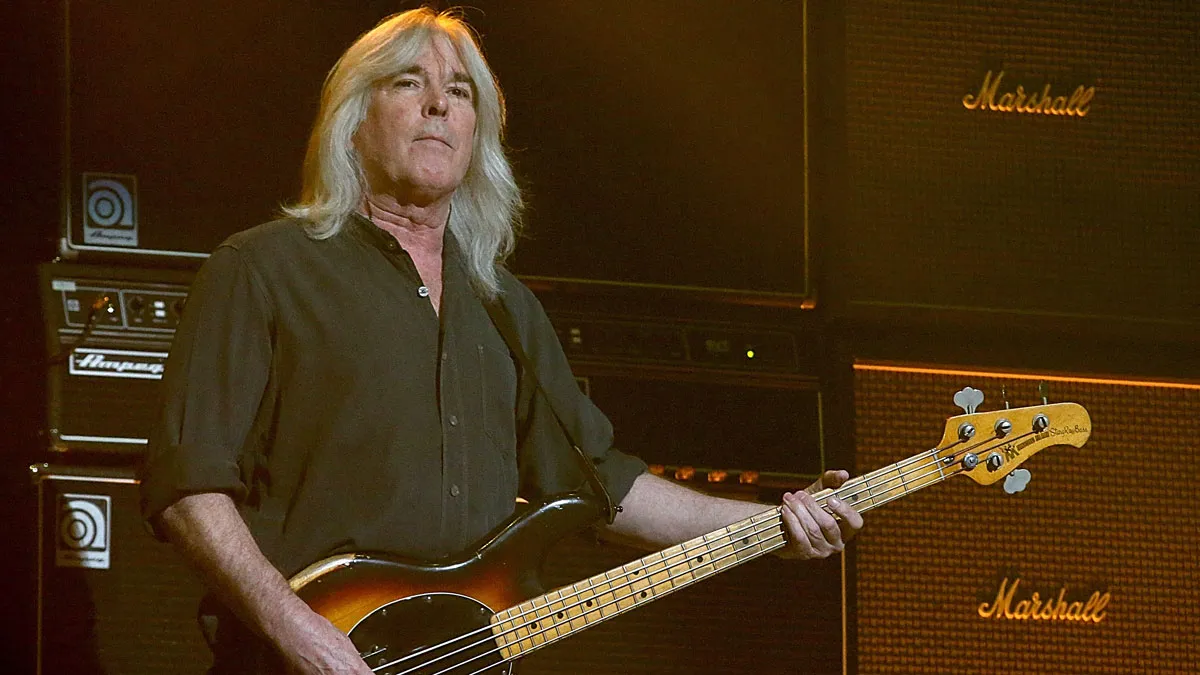
“I've also fiddled around with a Fender Jazz over the years and a Gibson Thunderbird as well, but not for very long. I always seem to go back to the Music Man. They're really good workhorses, and they just seem to fit the bill.”
Williams made the switch to Music Man in 1979, on the tour that followed the band’s Highway To Hell album.
He went on to favour a selection of late '70s pre-Ernie Ball StingRays, mainly in sunburst, and wearing quite heavy gauge (50 – 105) D'Addario flatwound strings. Those strings were set high, to allow maximum downstroke attack.
“For decades, I've used flatwounds everywhere – studio and live. I prefer the punch and the fatness of a flatwound string. I played wires when I was younger, but they have too much clatter for what I want.
“I play mostly downstrokes until my hand feels like it’s going to fall off! Again, with the flatwounds, the pick gives me a really nice solid punch.”

Williams joined AC/DC in 1977, having been invited to fly to Australia to record the band’s next album, Powerage.
Some claim that original bassist Mark Evans played on some of that record, and in The Youngs: The Brothers Who Built AC/DC, author Jesse Fink writes that producer George Young played bass.
“Not at all, and Mark was long gone at that point,” said Williams. “The Australian embassy in London was crapping me around something cruel. I had an interview, I would go along, and they would put me off. This happened four or five times, and the guys were already in the studio in Australia.

“I said to the guy behind the embassy desk, ‘Look, I'm going to lose this job.’ He said, ‘Well, I don't see why an Australian shouldn't have it anyway.’ They just wanted to be bastards. I finally got my visa, and we did the album.”
The twin-guitar fueled riffs soon started to gel with the crunching new rhythm section of Williams with native Aussie drummer, Phil Rudd, underlined by Highway To Hell's propulsion of AC/DC to the heights of hard rock.
Frontman Bon Scott's drink-related death stalled their momentum, though Brian Johnson's addition continued the success, and indeed took it to unprecedented heights with the multi-platinum Back In Black, recorded in the Bahamas by studio übermeister, Robert John ‘Mutt’ Lange, who would later utilise AC/DC's sonic imprint with Def Leppard and Bryan Adams.

“The first album we did with Mutt was Highway to Hell. We did two more: Back in Black and For Those, About to Rock. During that time, he was working with a lot of other bands, like Def Leppard, and he was starting to develop his sound.
“I think part of the reason why Mal and Angus eventually moved on from Mutt is he did have a signature sound that was becoming more prevalent than the band's sound. But we had tremendous success with him.”
Having anchored AC/DC for four decades, Williams is often dismissed as too conservative to be considered among the bass greats, but his role in one of the biggest rock bands in the world provided quite possibly the loftiest example of what all rock bass players should aspire to.
“Too often, it seems younger players are just blasting away on their own. Be part of a unit and listen to your other players and what's going on around you. And persistence is a wonderful thing.”

