Guitar World Verdict
The Triptychon is not a new idea, but it is well-executed. All of the fuzzes sound fantastic, and access to a tone control and the extra kick of the drive adds versatility and character. I'm not sure it will replace all the drives and fuzzes on your board, but it will streamline them, and work with the ones that remain.
Reasons to buy
- +
Comparatively good value.
- +
Intuitive controls.
- +
All blocks work well with each other and external gain stages.
Reasons to avoid
- -
Not cheap.
- -
No Big Muff fuzz option in the fuzz block.
You can trust Guitar World Our expert reviewers spend hours testing and comparing guitar products so you can choose the best for you. Find out more about how we test.
What is it?
It's no secret that many guitarists build their tone from multiple drive blocks – overdrives, fuzz pedals, boosts, tube amps, and even rack preamps.
Players from Eric Johnson to Billy Corgan have employed gain-stacking and drives to nail the sound in their heads.
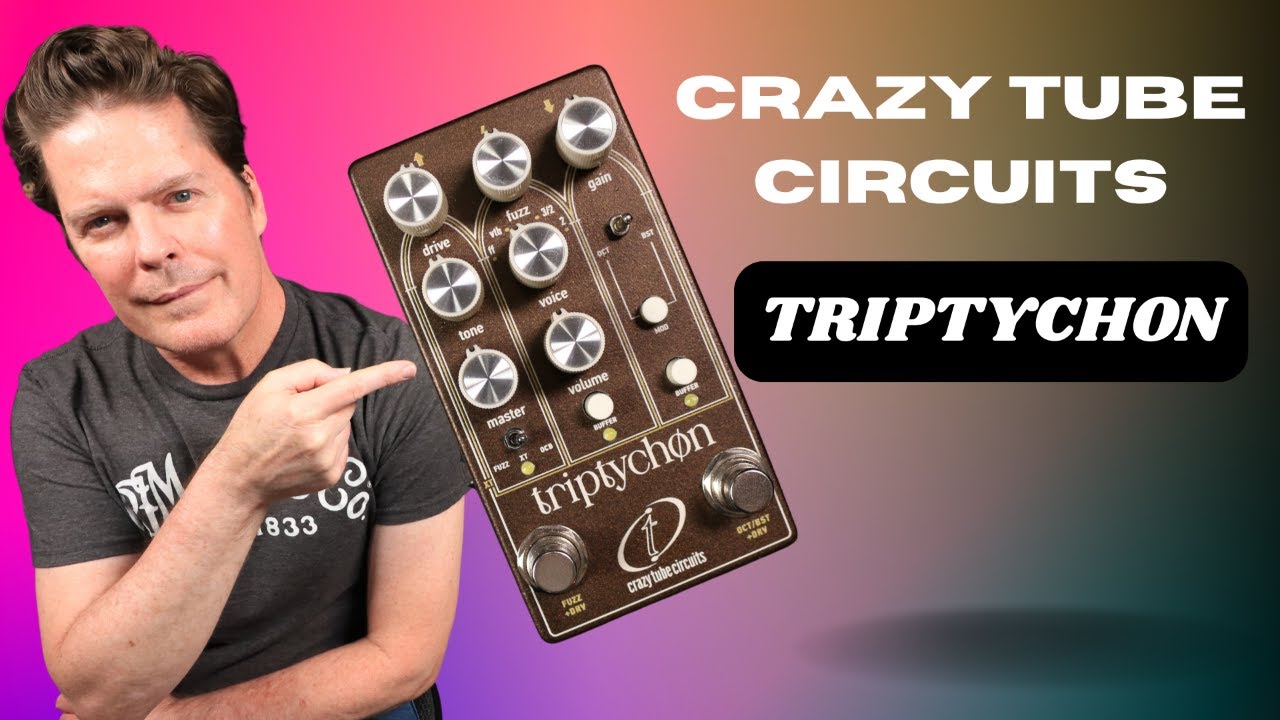
The Triptychon takes this truism and attempts to put three of the blocks – boost, fuzz, and overdrive – into one compact enclosure.
Specs

- Price: $359 | £269 | €299
- Type: Boost/Fuzz/Distortion
- Controls: Octave/Boost, Mod, Boost gain, Fuzz Gain, Fuzz Voice, Fuzz Volume, Drive Gain, Drive Tone, Drive Volume, Footswitch selector, 2x Buffer selector, 2x Footswitch
- Features: Boost, Fuzz, Drive pedals
- Connectivity: Input, Output, Expansion Footswitch, Power
- Bypass: True relay
- Power: 9V DC Centre-negative, 80mA
- Dimensions: 69 x 125 x 58 mm
- Weight: 385g
- Contact: Crazy Tube Circuits
Build quality

Build quality rating: ★★★★★
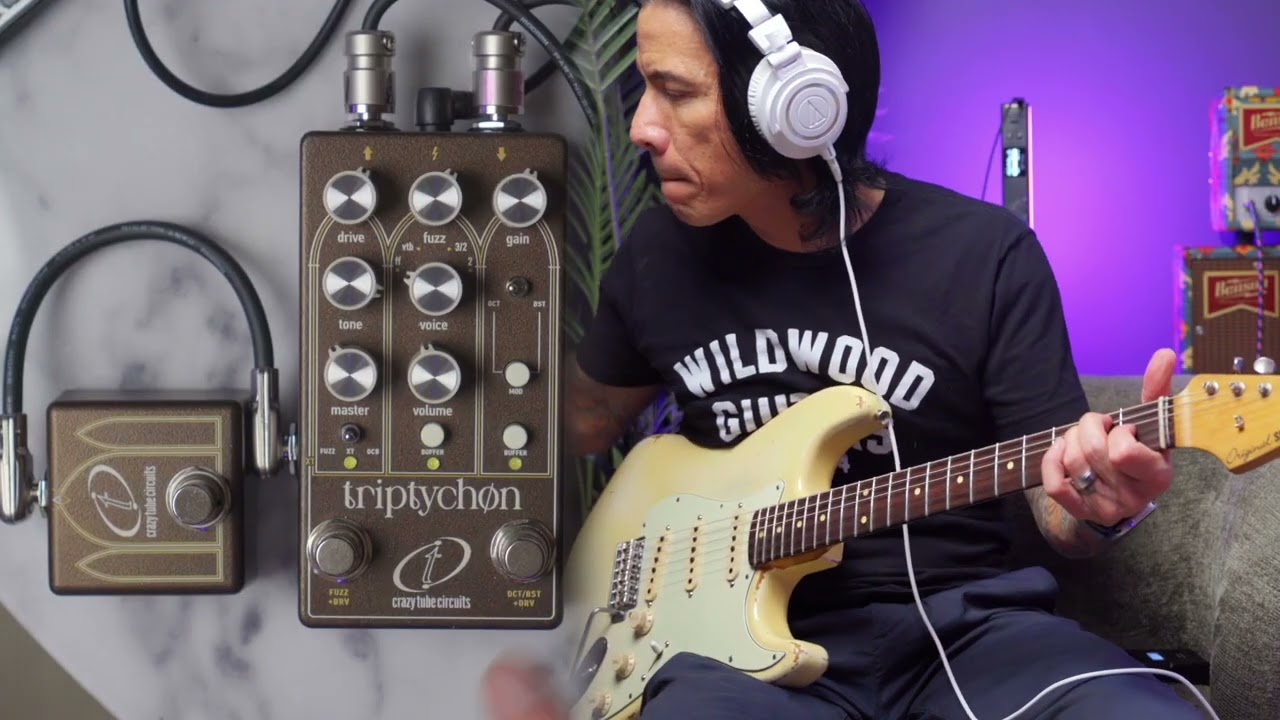
The Triptychon is well-built, sensibly laid out, and very compact given how much it's squeezing in. There's also an option to use an extension footswitch to control the drive block separately and have all three blocks independently switchable, which is cool.
Usability and features

Usability and features rating: ★★★★½
It's intuitive to set up, even if it takes a few minutes to get oriented in the context of your rig
The Triptychon crams so much functionality into its compact footprint that usability does suffer a bit. For me, the main snag is not immediately being able to figure out the anti-buffer feature. This helps with impedance when there is either a buffered pedal or a guitar with active pickups in front of it.
Still, apart from that, the pedal reads sensibly from right to left and vertically, so it's intuitive to set up, even if it takes a few minutes to get oriented in the context of your rig. From there it's simple to nail lots of different tones, even when switching fuzz voicings.
The switchable fuzz options are all two-knob units, so their Fuzz and Volume controls are included in the Fuzz block, while they rely on the Tone control in the Drive block.

If you're not using the extension footswitch, the Drive and Fuzz blocks are activated together, meaning that even if the drive is turned all the way down, the tone control is active, in my opinion an improvement on the original fuzzes.
The only feature the Triptychon doesn't offer is the ability to change the order of the effects. This might be an issue for some, but luckily for me, the three come in my preferred order, meaning it's a feature, not a bug. Although you can't reorder the effects, you can set it so the drive is on the second footswitch, instead of the boost, for added versatility.
Sounds

Sounds rating: ★★★★★
The Triptychon opts for the order of boost into fuzz, into drive. The plus side of this is that the drive tends to make the fuzz more controllable, not less. Though it's not as compressed as say, a Tube Screamer, it does still compress and add saturation in response to the fuzz.
This is rather like the response of a tube amp, which is what the designers intended. Completely wide open, it does become quite uncontrollable, but given the range of gain on the pedal, and the presence of three gain blocks, it's impressive how much of that range is usable.
The Boost block also sports an analog octave-up, if that's your thing, but i find myself leaving it in the Rangemaster setting, adding a treble boost. It's such a substantial voicing change that with the Gain up, on a neck pickup, engaging the boost will have you checking your guitar to see that you didn't toggle to the bridge by accident.

The only drawback I can think of is that, by not including a Big Muff-style fuzz voice, there's no Smashing Pumpkins-style 'Muff into drive' lead tone
For my money, the pedal is at its best when all three circuits are engaged, with the Fuzz and Drive controls north of 12 o' clock – the lead tones this thing can put out are simply brilliant.
The drive block on its own is easy to dial in for fantastic rhythm tones, and I found generally mixing the drive and fuzz sounded best - I'm a sucker for Fuzz Face into drive.
Though the Triptychon is designed to be a one-stop gain shop, it interacts well with other gain pedals. Using a darker, Space Echo-style boost, the fuzz and drive blocks respond with a pleasant kick, useful for thicker rhythm tones. At the other end, pushing up the level with the gain down results in lower-wattage tube amps adding their own breakup to the mix. Taking the fuzz and drive blocks back out, the boost on its own also has enough juice to claw saturation from the tube amp.
The only drawback I can think of is that, by not including a Big Muff-style fuzz voice, there's no Smashing Pumpkins-style 'Muff into drive' lead tone. Then again, this would have taken up valuable space with a very different fuzz circuit, so it's understandable.
Verdict

It may well be the only drive pedal that you need on your board
For a drive pedal, the Triptychon isn't cheap, but it may well be the only drive pedal that you need on your board.
Should that not be the case, it stacks well with other drives and the amps that follow it. The range of all the controls is well-judged; the result is that there's hardly a bad setting in the pedal.
Guitar World verdict: The Triptychon is not a new idea, but it is well-executed. All of the fuzzes sound fantastic, and access to a tone control and the extra kick of the drive adds versatility and character. I'm not sure it will replace all the drives and fuzzes on your board, but it will streamline them, and work with the ones that remain.
Test |
Results |
Score |
|---|---|---|
Build quality |
It's put together like a tank and plenty of thought has gone into the layout. |
★★★★★ |
Usability and features |
There's a lot going on here – the anti-buffer feature took a minute to figure out – but it's intuitive once you get going. |
★★★★½ |
Sounds |
Flawless, though we would like a Big Muff fuzz option. |
★★★★★ |
Overall |
A superb three-on-one dirt pedal covering all the main food groups. |
★★★★★ |
Also try
Hands-on videos
R.J. Ronquillo
Shawn Tubbs
Kris Barosci