Guitar World Verdict
The Bass Big Muff Pi 2 is a natural addition to Electro-Harmonix’s range – fantastic and versatile fuzz tones that can be kept in check with the Blend control, or let loose. What’s unexpected is just how well it works for guitar, too!
Pros
- +
Massive fuzz tones that are easily tamed if necessary.
- +
The simple but well-judged control set offers lots of potential.
- +
It also works a treat for guitar.
Cons
- -
Four-screw battery access.
You can trust Guitar World Our expert reviewers spend hours testing and comparing guitar products so you can choose the best for you. Find out more about how we test.
What is it?
Shopping for an Electro-Harmonix Big Muff is a bit like ordering a coffee on the high street; so many permutations, different sizes, different ingredients and different (sonic) flavors.
Or at least, that’s the case if you’re a guitarist. For a long time now, the bass contingent hasn't had nearly so much choice – just one circuit, in a couple of sizes. There's a more in-depth Deluxe version that offers lots of extra features, but also takes the blueprint further away from the simplicity the Muff has always offered.
Now though, a watershed moment, thanks to Josh Scott, of JHS Pedals fame, and Electro-Harmonix archivist Daniel Danger. Pedal historians, geeks, and also the co-authors of a comprehensive new volume on the history of EHX.
While researching, Danger and Scott had cause to dig around in the treasure-trove garage of former EHX engineer Bob Myer. There, they discovered a schematic for a dual op-amp powered Muff variant that had never made it off the drawing board.
The brains at JHS set to work on giving it physical form, and realized this was something special - a different, distinct new flavor that was a worthy addition to the range. These findings were shared with EHX, who conceded that it deserved its time in the sun after all.
It’s available now, named the Big Muff Pi 2 – aimed at guitarists, but with a fanbase among bassists for its huge low-end. If ever there was an excuse to create a new Bass Big Muff, here it was.
And here it is. Deep breath – it’s the Electro-Harmonix Bass Big Muff Pi 2, whose name conjures the feeling of reciting a highly specific Starbucks order and brings it right to your pedalboard.
Specs

- Price: $122 | £105 | €121
- Type: Bass fuzz pedal
- Controls: Volume, Sustain, Blend, Tone, Bass Boost
- Connectivity: ¼” instrument input, ¼” amp output
- Bypass: True
- Power: 9v DC, 20mA
- Dimensions: 70 x 114 x 53 mm
- Weight: 340g
- Contact: Electro-Harmonix
Build quality

Build quality rating: ★★★★☆

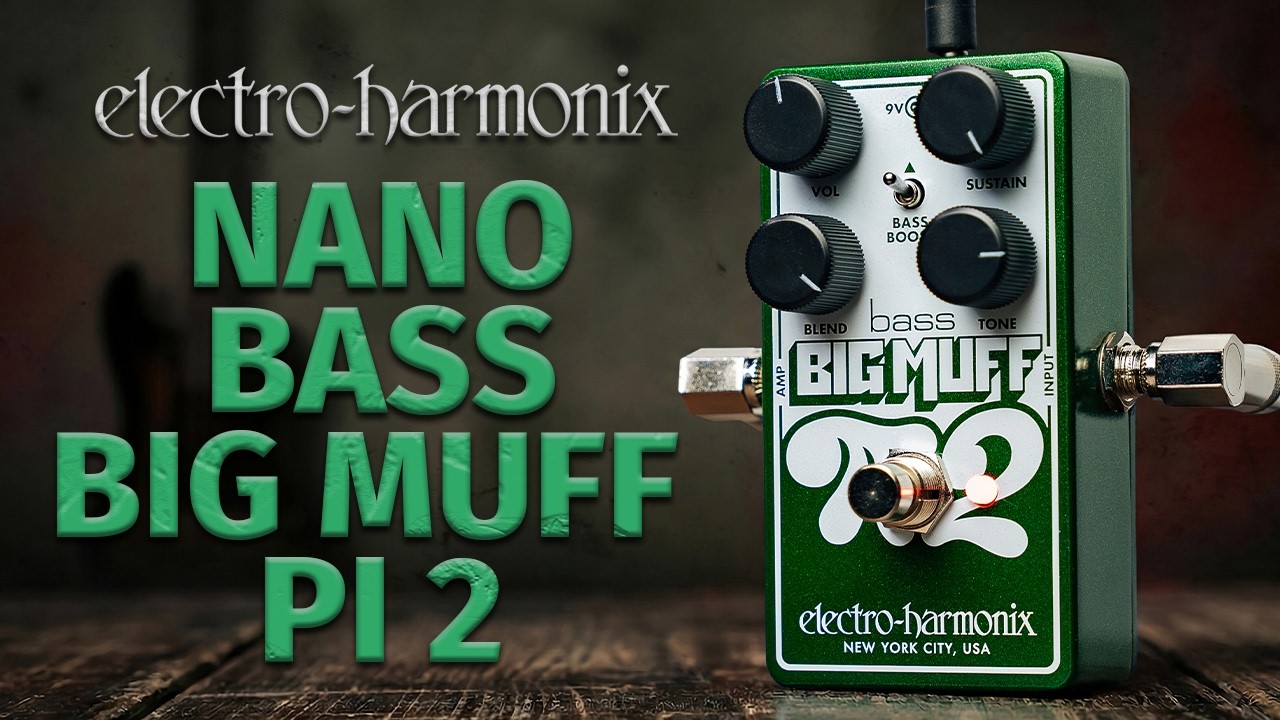
That coffee was made in about 45 seconds, though, whereas this feels a well-considered item. A solid metal enclosure in a fetching shade of dark metallic green, with four solid-feeling pots and a metal mini-switch.
The whole thing is marshalled by a metal plunger footswitch which, for the first time in Muff history, is able to trigger momentarily should you only require a short burst of fuzz.
Usability

Usability rating: ★★★★★
Switching the Muff on and slamming out some rock riffs unaccompanied is enormous fun
Other than that footswitch, there aren’t many hidden tricks here. The usual Volume, Sustain (that’s gain) and Tone knobs are present and correct, along with a Bass Boost switch, and a Blend knob for balancing the fuzz with the clean signal - a vital tool for bass overdrive and distortion.
Picking up my old Ibanez Roadstar P-style bass, I get the pedal hooked-up to my Line 6 HX Stomp-powered pedalboard. The Muff comes equipped with a 9V battery, which I duly disconnect in favor of my Cioks power supply – after unscrewing the base-plate of the pedal to reach it.
Sounds

Sounds rating: ★★★★★
Cycling through my bass presets, I alight upon my overdriven Ampeg SVT emulation. This preset is a perfect match for a hot P-tone, and it proves a good basis for my explorations.
Even switching the Muff on and slamming out some rock riffs unaccompanied is enormous fun – and it's far more versatile than you might expect, thanks to that essential Blend control.
When it’s set very low, you get the subtlest tones that the pedal is capable of but, let’s be clear, subtle is a relative term; even this makes it sound like the amp is melting. From there, higher Sustain settings bring out the archetypal Big Muff roar, in abundance, and it’s hard to think that anyone will be left wanting more gain.

Dial back the Blend, and you get something totally different. The distortion fades into the background and you have a defined, cutting overdrive/boost
The range of the Tone control is well-judged; my own favorite sounds are in the middle reaches of the pot, but either extreme still provides EQ settings that would be usable. The Bass Boost mini-switch is really useful too – I tend to keep it on, for the biggest low-end possible, but much fun can be had with it disengaged too.
I’m always curious to see how a bass-optimized pedal sounds on guitar, and so I grab my Strat and dial up my go-to clean Mesa/Boogie Mk IV sound. Initially, with Blend all the way up, it’s business-as-usual Big Muff – a thick, noisy, ultra-high-gain bellow.
But here’s what’s really interesting – dial back the Blend, and you get something totally different. The distortion fades into the background and you have a defined, cutting overdrive/boost.
This is useful on clean and dirty signals alike, and sounds fantastic. It’s rare to find a gain effect that can serve both bass guitar and electric guitar so well.
Verdict

I came to the Bass Big Muff Pi 2 expecting to enjoy some filthy, growling fuzz bass riffs, and it doesn't disappoint.
But the addition of a clean blend gives it far more utility, and I was blown away by how good it sounds for guitar too – to the point where I’d strongly consider buying one over the guitarists’ Big Muff Pi 2, for those extra ‘Easter egg’ sounds offered by the Blend knob.
It’s the best Big Muff there’s ever been for bass, and turns out to be quite something for those an octave above as well.
Guitar World verdict: The Bass Big Muff Pi 2 is a natural addition to Electro-Harmonix’s range – fantastic and versatile fuzz tones that can be kept in check with the Blend control, or let loose. What’s unexpected is just how well it works for guitar, too!
Test |
Results |
Score |
|---|---|---|
Build quality |
Solidly built, but four-screw battery access is a pain. |
★★★★☆ |
Usability |
No concerns whatsoever, it’s very easy to use and get great sounds from. |
★★★★★ |
Sounds |
Very good indeed – whether providing huge fuzz or a subtler blended signal. |
★★★★★ |
Overall |
The Big Muff Pi 2 is a superb addition to the guitar range, but this bass version may be the true master-stroke. |
★★★★½ |
Also try

Hands-on videos
Electro-Harmonix