


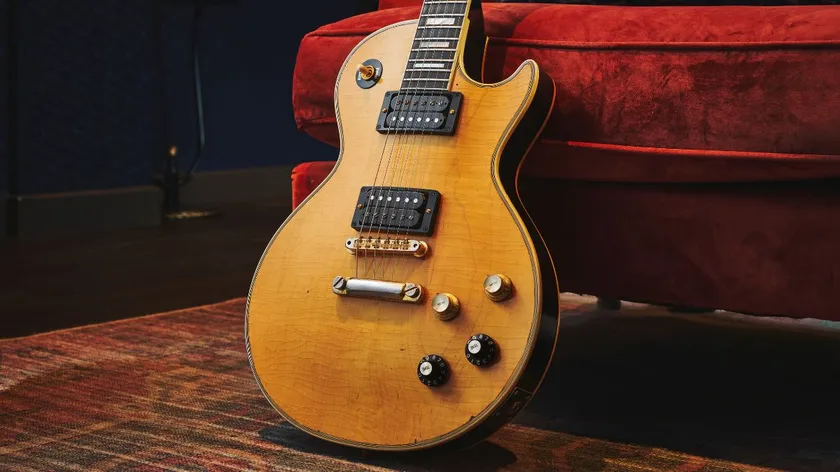


Some of the guitars in Gary Moore’s collection represent the deep craft of heritage makers such as Gibson during the golden era of 50s and 60s lutherie.
Others, however, reflect the road-forged pragmatism and rough prototyping that progressive musicians sometimes demand of their gear.
This much-modified ‘bitsa’ Charvel San Dimas is a perfect example of musicians and their techs jury-rigging guitars to meet needs not catered to by off-the-peg instruments or the pressing needs of busy touring, recording and promo schedules.
And it’s fair to say that this particular guitar gave authenticator Steve Clarke more headaches than some of the others, partly due to its hastily fitted mods.
“It was faulty straight off,” Steve smiles. “Plugged it in, dead. So the ’plate comes off and I have a look around, see what’s going on with this. And, again, just because it’s been left around and it’s gunked up, I started to spray the pots [with contact cleaner] because the volume had seized up a little bit. It freed up and it started to come back to life, but I then found the jack socket was faulty and I had to sort that out – I think I resoldered that one.
“Now, the EMG pickup that was on it, I eventually got a reading of 16.53k [in output]. But when I first opened the battery compartment, it was a gooey mess. The battery had been left in, gone green and burst,” Steve adds, ruefully. “Fortunately, I had spare connectors, so I cut the wires off and reconnected a new battery terminal to it. Bingo, it comes to life.”


“But when I looked inside [the guitar more generally], I was amazed it even worked… the scratchplate looked like somebody had used a hacksaw [to shape it] around the pickup but didn’t have an eye for finesse. So it was probably a bit ‘put together’ for Gary.
“The gap between the pickup and the scratchplate was larger on one side than the other, the jack socket was misaligned, and the pickup wasn’t straight [in other words, it was diagonally angled in the way a Strat bridge pickup is, though to a far subtler degree – Ed], so if you put the guitar in front of you, you’re thinking, ‘Is that deliberate?’”
The guitar is also fitted with a Jackson-branded neck, not an original Charvel example, but despite all these many ad hoc changes that may have been made under time pressure, Steve says the guitar represents a snapshot of an artist and his rapidly changing needs.
The guitar was initially used during Gary’s time in the band G-Force, from 1979 to 1980. It can be seen, in an earlier configuration with twin humbuckers, on the cover of Gary’s 1983 album, Dirty Fingers. Those pickups were subsequently removed and replaced by the single EMG that it now possesses.

Gary later praised EMGs to Music Maker magazine, saying: “I find that for live work they’re the best pickups I’ve ever heard. They really cut through.”
Steve Clarke reflects: “I suppose, at the end of the day, Gary must’ve just plugged it in and thought, ‘Yeah, it sounds great.’ He’s not going to take it apart – he’s not going to look inside or think, ‘Is it me or is that pickup a little bit wonky?’ Those guys were a different breed, you know?”
- This article first appeared in Guitarist. Subscribe and save.

