


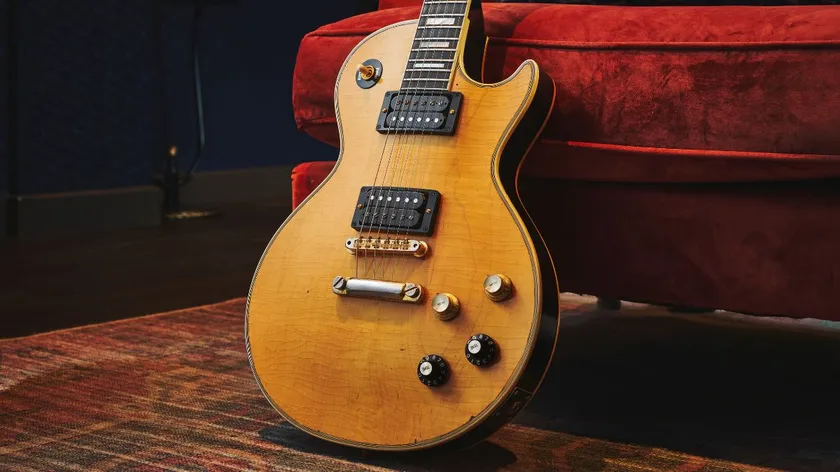


By the time you read this the last remaining guitars of Gary Moore’s collection to be auctioned will have proud new owners. Though most of us can only imagine what it must be like to own one of those hallowed instruments, we can all take inspiration from the music Gary conjured from their fretboards.
This example solo is influenced by a couple of landmark performances: first, Gary’s solo on the original (1974) version of Thin Lizzy’s Still In Love With You; and second, it borrows ideas from his live performances of Parisienne Walkways and Still Got The Blues over the years.
Though Gary was capable of great delicacy and accuracy on the instrument, this solo was inspired by his more fiery moments, plugging into an already driven Marshall amp and then boosting further with an Ibanez Tube Screamer. This is a classic combination, similar to how Gary would run his own live rigs.
One popular way to use a Tube Screamer is to turn the level up to maximum and hit the amp’s input hard. You still get the tone-shaping benefits of the boosted mids and attenuated low-end, and you can add more drive with the gain control if needed.
Gary certainly liked to use a lot of drive and was extremely adept at avoiding unwanted feedback/squealing by zeroing the volume knob between phrases. The Patent Applied For pickups on vintage Les Pauls were not wax-potted, so were more inclined to squeal than many modern ones.
Many believe unpotted pickups have a tone of their own, though at those levels, any pickup would be inclined to feed back. Another way Gary handled this was to allow the unused strings to ring momentarily before/between phrases, which gave his playing a rough edge and urgency. Hope you enjoy and see you next time!
Example 1

This opening phrase stays largely within the shape 1 A minor pentatonic, featuring held bends and controlled vibrato. We’re starting low and keeping things relatively simple and melodic for now, leaving some headroom for later on.
Gary was conversant with many styles and his note choice would often reflect this, a subtle example being the B in bar 3, which fits over the Dm/G chord. Soon afterwards, the final note (E) is the result of a slide outside shape 1 pentatonic into shape 2.
Example 2

We start with this ascending C major scale run, ending with a held bend. From here, you could regard this as a shape 4 A minor pentatonic phrase, changing over the subsequent Esus4-E chords to an E dominant 7th arpeggio based phrase (or E Mixolydian if you prefer).
These terms can sound a little daunting, but it’s important to remind ourselves that they are simply names for sounds. We’re staying in the same position on the fretboard throughout.
Example 3

We’re reaching something of a peak with this high-register phrase, with higher speed playing and some push/pull in the timing.
Also, note the brief open-string noise before the ascending A minor pentatonic run. We’re working with shape 1 again here, an octave above the opening phrase.
Keep an eye on the picking directions: some of them may seem counterintuitive at first, but they allow you to reach surprisingly high speeds with relatively little effort. This kind of playing was a big influence on the young John Sykes.
Example 4

Keeping things simple and melodic over the Dm/B chord, there is a final flourish coming over the Esus4-E chords with a return to the E dominant 7th arpeggio/E Mixolydian idea.
This is more of a nod to Gary’s fusion years with Colosseum II, though he does visit this kind of phrasing briefly during the outro of the full length version of Still Got The Blues. It just felt right at the time!
Hear it here
Thin Lizzy – Nightlife
The version of Still In Love With You from this album features Gary’s original solo, which inspired Brian Robertson’s much-loved version from the Live And Dangerous album.
This original solo is at a significantly higher tempo yet starts with a classic blues feel. You can hear where Gary’s playing would head in later years as the solo progresses to those high notes, though. Another version of this solo worth hearing is by John Sykes on Lizzy’s Life: Live album.
Gary Moore – Blues Alive
Taken from recordings of Gary’s then-recent 1992 tour, this album is (of course) full of great playing, but make sure to pay particular attention to the live versions of Still Got The Blues and Parisienne Walkways.
These give us the closest insight into how Gary plays in the heat of the moment. You’ll hear him allow lots of open strings to ring into and between phrases, which helps minimize unwanted feedback and gives his playing an exciting and urgent edge.
Gary Moore – Back On The Streets
This solo album from 1978 showcases Gary’s transition from fusion into his ‘rock’ era, which continued through the '80s.
There is the original version of Parisienne Walkways, featuring some very precise, controlled playing, and What Would You Rather Bee Or A Wasp, which takes a more flamboyant approach but features more fusion-influenced harmonic ideas.
The title track demonstrates that Gary was very aware of the punk explosion but didn’t feel the need to dumb down his playing.
- This article first appeared in Guitarist. Subscribe and save.

