

“It’s funny how life brings you full circle,” reflects the renowned repairman, engineer, tech and journalist Huw Price. Rewind a few decades and the Welshman was hammering out Status Quo’s Caroline in a youthful covers band.
Back in the present day, the 61-year-old found himself invited to Bonhams auction house to prepare the guitars of the British rock band’s late rhythm man, Rick Parfitt, for the much-anticipated sale of pop-culture treasures held this month.
“I used to play Rick’s guitar parts in that band,” Price remembers. “So it felt pretty special to be playing his actual No 1 Tele, all those years later. That was a real shiver-down-the-spine moment. I mean, it’s clearly the guitar he’s most readily identified with.”
Even if we’ve never actually attended one, the auction is such a fixture of film and TV that we assume we understand the process. In reality, the clack of the gavel is merely the crescendo in an orchestra of behind-the-scenes activity, from establishing an item’s provenance to setting valuation and arranging transportation and secure storage.
Unlike the scenario of the seller who shows up with a supposedly Hendrix-owned Strat, there was no need to prove this was Parfitt’s gear. “Rick’s estate has looked after these guitars and amps for the past decade,” says Claire Tole-Moir, head of the Popular Culture & Science department at Bonhams. “They now feel the time is right for them to find new homes where they can be cherished by fellow fans and collectors.”
Price’s role was to spend two day s with Parfitt’s collection, authenticating, assessing condition, testing playability, checking electronics, fettling and carrying out minor repairs – while taking care not to ‘correct’ the quirks that add to the storytelling aspect.
“The brief was to be minimally invasive,” he explains. “I certainly wasn’t going to repair any paintwork or say, ‘Oh, this guitar could do with a refret.’ That’s not the gig. The main point of interest is that these are Rick Parfitt’s guitars, and the brief was very much to keep them as original as possible. Including the strings.”
Rocked All Over The World

Anyone who has seen Parfitt’s No 1 – and you can’t exactly miss it, given the guitar’s starring role in Quo folklore, including 1985’s curtain-raising set at Live Aid – will know that attempting to restore this Tele to mint condition is a fool’s errand.
Bought in Glasgow in the mid-’70s, with the £80 asking price forked over in instalments (“Rick said in one interview it had more than paid itself off,” laughs Tole-Moir), the guitarist once claimed “you can hit it as hard as you like and you won’t put it out of tune”.
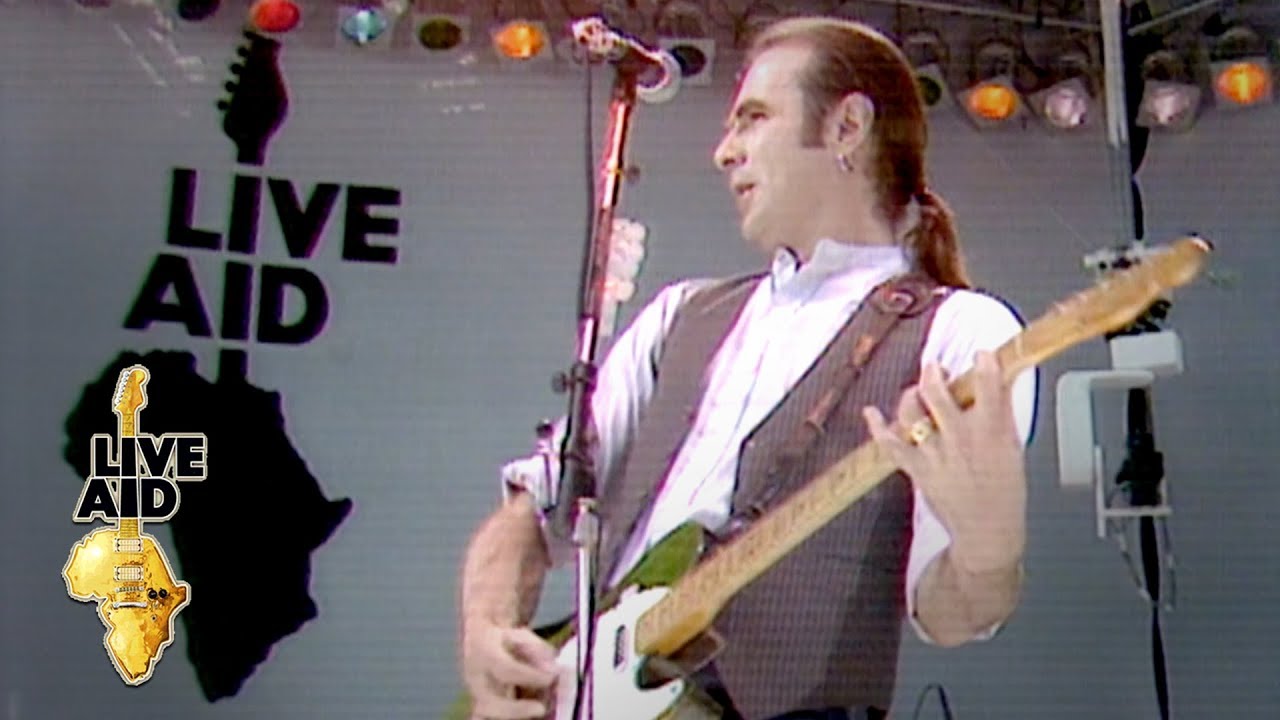
Inspecting the Tele today, it seems the Quo man tested that theory almost to destruction. “It’s unbelievably weathered,” says Price. “It’s got Rory Gallagher levels of wear. The top of the body, Rick has worn to a gentle chamfer in the forearm area. It’s also extremely worn on the top edge at the back. A lot of sweat has gone into the wood and the fibres have swollen and shrunk, so there’s an uneven texture.
“I suspect that Rick wasn’t precious about his instruments. I mean, he may have had an affection for them, but these were not cosseted guitars. These were tools of the trade for a professional working musician.”
The No 1’s finish alone warrants its own feature, continues Price of the historic coats of paint, chips and touch-ups. “It’s an ash body, fairly light, a really nice weight. But multiple, multiple refinishes. You can see the layers. I suspect it was initially stained yellow. Then there’s a clear sealer coat, probably Fullerplast. Then there’s a coat of white, with a coat of probably cellulose on top, which has yellowed up to a dirty blonde. Then somebody painted it a really dark blue.

“And then,” he continues, “the finish we all associate with Rick is a kind of off-white that’s been applied over the top. It’s not nitrocellulose, it’s some kind of enamel finish. The pickguard looks to be the original three-ply off-white ’guard that’s been painted with a black enamel, but Rick has basically worn through the enamel.
“As I recall, the tuners are Kluson-style replacements, and the chrome plating has completely worn off the control knobs to reveal the brass underneath. So there are all these different layers to that Tele. If you look around the neck heel, and also in the neck pocket, you can actually still see the original finish.”

The neck also helped to skewer an enduring misconception, explains Price. “There’s a lot of misinformation about this Tele. All kinds of years are ascribed to it. It’s been called a ’59 or ’60, and it clearly isn’t that. I can tell you for sure, the date stamp on the neck is February ’66. I’d say it’s very typical of the era. Not an especially fat neck, but a bit of heft, more than you get in the early ’60s.
“It’s a C profile with soft shoulders, very familiar, with an even depth all the way along. And the fact it was configured for a strong-armed rhythm player meant it actually felt more like a really nicely set-up acoustic. Rick called it his Range Rover, and it’s not going to fret out or go out of tune. It was by far and away the nicest one of his guitars to play. You can see why he liked it.”

When Price dug deeper, however, Parfitt’s No 1 revealed itself as anything but factory-spec. “With regard to the controls, the only original bit was the tone capacitor. Both potentiometers had been changed. And the tone control wasn’t actually connected at all, it was out of the circuit. The pickup switch was replaced, but that wasn’t in-circuit, either.
“And with the neck pickup, the wires just had heat-shrink put over the ends, and it wasn’t hooked up to anything. That neck pickup cover had also lost all its plating and was wedged in due to shrinkage of the pickguard material. Hence we were unable to verify its originality. So, basically, the electronics are just a bridge pickup to a volume control, and then shielded cable connected to the output jack.”
For authenticity’s sake, Price didn’t hook up any of those dead components, instead turning his attention to the unit that drove Quo’s roaring sound.
I have absolutely no idea why Rick swapped the bridge. But I think Francis Rossi’s Tele had the same treatment at some point
Huw Price
“The bridge pickup was non-original, but Rick had obviously played it for a long time because it was quite rusty. It’s actually a Seymour Duncan STL-3 and it looks to me like the slugs are the wider diameter than standard. The amount of sweat on the hardware and pickup itself suggests to me he probably went through numerous pickups over the years and they just did running repairs. They just grabbed another pickup and stuck it in, you know?”
But even Price can’t rationalise the butchery of the Tele’s hardware (which, of course, only adds to its appeal for fans). “The original bridge was chopped down with the rear half removed. What’s left of the bridge plate is merely the mounting for the pickup, with two screw holes added to fix what remained of the plate to the body.

“And then, the major modification is that they put in Les Paul Junior-style bridge posts and a wraptail bridge,” he adds. “And the wraptail bridge is not some wonderful vintage Gibson-type bridge. It’s from a Japanese copy. It’s got ‘TV Made In Japan’ on the bottom.
“Because the geometry of a Tele doesn’t work with a wraptail, the way they got around that was to file deep grooves into it, to lower the action so it was actually playable. They put six more ferrules on the front of the body so the strings came through the body then passed over this wraptail bridge.”

For a moment, Price sounds happily baffled: “I have absolutely no idea why Rick swapped the bridge. But I think Francis Rossi’s Tele had the same treatment at some point. I don’t know whether some tech said, ‘I’ve got a good idea,’ and they just went with it.
“Most people, if they mess with a Tele bridge, they put on individual saddles because they’re having problems with intonation. If anything – because the wraptail is not intonatable at all – I’d say the intonation was worse than it was beforehand.”

Despite that, testing the ’66 through a portable amp revealed a “really nice, resonant tone, more muted and woody than the classic Tele twang”, remembers Price.
But there was no time to jam through the catalogue of Quo riffs, with Bonhams set to auction a total of 12 guitars and four amps, and each instrument requiring a checkover.
“It’s a case of quality over quantity,” stresses Tole-Moir of the relatively streamlined collection (for comparison, Johnny Marr auctioned almost 100 guitars at Christie’s in September). “From Gibson Melody Makers to a Rickenbacker and even a Dobro resonator, this is a considered collection with a clear sense of purpose. Rick knew what worked for him and stayed true to it.”

Also Under the Hammer
While Parfitt’s No 1 is undoubtedly top of the lots, there are others that turn the head. Also likely to warm up the bidding is a natural-finish 1960 Fender Esquire, used since its acquisition in 1977 for open-tuned tracks like Rain and Mystery Song, with a capo at the 2nd fret.
“That one is lovely,” nods Price. “It was originally white or white blonde and it still has the original single-ply pickguard. There wasn’t any evidence of a neck pickup having been fitted, which is quite unusual.”

Another hot property is a ’63 Gibson SG Junior. “Rick owned more than one SG and, according to his tech Lloyd Gilbert, often used one to play Dirty Water, but this was the guitar he kept throughout – it’s even engraved with ‘RP’ to the reverse of the body,” explains Tole-Moir.
For his part, Price was impressed by the SG’s condition: “It’s in really nice shape. The control wiring had been messed with, but the pickup was original. I think he had three SG Juniors in total. The volume control wasn’t working on one of them, but it was basically just that the grounding solder joint had gone, so I just did a tiny bit of soldering work on that and got it up and running.”


Some of Parfitt’s favourite amps will go under the hammer, too. The most curious is a heavily modded Marshall (Price: “It has no preamp tubes – I think they basically just used it as a power amp”).
According to Lloyd Gilbert, the world-famous intro for Whatever You Want was recorded on this amp without any pedals, just using the chorus sound
Claire Tole-Moir on Rick Parfitt's Roland JC-120
But the more significant sale for Quo fans is the Roland JC-120 dated to the late ’70s or early ’80s. “According to Lloyd Gilbert,” says Tole-Moir, “the world-famous intro for Whatever You Want was recorded on this amp without any pedals, just using the chorus sound. It also has ‘RP’ in red stencilling to the top of the cabinet.”
Right now, the market for celebrity-owned guitars is booming (Marr’s auction more than tripled its pre-sale estimates). Is Parfitt’s posthumous sale in the same super-league?
Tole-Moir believes so: “Status Quo are perhaps not always given the same critical prestige as The Rolling Stones, Led Zeppelin or The Who, but they’re absolutely deserving of a place in the story of British rock music.
“Far more than a guitar, Rick’s Tele became an integral part of his identity as a musician. Along with Francis Rossi’s green Telecaster – which Bonhams sold in 2019 – it’s one of the defining visual symbols of Status Quo.”
And while Price stresses that his role lies in nuts and bolts – not marketing or money – he’s quietly confident.
“I think some pretty serious collectors of rock ’n’ roll memorabilia will be very interested. It might be specifically British buyers because Quo were never big in the States. They’re a quintessentially British rock ’n’ roll band. And I suspect – and perhaps hope – that Rick’s guitars will stay here. That’d be a nice thing…”
- See here for more on Huw Price’s work.
- Bonhams’ Rock, Pop & Film: Featuring The Rick Parfitt Collection runs from 16 to 26 November.
- This article first appeared in Guitarist. Subscribe and save.

