


In the decade since Courtney Barnett released her debut album, Sometimes I Sit and Think, and Sometimes I Just Sit, she’s done very little sitting. The North Melbourne ambassador has put out three studio records, a live LP with Kurt Vile, and a soundtrack to 2023’s anti-rock biography Anonymous Club. Slacker rock by sound, but not by nature.
For her latest record, she and her band recorded in Joshua Tree, California, experiencing a desert-inspired renaissance after years on the road. Creature of Habit finds the Aussie songwriter returning to fuzzed-out fretwork on single, Stay In Your Lane, while tracks like Same fire up the chorus pedal for a synth-fuelled, sunshine ode.
We spoke to Barnett from her home in LA about her latest studio stint and trusting your instincts.
You’ve recently been playing in small indie venues like the Punters Club in Melbourne, a contrast to supporting Foo Fighters in stadiums in 2023. How does your guitar rig change depending on the size of the show?
The only time I change it is for a solo show. If it’s a band show, we keep everything pretty consistent, no matter the stage size. My front-of-house engineer was using a through box, so he caught the line after, but it still captured the amp sound. It gives more control than mic’ing it up, which can pick up other things.
The new single features Waxahatchee. What made Katie Crutchfield’s voice right for Site Unseen?
I wrote the harmony part assuming I’d sing it, throw some reverb on, and that would be it. But we re-recorded it a few times, and by the third or fourth version I realized her voice would be perfect – especially for that high range. I was honored she took the time to sing on it.
You began writing songs when you were 10. When did you first pick up a guitar?
My brother and his friends played. He was four years older, and I was always eyeing it up. I borrowed a neighbor’s guitar but didn’t know what to do with it. Then a family friend gave me this old three-quarter nylon string acoustic that was falling apart – the fretboard was coming off the neck. It was rattly, but someone restrung it left-handed, and that’s when I started lessons.
When did you shift to electric guitar?
I got some sort of black Ibanez. I begged my parents for it for a couple of years. It was a beginner pack with the guitar, a Peavey amp, and a soft case.
Which guitarists first made you want to write songs?
Definitely Kurt Cobain. It was all the lefties: Kurt, Jimi Hendrix, and Paul McCartney. My guitar teacher taught me Purple Haze, which felt impossible at first, but it was such an accomplishment once I got it. He also taught me Blackbird, which is still my mom’s favorite. If I’m playing, she’s like, “Play Blackbird. It’s so much nicer than all those loud songs!”
This new record sees you reunited with longtime collaborator, producer, and Warpaint drummer Stella Mozgaw. How has your creative relationship evolved?
She’s an inspiring musician with a great producer brain. She introduced me to a lot of music, which really opened things up for me. My first time in the studio with Stella was with Kurt Vile. We also did the instrumental album End of the Day, where we improvised for two days to a film on the wall. It’s always an inspiring process working with her.
You’ve said writing on an acoustic guitar can make it easy to fall into the same chords or strumming patterns. How do you break out?
It’s hard to notice those patterns on your own. I try to stay aware and then set myself little exercises, like writing a song without a chorus, or using more than four chords. Just small challenges to push outside the box.

During that songwriting process in the desert, you mentioned you were tapping into other forms of creative expressions, exploring Georgia O’Keeffe’s artworks and cooking. What was on the stereo?
I was listening to McCartney II a lot – I’m obsessed with that album. I had Marvin Gaye’s Midnight Love on vinyl, and Harry Nilsson. At the same time I was diving back into classics: Nina Simone, Joni Mitchell, Leonard Cohen.
You’ve said: “Sometimes you have to spend a few hours going in the wrong direction to find the right version of the song.” Which tracks on this record took the longest to find their final shape?
I’ve had a few Stratocasters over the years, but I’ve never played them live. I always go back to the Jaguar
Great Advice has gone through so many versions. I had one in 2017 when I was making Tell Me How You Really Feel, but it never got finished. In 2020 it transformed again, and I thought it might work for Things Take Time Take Time, but it didn’t. It went in the “too hard” pile until this album. It’s very different now, but I really like where it ended up.
A lot of the songs got to about 70 percent and then I struggled with them – except Stay In Your Lane and Sugar Plum, which came later. There was a lot of self-doubt in finishing them, knowing they’ll live forever.
How do you balance self-doubt with knowing a song isn’t finished?
It’s interesting to feel both at once – to feel both and to know that they can coexist. Eventually it’s about trusting yourself. I don’t really know what that means! But I know in the moment where something doesn't feel right, and then something does. It's a real thing.
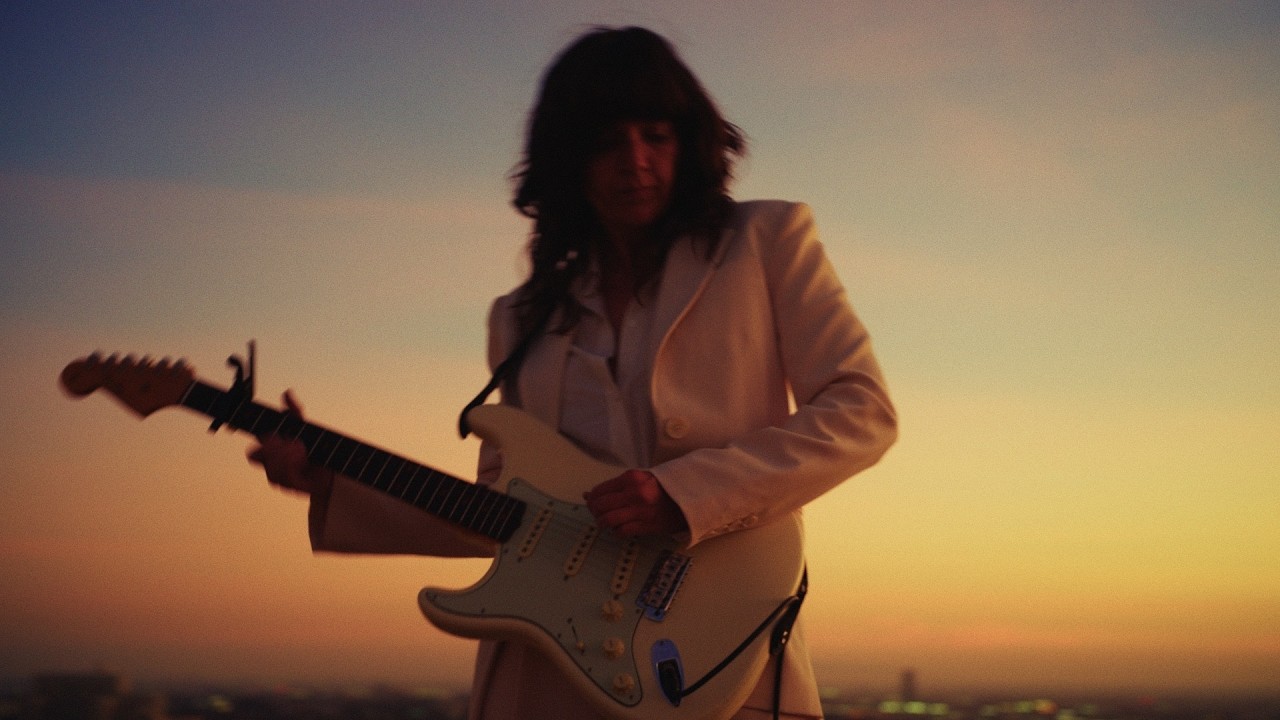
Studio footage shows you recording Sugar Plum on a classic Olympic White Fender Stratocaster, a favorite of Jimi Hendrix – but you’re usually seen with a sunburst Jaguar. How do the tones compare?
I’ve had a few Stratocasters over the years, but I’ve never played them live. I always go back to the Jaguar. It’s such a workhorse; it does everything I want. I forget when I got the Strat, but I did some writing on it. I was set up making the demo for Sugar Plum, and that's probably the guitar I had here. I ran it through my Roland JC-40 with the chorus on.
We also spotted a Boss Digital Delay, a Fulltone OCD, and an MXR Micro Amp on your board.
Someone gave me the OCD years ago – it’s always been a good multi-step overdrive. In the studio I mix things up a fair bit, but I definitely used that, the Roland Jazz Chorus, the Avalanche Run Stereo Reverb, and an EF-P3 Chorus Vibrato Pedal. John Congleton’s studio had some fun pedals lying around.
You’re heading out on a huge North American tour soon. How will you translate the record to the stage?
The nice thing is we recorded these songs as live as possible, with very few overdubs. Usually, you rehearse the songs and think, ‘How are we going to play this thing?’ But we got together and it already sounded good. Songs like One Thing At A Time with big guitar moments will be really fun to play live.
- Creature of Habit is on sale now. Barnett’s latest tour commences on March 28.

