




Whether you call them beginners’, budget, entry-level or student models, the stigma of low-cost guitars has diminished significantly – and perhaps even disappeared – over the past 25 years.
Thanks to rapid advancements in guitar building technology and knowhow, the gap in quality between an affordable guitar and a high-end professional instrument has become narrower than ever.
In fact, many pros today proudly perform on stage with budget guitars and are increasingly attaching their names to a new breed of affordable signature models.
The concept of a budget-model guitar is nothing new. American guitar companies started offering instruments with basic features and relatively austere designs at reduced prices as far back as the Great Depression in the late 1920s, if not earlier.
During the early years of the solidbody electric guitar, models like Gibson’s Les Paul Junior and Fender’s Musicmaster provided good value by maintaining professional playability while stripping their features down to the bare essentials.
However, most companies were (and still are) hesitant to introduce low-cost models that could adversely affect perceptions of the brand’s overall quality. One way to avoid or lessen this is by establishing a secondary or “B” brand.

For example, when Gibson moved the production of Epiphone guitars from Kalamazoo, Michigan, to Japan in the early ’70s, Epiphone primarily became a budget brand.
Oddly enough, even though the Japanese factory that made Epiphone guitars also built “lawsuit” model copies of Gibson guitars (and Fender, Rickenbacker and other American brands) that directly competed with Gibson, no-one at Gibson or Epiphone thought it might be a good idea to offer the Japanese copies themselves as an alternative to their more expensive Gibson counterparts.
Instead, the instruments Epiphone sold and marketed in the U.S. had designs based on previous Wilshire, Casino and other models from the ’60s or entirely new designs altogether.
This industry mentality changed when Fender joined forces with the Japanese manufacturer Fujigen Gakki, which built copies of Fender’s flagship Stratocaster and Telecaster models that Fender started to sell under the Squier brand name.
As labor costs increased in Japan, production of Squier instruments relocated to South Korea and eventually China and Indonesia, which remain the primary sources of most of today’s affordable acoustic and electric guitars.
Eventually other companies adopted Fender’s Squier approach as they were forced to increase the prices of their primary models beyond the budgets of most new aspiring players.

ESP established its LTD series in 1996, but the “B-brand” business model really started to gain momentum in the new millennium with the introductions of the PRS SE line (2001), G&L’s Tribute import series (2003) and the Sterling by Music Man brand (2008), among others.
“We started the SE series because Carlos Santana had just released the Supernatural record and was riding an enormous wave of success,” says PRS COO Jack Higginbotham. “It all started with Carlos’s desire to create an affordable, inspirational guitar.
“The original PRS SE Santana was relatively plain when compared to the products we produce today, but we emphasized the fundamentals – neck shapes, proprietary hardware and attention to detail – when it came to playability and the fundamentals of guitar building. The first priority was quality and value, the second being price.”
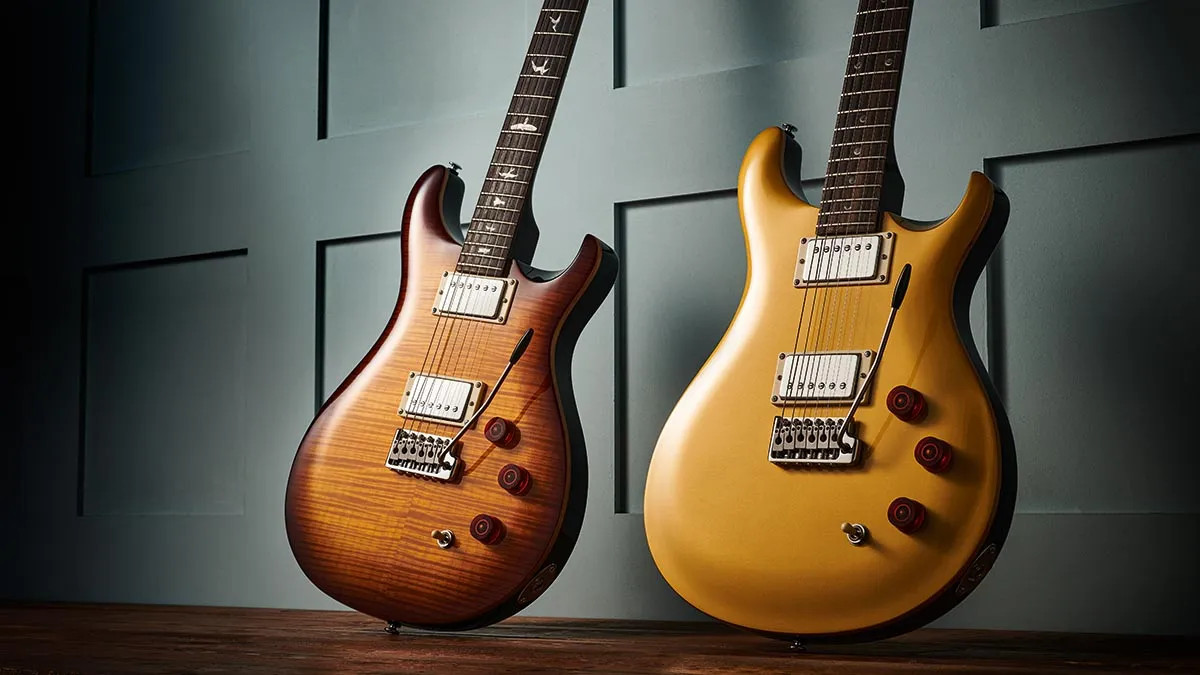
The PRS SE series has grown significantly and now consists of about three dozen different electric and six acoustic models, including Dave Grissom, Mark Holcomb, Zach Myers, and Mark Tremonti signature guitars, the highly popular SE Silver Sky designed with John Mayer, semi- and hollowbody electric guitars, and baritone and 7-string extended range instruments.
Similarly, the ESP LTD and Sterling by Music Man series guitars offer numerous lower-cost alternatives to popular models from their flagship brands.
For example, the LTD version of James Hetfield’s Snakebyte model costs $1,499 compared to the $5,699 price tag of the ESP model: the main differences are a 3-piece versus 1-piece neck, molded versus bone nut, standard strap buttons versus strap locks, and LTD locking tuners instead of Sperzel locking tuners.

Sterling by Music Man also offers a variety of models like the Axis, Luke, Majesty and Valentine that closely resemble their Music Man counterparts.
The quality of the hardware has improved so upgrades are no longer necessary, and many ship with high-quality proprietary pickups
In recent years, Fender’s Squier brand has blossomed more into its own distinct identity, offering everything from its vintage-inspired Classic Vibe series to the more experimental Paranormal series.
Unlike the somewhat ho-hum budget guitars of yesteryear, many Squier guitars now offer dazzling finishes like metallic sparkles and dayglo, and some of them have more flash, panache and personality than many standard Fender guitars.
Although these new secondary brands may be more affordable than their flagship siblings, the guitars have become more of an alternative choice than a compromise.
The quality of the hardware has improved so upgrades are no longer necessary, and many ship with high-quality proprietary pickups or models from DiMarzio, Seymour Duncan, EMG or Fishman already installed.
- This article first appeared in Guitar World. Subscribe and save.

