




Guitar World Verdict
The simplicity and classic BBD sound of the delay won the day out of the four that we tested, but the other three could all do a job for you without breaking the bank.
Pros
- +
Compact.
- +
Affordable.
- +
Easy to use and largely impressive sounds.
Cons
- -
Distortion's boost can add unwanted treble.
- -
Chorus's Level knob could be better.
- -
Reverb's parameter adjustment isn't over-intuitive.
You can trust Guitar World Our expert reviewers spend hours testing and comparing guitar products so you can choose the best for you. Find out more about how we test.
What is it?
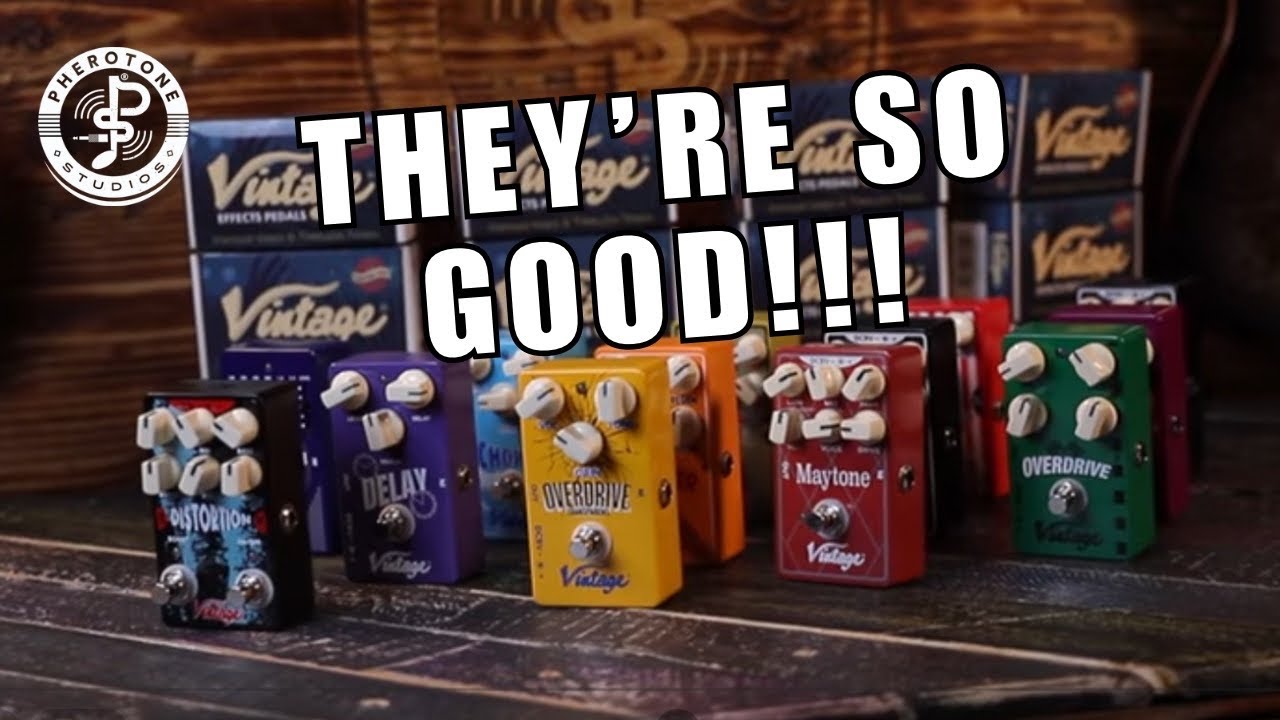
Leeds-based musical instrument distributor John Hornby Skewes & Company created the Vintage brand back in 1993 as a source of decent-quality but affordable guitars. Now we have the brand’s first foray into effects pedals with the “13 voices of Vintage”, which also has a power supply available to buy separately.
There’s a broad selection on offer here. Three of the pedals are in the amp-in-a-box genre – the Commander offering Marshall flavour, the American Pie doing the Fender thing, and the Maytone channelling Vox AC30 tones. These three are six-knob pedals with three-band EQ and control over voicing as well as Level and Drive.
Besides these, the basic food groups of dirt are represented by the Overdrive, Transparent Overdrive, Distortion and Americana Fuzz pedals. As a useful complement to any of those, there’s also the Equalizer 6-Band EQ pedal with a +/- 18dB range for each band offering transformative tonal shifts and possible boosts if you need it.
Modulation is covered by the Chorus, Flanger and Tremolo pedals, while the Delay and Reverb options complete the line-up. The Chinese-made pedals appear to be solidly put together and feature colourful graphics. They run from a nine-volt supply and there is no provision for battery power.
We don’t have the space for a full review of all 13 pedals, so we’ve taken a different approach by selecting four pedals together with the VPS09 power supply to create a practical pedalboard that costs less than that of a single boutique pedal. Okay, we are talking £244.95 to be exact, but we can think of plenty of single pedals that cost way more than that.

So, what should be on a simple practical pedalboard? Well, a dirt pedal, modulation pedal, delay and reverb would be the most obvious choices, but everyone will have their own personal take on that.
The pedalboard power supply has four fully isolated outputs – one for each pedal we’ve chosen here – but besides individual pedal cables, it also comes with a daisy-chain cable that could run several pedals from one of the outputs. And considering that each output can supply up to 500mA, there’s plenty of juice for that.
Specs
Distortion

- PRICE: $/£49
- ORIGIN: China
- TYPE: Distortion and boost pedal
- FEATURES: True bypass
- CONTROLS: Tone, Mid, Bass, Boost, Volume, Distortion, Boost footswitch, bypass footswitch
- CONNECTIONS: Standard input, standard output
- POWER: 9V DC adaptor (not supplied)
- DIMENSIONS: 68 (w) x 113 (d) x 48mm (h)
Chorus

- PRICE: $/£49
- ORIGIN: China
- TYPE: Chorus pedal
- FEATURES: True bypass
- CONTROLS: Level, Rate, Depth, bypass footswitch
- CONNECTIONS: Standard input, standard output
- POWER: 9V DC adaptor (not supplied)
Delay

- PRICE: $/£49
- ORIGIN: China
- TYPE: Delay pedal
- FEATURES: True bypass
- CONTROLS: Level, Delay, Repeat, bypass footswitch
- CONNECTIONS: Standard input, standard output
- POWER: 9V DC adaptor (not supplied)
Reverb

- PRICE: $/£49
- ORIGIN: China
- TYPE: Reverb pedal
- FEATURES: True bypass
- CONTROLS: RES, CFR, LPF, PRD (pre-delay), Mix, Decay, bypass footswitch
- CONNECTIONS: Standard input, standard output
- POWER: 9V DC adaptor (not supplied)
- CONTACT: Vintage Guitars
Usability and sounds

Discounting the three pedals that are based on amps that could also surely do the job, there’s a choice of two overdrives, plus distortion and fuzz pedals here.
While overdrive might be the preferred choice for a range of musical styles (particularly with a couple stacked together), and the fuzz could satisfy any Hendrix cravings, we’ve gone for the Distortion because it’s the only pedal in the range that has twin footswitches – a footswitchable boost to be stacked with distortion, adding flexibility.
The pedal can give you what some may consider to be an overdrive sound with its Distortion knob at zero, but any further movement of it will get you straight into thick distortion, rich with harmonics.

A three-band EQ tempers all of this with a Tone knob handling treble, alongside a Bass knob and a very potent Mid knob for hollowing things out or poking honky presence through.
You’ll need to set these carefully to get more traditional tones as there are some noticeable shifts here, and switching the boost in can get extreme – it adds spiky treble as you advance the dial. While it’s probably not a pedal that a blues player would embrace, it has a hooligan element that may win it admirers.
There’s no phaser in the range, but you do have three other distinct modulation flavours available and our choice is the Chorus pedal, described as being “based on a classic 1970s analogue circuit”. We suspect this may be referring to a Boss CE-2 (it’s a similar colour), something borne out in an A/B test with our CE-2 as the new pedal offered a similar flavour.

Besides the obligatory Rate and Depth knobs, this pedal sports a Level knob that might be better labelled as ‘Intensity’. While it mixes effect with dry sound, it doesn’t run from completely dry to completely wet, though it does add a useful extra degree of control in dialling the chorusing to your taste and getting close to vibrato at its extreme.
It’s a bit of a no-brainer having a delay pedal on your ’board, whether you’re using it for a basic slapback or a longer delay, and this one can cover just about all the likely contingencies with its maximum delay time of 600ms.
It’s an analogue BBD delay that’s easy to dial in, with a repeats trail that blends naturally with guitar tone – it’s good to know that it can easily hold its own alongside classic vintage units and more expensive offerings.

Conventionally, coming at the end of this particular chain is reverb. The pedal offers six knobs, albeit perhaps not adjusting the usual set of parameters you’d expect.
This is solid workmanlike ’verb that will do the traditional job of putting a sense of space around your sound, but it can also deliver deeper atmospheric ambiences
Mix and Decay set the amount of reverb in relation to the dry sound and the length of the reverb tail respectively, but the basic nature of the reverb is set by a Resonance knob.
This pretty much simulates room damping – turn it up for the sense of a bigger, splashier room – and you can combine it with the Pre-Delay knob that sets the size of the delay before the main body of the reverb comes in.
EQ comes as a centre frequency knob that effectively offers broad tonal shifts, and a low-pass filter that adjusts low-end warmth in the signal. This is solid workmanlike ’verb that will do the traditional job of putting a sense of space around your sound, but it can also deliver deeper atmospheric ambiences.
Verdict
Verdict: ★★★★

We welcome the fact that Vintage has expanded its scope with this set of pedals and is offering a variety of tonal options for not much outlay, plus a very practical compact power supply that will work with a variety of manufacturers’ pedals.
Guitar World verdict: The simplicity and classic BBD sound of the delay won the day out of the four that we tested, but the other three could all do a job for you without breaking the bank.
Hands-on videos
Pherotone Studios
Rich. Words. Music.

- This article first appeared in Guitarist. Subscribe and save.

