



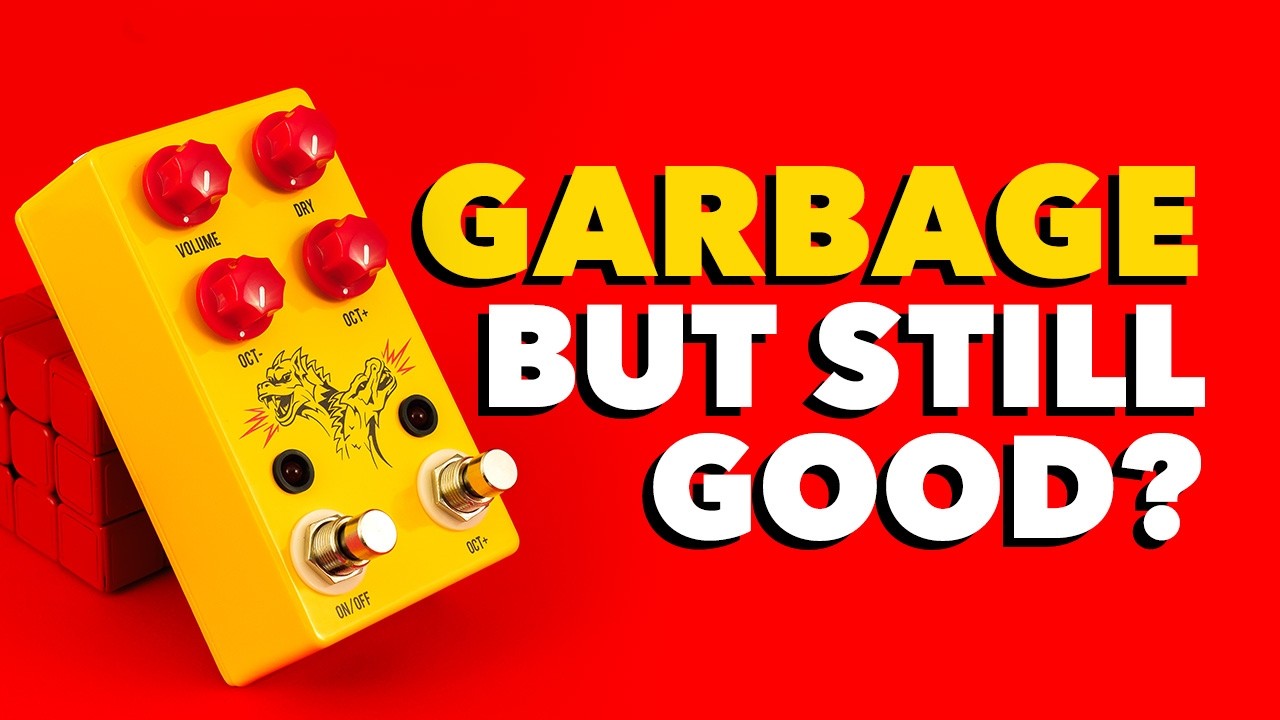
JHS Pedals is venturing into previously uncharted territory with its first-ever octaver pedal, the Double Dragon – but this two-headed beast has a different approach to fire-breathing.
Josh Scott’s firm has covered a lot of ground with its stompbox creations, from a build-it-yourself Klon copy to the John Mayer-approved, lo-fi -friendly 424 Gain Stage and beyond. The Double Dragon, meanwhile, marries that lo-fi aesthetic with an all-analog circuitboard.
JHS says the pedal is “built on the shoulders” of the 50-year-old octave-divider technology that powers the likes of the MXR Blue Box, Boss OC-2, and Electro-Harmonix Micro-Synth, for a more nostalgic take on the doubling effect.
It can thicken up single notes, but when playing chords, the “circuit starts to stutter, jump, and fight itself, making something new.” The effect is not meant to be perfect, and it’s the pedal’s imperfections, rather than flawless replications of what’s played, that give it its mystique.
Indeed, this is more than just mimicry. Like a joyous Dr. Frankenstein cackling in his laboratory, illuminated by a thunderstorm, JHS exclaims, “It’s alive!”
The lower octave provides the foundation, while the upper octave is said to land somewhere between an Octavia and a Superfuzz. Each octave gets its own independent Level control, alongside a Master Volume and Dry knob for dialing in the unaffected signal. Beyond them, there are two footswitches, with a Master On/Off on the left, and an On/Off for the Oct+ on the right.
JHS suggests pairing the Double Dragon with an overdrive pedal, mid-heavy Tube Screamers in particular, and, for the bolder among us, sticking a fuzz pedal after it in the signal chain. Adding pitch vibrato, meanwhile, makes for more synth-y sounds.
“This is a look backward at octavers,” says Scott. “Every DSP company does a really good job at a low latency, perfectly replicated up or down [effect]. I don't want to do that.

“I want to take old garbage octaves from our past and make my version of that because it's fun, unpredictable, incredibly musical, even though I hate that word. It feels like a friend you have to collaborate with, rather than a device that does what you want it to.”
It features top-mounted jacks, draws the standard 9V of power for easy popping onto pedalboards, and offers silent buffered bypass switching.
The JHS Double Dragon is available now for $179. And yes, it's suitable for bass too.
Check out JHS Pedals for more.
It arrives in the wake of the best pedal JHS has ever built (it reckons) in the Morning Glory Clean, an alternate take on the Op-Amp Big Muff concept, and the retooling of one of its most beloved signature stompboxes.

