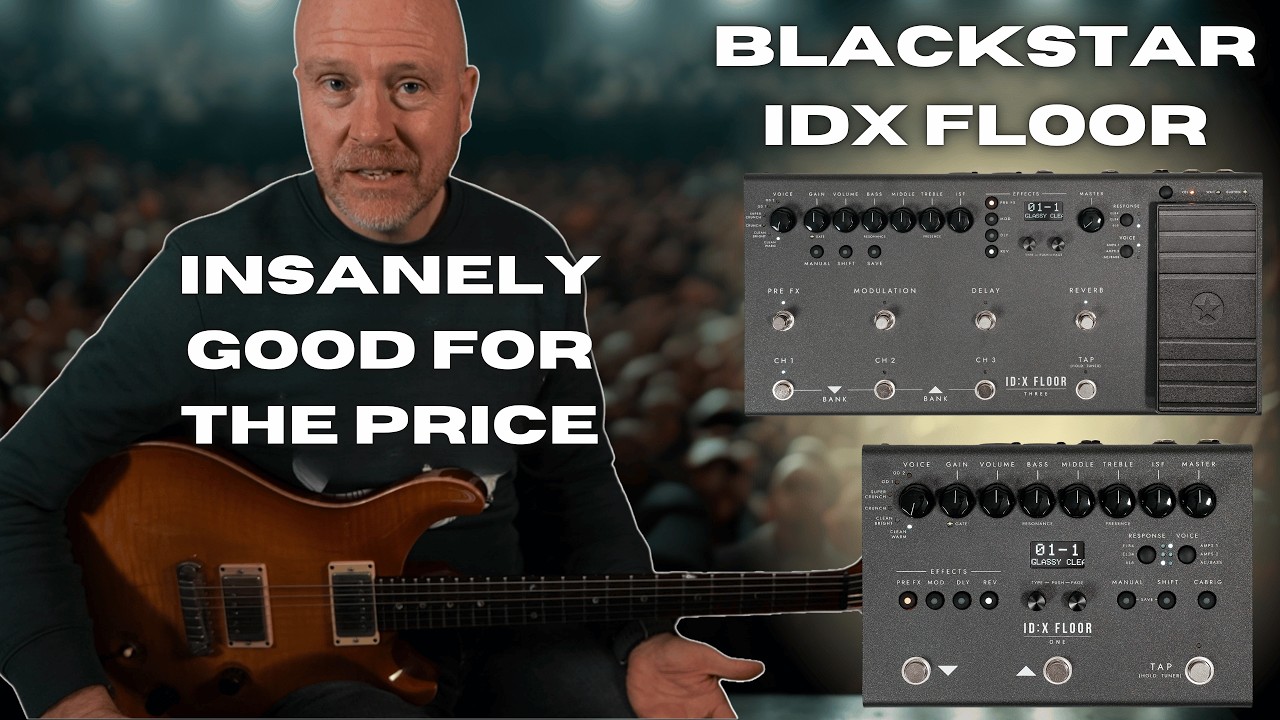
Guitar World Verdict
This is a really solid first foray into the world of digital modeler floorboards for Blackstar, which clearly has a bright future in the market. It's got plenty of good tones, a fairly easy functionality, and is nicely sized for an entry-level modeler experience.
Reasons to buy
- +
Impressive suite of tones at an affordable price.
- +
Accessible modeler experience.
- +
Other options in the range available should you want/need more.
Reasons to avoid
- -
Not sold on the footswitch design.
- -
OLED screen is very small.
- -
Patch editing isn't especially intuitive.
You can trust Guitar World Our expert reviewers spend hours testing and comparing guitar products so you can choose the best for you. Find out more about how we test.
What is it?
Everyone and their dog seems to be getting in on the amp modeler game these days. And for good reason. The future is digital. The end of the tube amp is nigh. Forget your ol’ combos and start playing a pedal that brings up a million and one guitar tones with the click of a button, or the tap of a screen…
At least, it certainly feels that way. There will also be a place for 'real' amps, but over the past 10 years, there’s been a veritable boom in the amp modeler world, one that has felt particularly apparent since the turn of the 2020s. You know the drill. Neural DSP’s Quad Cortex changed the game. Fender entered the game. Line 6 has now reframed the game. It’s a war of attrition with other far-flung brands such as Valeton, Hotone, IK Multimedia, Headrush, Mooer and more all weighing in with their own take on the humble amp modeler / capture device.
Now Blackstar can be added to the list. The British amp builder, whose recent releases such as the ultra-light St. James series and Beam Mini have earned some serious plaudits, has decided that now is the time to put its own spin on the modeler design. Enter the ID:X Floor series.
Of course, Blackstar is no stranger to floorboard rig solutions. The Amped 1 pedalboard amp received a near-perfect score from Guitar World. The expanded Amped 2 and Amped 3 continued that momentum.

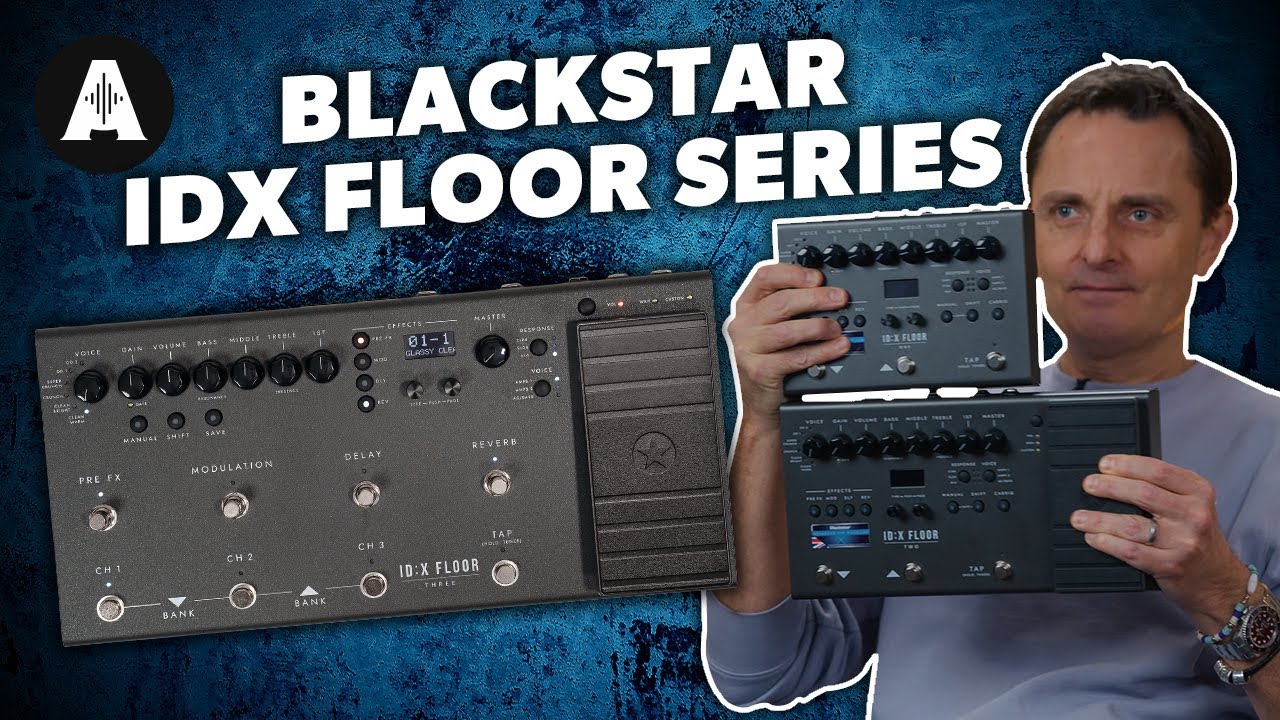
But the ID:X Floor family is a different proposition. Here, the name of the game is all about good ol’ digital guitar amp and effect emulation, with each variant – there are three different ID:X Floor pedals on offer – looking to package a raft of usable, no-nonsense guitar tones into remarkably affordable packages.
And affordability is a big selling point here. The ID:X Floor One I have here is just $269. For that, you get three amp responses, three amp options, six amp voices and four effect types to play with (35+ in total) including reverb, delay, modulation and pre effects.
Immediately, it looks like a tempting prospect, especially for those looking at the lower end of the price bracket, and with Blackstar’s backing in its corner, the ID:X Floor One has all the markings of being a potential fan favorite – or even unsung hero – in the making.
As someone who’s played and gigged with everything from the Nano Cortex, Quad Cortex mini and Helix Stadium, I was very excited to see what the ID:X Floor could do. Let’s dive in…
Specs

- Launch price: $269 | £169 | €189
- Type: Amp modeler
- Controls: Amp voice / Gain, Volume, Bass, Middle, Treble, ISF, Master / Pre FX, Modulation, Delay, Reverb / x3 tube response, x3 amp type / x3 footswitches
- Features: 99 patches, 35+ effects, 12 guitar amp models, 3 bass amp models, 2 acoustic voices / CabRig Tech / OLED display / In The Room Tech
- Connectivity: MIDI In, XLR stereo out, headphones out, Amp Out, Line In, USB-C
- Power: 9V, 500mA
- Dimensions: 215 x 68 x 155 mm
- Weight: 1.33kg
- Options: ID:X Floor Two, ID:X Floor Three
- Contact: Blackstar
Build quality

Build quality rating: ★★★★☆
I’ve had experience with the Blackstar ID:X family before – I reviewed the ID:X combo when it came out – so it came as no surprise to find out the build quality here was solid. The pedal is made from a nice, heavy-duty brushed steel-esque chassis, which has a nice weight to it. It certainly feels more expensive than its price tag.
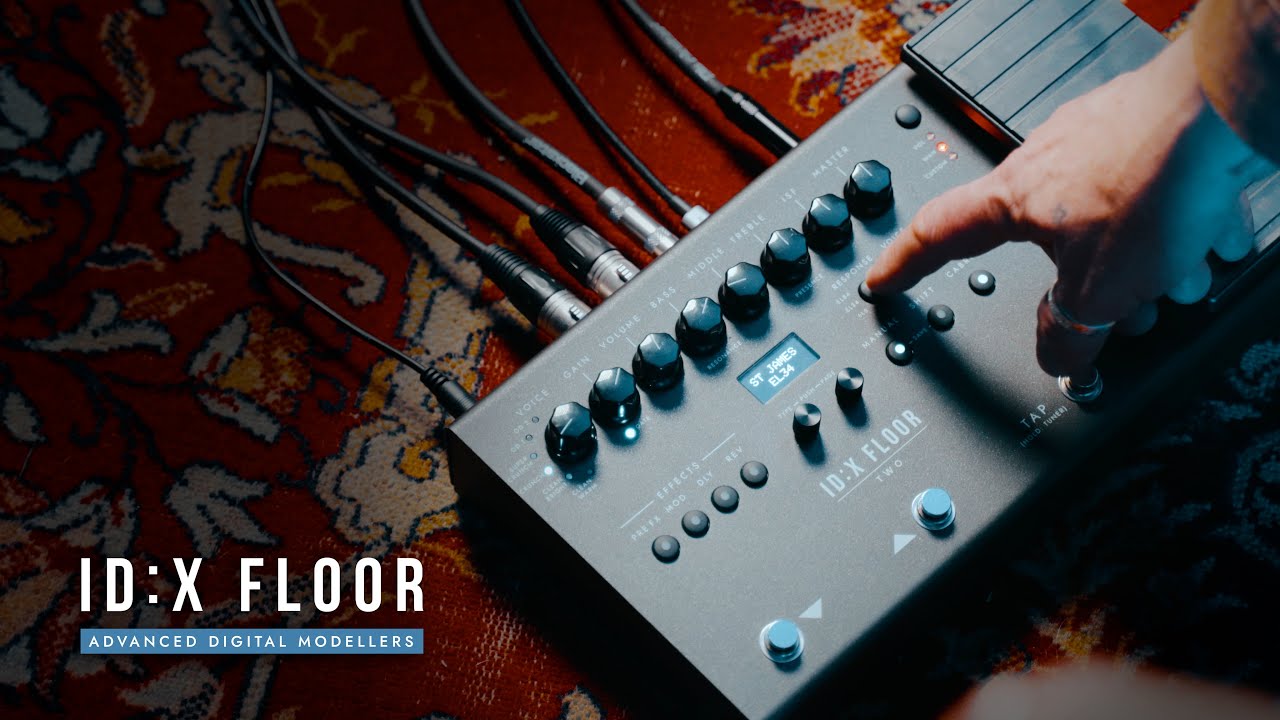
The pedal also has a nice slant, meaning the control knobs are almost tiered above the footswitches, and there are chunky rubber feet in each corner to prevent any slipping. On the rear, there are connections for stereo XLR out, MIDI in, Phones out, an input jack, and USB-C for using Blackstar’s CabRig tech – and for connecting to the Architect software for deep dive control and patch sharing.

However, in terms of practicality, because of the pedal’s dark grey color and in places tiny font size, it can sometimes be hard to decipher what’s where, especially at a distance. Using this in a dark room, perhaps even on a dark stage, would make this harder.
I have a few other nitpicks. As I’ll expand on in the next section, the footswitches didn’t fill me with confidence. The switches themselves feel quite shallow, with some especially flat switch tips, meaning stomps don’t feel especially robust.
The OLED screen is also absolutely tiny, to the point where it doesn’t really improve the user experience. There is so much information it tries to show that it almost trips over itself. Something a bit bigger would have gone a long way.
Usability

Usability rating: ★★★★☆
The ID:X Floor is designed to offer a frills-free playing experience that lets you quickly and reliably dial in good tones
Ultimately, Blackstar doesn’t do a lot wrong in this department. By its very nature, the ID:X Floor is designed to offer a frills-free playing experience that lets you quickly and reliably dial in good tones, without any menu deep-diving or option paralysis. And it definitely does that.
Straight out the box, you can select one of six amp voices from the top rotary dial. These are Clean Warm, Clean Bright, Crunch, Super Crunch, OD1 and OD2. Using a secondary select button, you can also choose between Amps 1, Amps 2, and Acoustic/Bass options.
In total, these two controls give access to 18 Blackstar-style amps, from the St. James 6L6 and Artisan 30, to the Ampton Plexi and Series One 100.
There is also a button for choosing between tube response – EL84, EL34 and 6L6 – which cover a range of Marshall-style and Fender-style valve responses. That means even more tones to explore through simply twisting a knob and clicking a few buttons – perfect for anyone looking for a tangible tone-tailoring experience.
I will say, though, I’m not sure why the LED lights that signify which response and amp is selected aren’t right next to the text, and are instead flanked by the buttons themselves. I’d have put them next to the relevant text for better clarity.

Once your amp set up is in place, there’s a familiar assortment of real-amp-like control knobs for fine-tuning, including a three band EQ; Gain, Master and Volume knobs; and an ISF control – the latter of which is Blackstar’s proprietary Infinite Shape Function (more on that later).
Below, you have buttons to trigger the effects, and two smaller dials for a) choosing which type of effect there is and b) controlling the varied parameters.
For those coming from an amp world, the ID:X Floor One isn’t that much of a step away. The controls are tangible, physical, and feel like an amp would. Those familiar with any digital modeling combo will be even more at home here.
The only issues I had with it can only be described as limitations of the format itself. The footswitches, for example, are for ‘Patch’ recalling only, and can’t be used to trigger effects. Yes, technically you could set up two Patches – one with delay, one without, for example – to get around this, but a secondary switch function dedicated to effect recall would have been nice.

But, like I say, that’s a restriction of the tiny format used here. The larger ID:X Floor Three has dedicated effect footswitches. It is something to bear in mind if you’re deciding which one to go for.
And, while on the footswitches, I wasn’t too keen on how shallow they felt. I’m fine with a soft touch switch, but these were so soft that the switch was almost imperceptible. That’s down to the fact the switch tip itself is so small. Something a bit beefier under the foot would have been nicer.
Likewise, although the tangible controls themselves are fool-proof to operate, maneuvering between Patches can be quite a chore owing to just how tiny the screen is. It’s so small, to the point where it can be quite tedious. So much information needs to be crammed onto that teeny LED screen that it can feel claustrophobic and tricky to use. Having it a bit bigger would have improved the experience 10-fold.
Nevertheless, the screen isn’t the beating heart of the ID:X Floor One, and it doesn’t overly rely on it for its tones. The mission here isn’t a world-beating UI – it’s fast, easy and great guitar tones. Does it deliver?
Sounds

Sounds rating: ★★★★☆
I’m also impressed by how Blackstar has attempted to Blackstar-ify the floorboard modeler experience
I am a sucker for Blackstar amps, and have been really impressed with every one I’ve played over the past few years. I’ve already mentioned how fond I was of the ID:X, but I’ve also played some St. James combos at gigs on various occasions. I’m pleased to say that the essence of those amps are faithfully repurposed here.
I’m also impressed by how Blackstar has attempted to Blackstar-ify the floorboard modeler experience. You get the company’s ISF control, which moves between American and British amp sounds – in Blackstar’s words, a tighter, more focused tone akin to Fenders, and a “woodier, warmer” soft crunch of Marshalls. The ISF isn’t a gimmick, and I find it to be a really helpful additional measure to tweak tones.
Not only that, Blackstar has an exclusive ‘In the Room’ voice to give (you guessed it) a room-like feel that hopes to recreate the vibe of playing an actual amp in an actual room. Again, not a gimmick. The low-ends have a nice, full feeling, and the top-ends are neatly tapered to avoid the digital-y spike that often accompanies emulations. There’s a depth there that is really convincing.

The cleans are exceptional, it has to be said, and while the crunch amp settings aren’t loaded with harmonic nuance, they can absolutely rip
Unsurprisingly, these tones aren’t world-beating for the modeler market, and it doesn’t sound quite as good as the considerably more expensive Neural DSP hardware, but there’s a lot to like here. The cleans are exceptional, it has to be said, and while the crunch amp settings aren’t loaded with harmonic nuance, they can absolutely rip. And there’s plenty to separate them, too.
As for effects, there are 35 to play with, all of which I enjoyed thoroughly. I was particularly impressed with the reverbs, which had good slap-y spring options and ambient effects alike, and the modulations, especially with tremolo and chorus. It can be a pain to dial them in using the tiny screen and effect dials, but that’s unavoidable given the size of this pedal.
Aiding the cause is Blackstar’s CabRig tech, which offers next-gen DSP speaker emulation. These, according to Blackstar, are better than your average Impulse Response, because they avoid the inherent latency and potential phase issues that come with IRs.
All in all, these are some really usable tones, with some impressively expansive control options, and I’d have no qualms with gigging with one of these.
Verdict

This, in my eyes, is an excellent option for those looking to get into the amp modeler world
This is a really solid – and sensible – first foray into the world of digital modeling floorboards from Blackstar. It was never going to be able to take on Neural DSP and Line 6. Everyone knew that. But what it decided to do instead – i.e. go after the budget end of the market with a product that punches well above its price class – is an inspired move.
And it’s paid dividends. This, in my eyes, is an excellent option for those looking to get into the amp modeler world, or for those looking for a budget-friendly modeler to add to their setup. Not only would it be up to the task for smaller gigs, it’s an ideal amp alternative for those looking for a range of tones at a really tantalizing price point.
Blackstar’s future in the world of amp modeling is really bright, and I look forward to seeing how the firm looks to develop its tech further. It has nailed the niche here.
Guitar World verdict: This is a really solid first foray into the world of digital modeler floorboards for Blackstar, which clearly has a bright future in the market. It's got plenty of good tones, a fairly easy functionality, and is nicely sized for an entry-level modeler experience.
Test |
Results |
Score |
|---|---|---|
Build quality |
Robust and nicely laid out, though the switches don't feel too heavy duty. |
★★★★☆ |
Usability |
Easy to operate thanks to the control knobs, but deeper editing requires time and patience. |
★★★★☆ |
Sounds |
Excellent amp sounds and effects for a modeler of this price. |
★★★★☆ |
Overall |
A great affordable option that provides a basic-but-noteworthy modeler experience on a budget. |
★★★★☆ |
Also try
Hands-on videos
Andertons
Blackstar
The Studio Rats