




Guitar World Verdict
The FG/FS7 Series is another success for Yamaha. It offers straightforward choice – different body woods, whether a pickup is fitted or not – in two of the acoustic market’s most popular body sizes. The sound is everything you could ask for: characterful, full and vibrant, all wrapped up in the practically faultless workmanship for which the brand is famous.
Reasons to buy
- +
The FG7 is a thoughtfully designed package.
- +
It has monstrous volume and tone.
- +
Build quality is top-class.
- +
FS7 is a neat and petite model with a great set of tones and easy playability.
- +
FS7 has a sympathetic pickup system.
Reasons to avoid
- -
The FG7's dead spot and slightly high action for fingerstylists – but we’re nit-picking.
- -
The FS7's four-piece top may deter traditionalists.
You can trust Guitar World Our expert reviewers spend hours testing and comparing guitar products so you can choose the best for you. Find out more about how we test.
What is it?
Yamaha is a company that you could say is known for its quiet innovation. Its teams have been responsible for some remarkable steps forward in guitar design over the years. But the thing is, they rarely ever shout about it.
Take, for instance, the AG Stomp preamp and microphone modeller that came out in 2001. It was years ahead of what we know as modelling today, but it became a best-kept secret among acoustic guitar players. Then there was the Silent Guitar range and, more recently, the TransAcoustic line with built-in reverb, delay and looping. We could go on, but you get the general idea.
So around three years ago when the brand released its top-of-range FG/FS9 Series acoustics, there was no flag-waving, no fanfares, and yet the range really did take acoustic guitar building into modern times, while keeping a firm hold on the traditions of the craft at the same time.
The FG/FS9 guitars were simplicity itself; they gave the guitarist the choice between concert or dreadnought body sizes, mahogany or rosewood for the back and sides, all sporting an Adirondack spruce top. And you could choose whether you had a pickup system preinstalled or not. That particular series was in a price range that hovered around the £4k mark.
Three years later we have the FG/FS7 Series with very similar thinking behind the individual models but at the lower price point of £1,800 to £2,400. There are eight models in the 7 Series, once again offering the player a choice of body size, mahogany or rosewood, pickup or no pickup and so just about all basic needs are catered for.
If you’re a living room player who enjoys smaller bodies with rosewood for the back and sides but who doesn’t need a pickup, you’d go for the FS7 R. If you’re a singer-songwriter who plays gigs and likes the firepower a mahogany-backed dreadnought guitar has to offer, then the FG7 MX is calling your name. Okay, so they all come with a natural finish and there are no cutaway models, but the basics are all present and correct.
Another thing to consider is that Yamaha has brought its decades of experience at building acoustic guitars to bear and has taken a very serious look at what the player needs from an acoustic guitar.
So The FG/FS Series has reinforced backs for greater projection, scalloped bracing individual to each body size, and soft V neck profiles that sit in the hand like they’ve always belonged there. And so on.
The models we have for review today are the FG7 R – that’s a dreadnought with rosewood back and sides and no pickup. And our other model is the FS7 MX – a concert-sized guitar with mahogany back and sides and an Atmosfeel pickup (of which, more later). So let’s consider them one at a time.
Specs
Yamaha FG7 R

- Price: $2,299 | £1,883 | €2,499
- Origin: Japan
- Type: Dreadnought
- Top: Sitka spruce
- Back/Sides: Indian rosewood
- Max Rim Depth: 125mm
- Max Body Width: 412mm
- Neck: African mahogany
- Scale Length: 650mm
- Tuners: Gotoh SXN510 Cosmo Black
- Nut/Width: Bone/44mm
- Fingerboard: Ebony
- Frets: 20
- Bridge/Spacing: Ebony with bone saddle/55mm
- Electrics: N/A
- Weight (kg/lb): 2.17/4.8
- Left-Handers: No
- Finish: Gloss body, satin neck
- Contact: Yamaha
Yamaha FS7 MX

- Price: $2,799 | £2,225 | €2,599
- Origin: Japan
- Type: Concert-sized acoustic guitar
- Top: Sitka spruce
- Back/Sides: Mahogany
- Max Rim Depth: 115mm
- Max Body Width: 380mm
- Neck: African mahogany
- Scale length: 634mm
- Tuners: Gotoh SXN510 Cosmo Black
- Nut/Width: Bone/44mm
- Fingerboard: Ebony
- Frets: 20
- Bridge/Spacing: Ebony with bone saddle/55mm
- Electrics: Atmosfeel (under-saddle pickup plus contact sensor and mic)
- Weight (kg/lb): 1.95/4.3
- Left-handers: No
- Finishes: Gloss body, satin neck
- Contact: Yamaha
Build quality, usability and sounds

Yamaha FG7 R
We should point out that both guitars come in very swish hard cases with attractive grey tweed covering, and while they are something to pause over and admire, we wouldn’t want to venture out in a rainstorm with one as they don’t look particularly weatherproof. A minor gripe, however, and the same thing could be said about Fender’s tweed cases, after all.
As one would expect from Yamaha, workmanship is sublime throughout
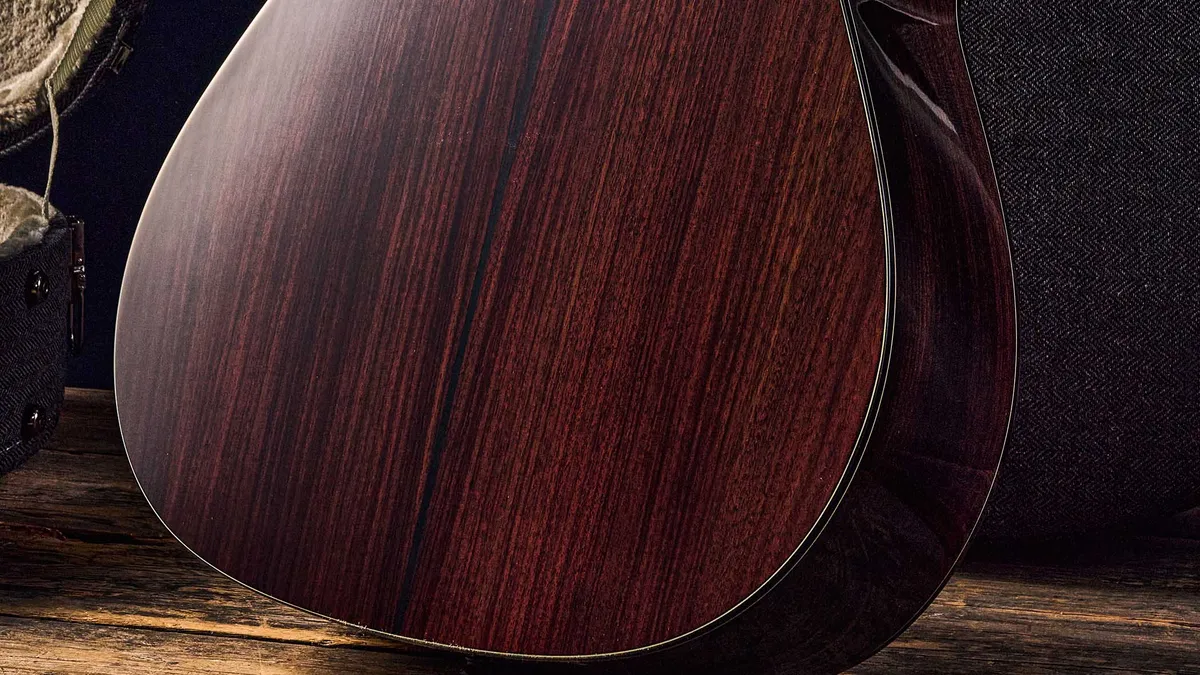
As we’ve said, the choice of back and side timber on this dreadnought model is Indian rosewood with its characteristic grain pattern showing through the guitar’s dark stain. The top is Sitka spruce, which we’re told has scalloped X-bracing under the hood.
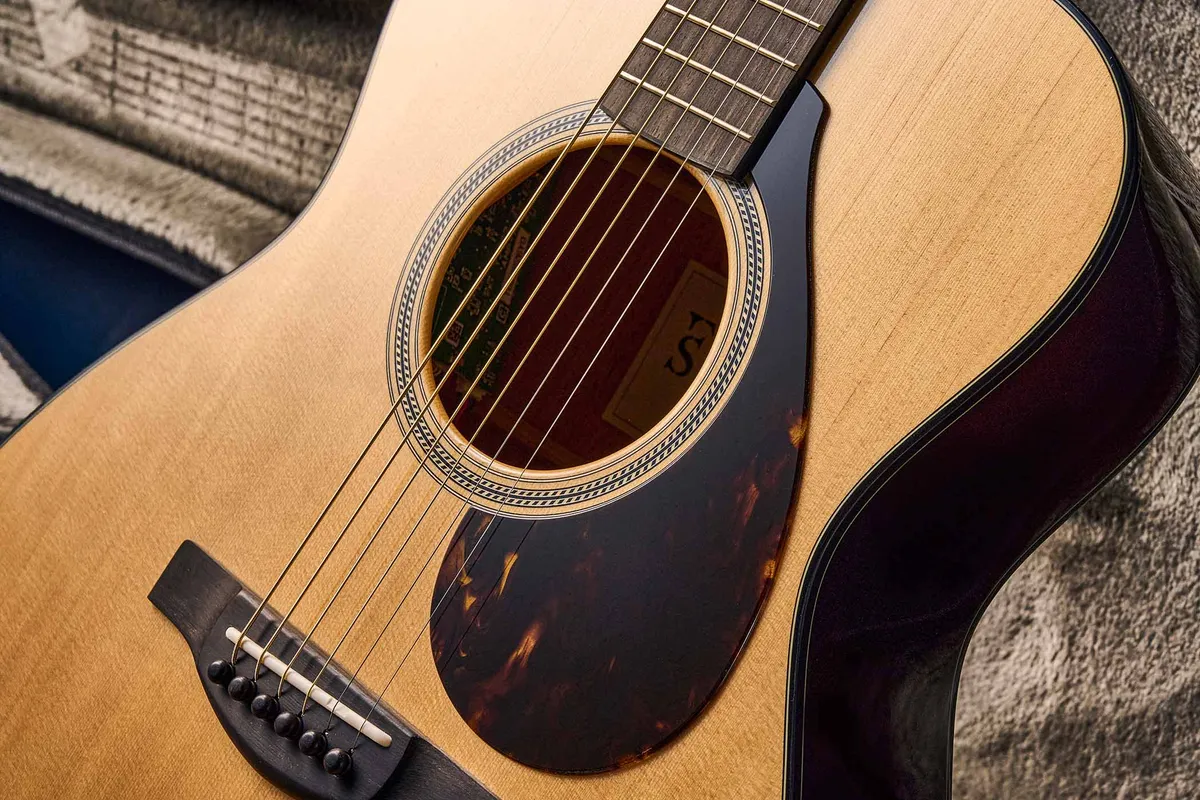
All very traditional, of course, and while we’re on the subject, there are some touches here and there on both models that reflect their Japanese heritage. For starters, the inner labels are made from washi paper, which is handmade with its origins in the seventh century.

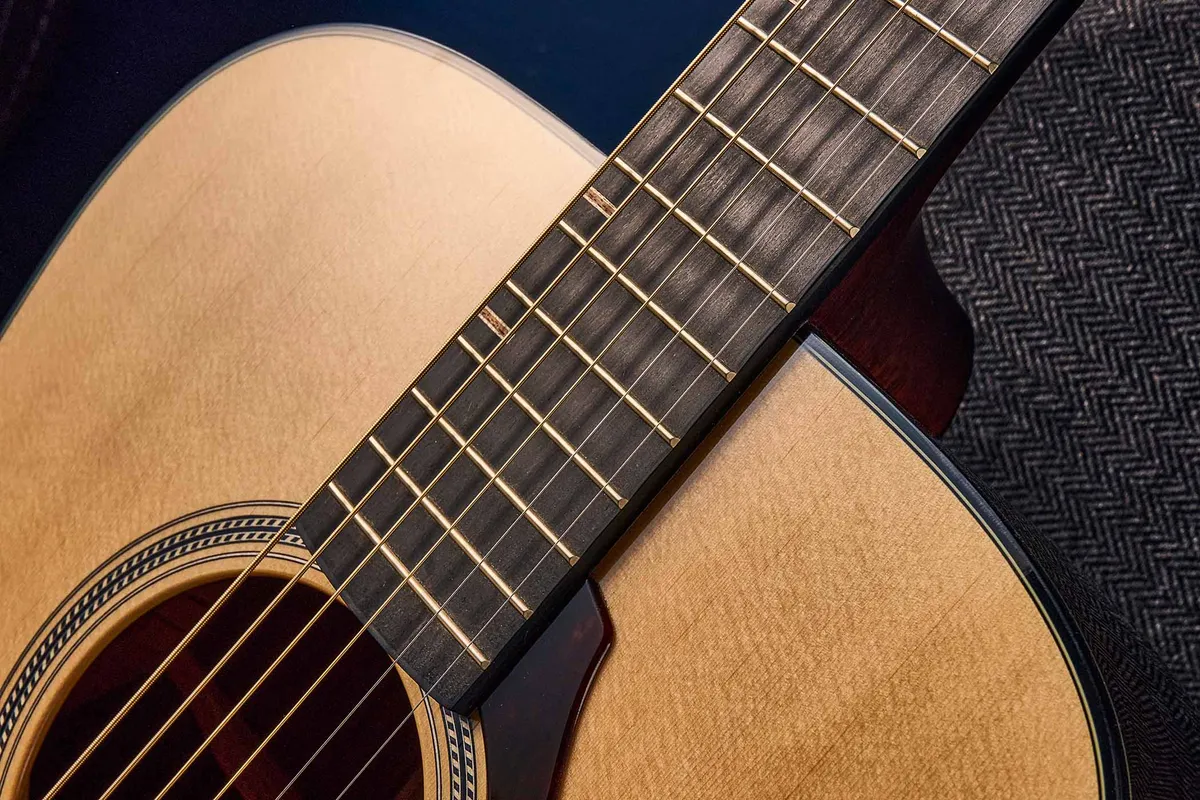
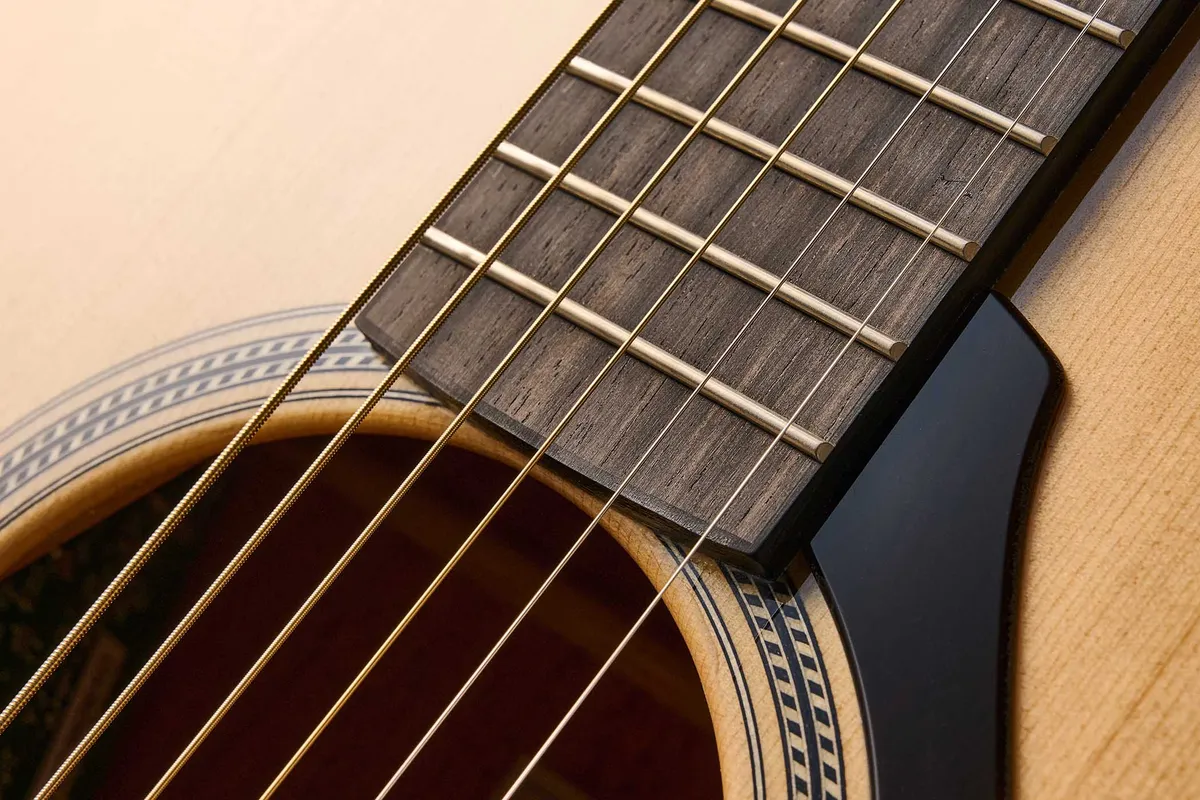
Then there are the fretboard markers that reflect the Japanese art of Kumiki – centuries old woodworking – and the rosette is designed after Shimenawa hand-braided rope styles. So you can tell that a great deal of thought has gone into the overall aesthetic of this series.
Coming back down to more basic matters, the dovetail-jointed one-piece neck is made from African mahogany and has what Yamaha refers to as a “soft V” profile. At the top there are Gotoh Cosmic Black tuners, a 44mm bone nut and an ebony fingerboard with 20 fairly narrow frets. At the opposite end of the string length there is an ebony bridge with a compensated bone saddle.
As one would expect from Yamaha, workmanship is sublime throughout, but we’ll have to wait a little to see if this instrument sounds as good as it looks while we take a look at its smaller-bodied concert-sized sibling.
Yamaha FS7 MX
As we’ve already said, the FS7 shares much the same spec as the FG as far as fixtures and fittings are concerned. It’s a different body shape, of course, which Yamaha refers to as “concert”, but to us it sits very much in the same postcode as an OM or 000. Then there’s the fact that we’re looking at mahogany for the back and sides, and there’s also a slight contrast in scale length.
While the FG sits at 650mm (25 9/16 inches), the FS measures up at 634mm (25 inches) and so you might say that the former is ‘Fender-ish’, while the latter is ‘Gibson-ish’. It might only be a 16mm deviation, but we all know how much it can change the feel of a guitar.
The FS also comes fitted with Yamaha’s Atmosfeel pickup system, with its three preamp controls on the upper bout, which will come fully into play when we move on to sound-testing both instruments.
The Sitka spruce top on the FS does appear to be a four-piece affair, as opposed to the more traditional bookmatched two-piece on the FG. While this might be surprising, it must be noted that both Martin and Taylor have experimented with four-piece tops in the past, stating that it makes little or no difference to the sound. We’ll keep an open mind and let our ears decide.
Switching back to the FG7, the soft V profile of the neck offers the left hand a comfortable ride. It’s more chunky than some Yamahas we’ve played in the past, but it’s not been overdone. The string action sits in the Goldilocks zone of being neither too high nor too low – some fingerstylists may prefer it lower, but that is a relatively easy fix for a trained tech.
The first few probing cowboy chords provided quite a surprise: this guitar is loud. Yamaha says that it’s worked hard to produce a full and robust tone from this series, and whatever the boffins have done has paid off. Not only is it loud, it’s tonefully loud, if you see what we mean.
All frequencies are fully present with very strong bass and bright, singing trebles in abundance. We did notice a bit of a dead spot on the D string’s 2nd fret on our test sample – the note E at around 165Hz – but it’s only just noticeable and didn’t become a problem during the time we spent with the guitar.
Fingerstyle is crystal clear, too, and so, if Yamaha has targeted the singer-songwriter market with this instrument, all ends are pretty much covered. It’s certainly a guitar we wouldn’t think twice about taking on a gig.
We did wonder if the surprising amount of volume from the FG would be a feature on its little brother, too, and were delighted to find that the FS can fully account for itself in that department
We did wonder if the surprising amount of volume from the FG would be a feature on its little brother, too, and were delighted to find that the FS can fully account for itself in that department. Naturally, the smaller body size means that the overall output is reduced and is a little more demure.
But, like its larger sibling, everything you need is fully present and correct. Summing up, you could say that any quality dreadnought played side by side with an OM is going to produce similar results. Furthermore, the four-piece top doesn’t seem to have any drawbacks whatsoever and so all is well there.
The Atmosfeel pickup/preamp system is governed by three controls: Mic Blend (going from full piezo at one end to full mic at the other), Bass EQ and Master Volume.


Put through our Boss Katana-50 EX on the Acoustic setting, we found the guitar’s preamp really instinctive and easy to use, and settled for the piezo to mic mix set around 60:40 per cent and the bass at just under halfway. Simplicity itself, which is precisely what you need in a live setting. The sound is very faithful to the raw acoustic output, too.
Verdict
Verdict: ★★★★½
The FG/FS7 Series is another success for Yamaha. It offers straightforward choice – different body woods, whether a pickup is fitted or not – in two of the acoustic market’s most popular body sizes.
Then there’s the sound, which is basically everything you could ask for: characterful, full and vibrant, all wrapped up in the practically faultless workmanship for which the brand is famous.
Guitar World verdict: Which one would we pick to accompany us on our next acoustic gig? It would have to be the dread because of its spirited tone and volume. Results may vary, though, so go and test drive the FG/FS Series. We think you’ll be as charmed as we were.
Hands-on videos
Yamaha
- Best Yamaha acoustic guitars: our pick of Yamaha acoustics to suit all players
- This article first appeared in Guitarist. Subscribe and save.

