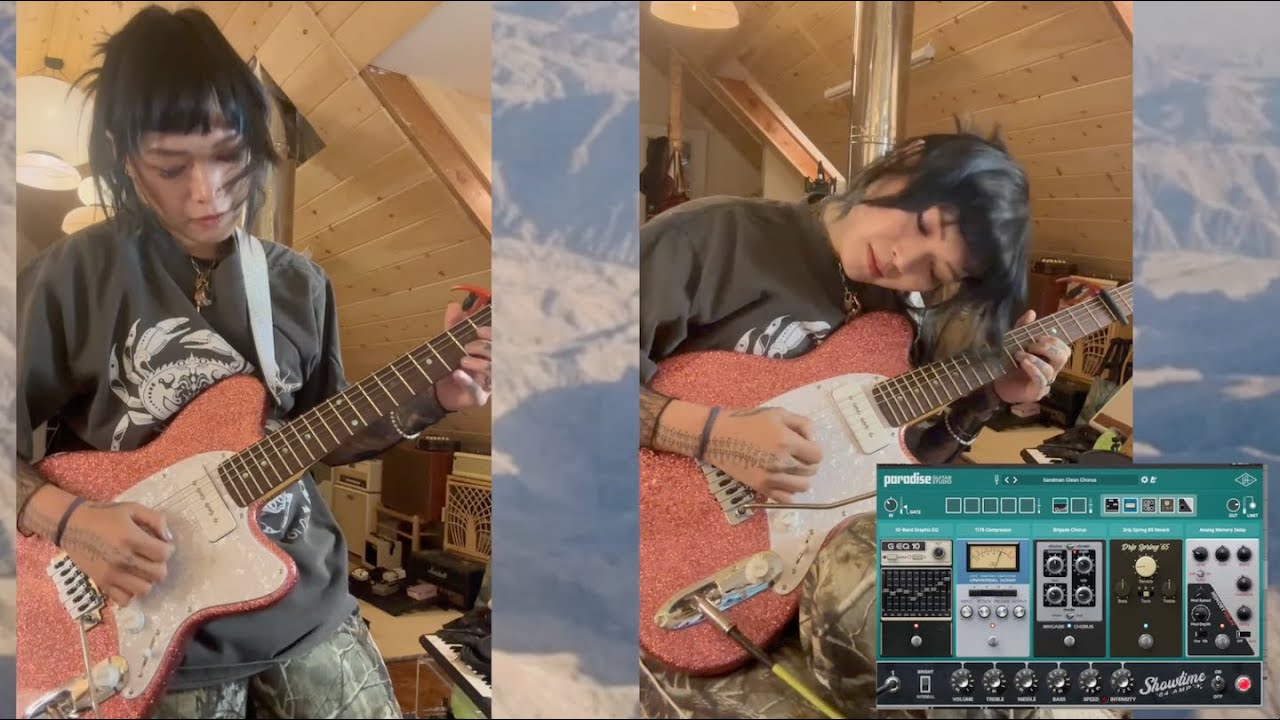
Guitar World Verdict
In terms of sounds, Universal Audio Paradise Guitar Studio delivers a utopia of modeled guitar tones that will suit pretty much any guitarist out there. The sounds are simply sumptuous, whether playing clean and ambient stuff or piling on the saturation for lead tones and heavy riffing. It won’t offer tone tweakers much in terms of the cabinets, and there’s no built-in IR loader, but if you want record-ready guitar tones at the click of your mouse button, it’s got them in spades.
Reasons to buy
- +
Models all of the classic guitar amplifiers from rock guitar history.
- +
UI is very user-friendly and easy to navigate.
- +
Lots of great preset options that will cover nearly every style and sound.
Reasons to avoid
- -
You can’t make many tweaks to the cabinets.
- -
Other plugins have a lot more amp and effects options.
You can trust Guitar World Our expert reviewers spend hours testing and comparing guitar products so you can choose the best for you. Find out more about how we test.
What is it?


Launch price: $199
Type: Plugin
Formats: Mac/PC
Amps: 11
Effects: 25
Buy at Universal Audio
Being no strangers to the world of guitar plugins, Universal Audio has thus far stuck with modeling individual amplifiers for its plugin offerings. Paradise Guitar Studio builds on that foundation, offering a modeling experience that, in Senior Product Designers James Satiago’s words, will “make any guitarist feel like they’re playing in a dream studio”.
That means 11 vintage and modified tube amps, 35 cab and microphone options, and 25 effects, including some of UA’s studio staples like the 1176 compressor, Lexicon-style reverb, and tape delay. There’s now a built-in guitar tuner, which was notably absent from their previous offerings, and 300 presets that cover rock, blues, indie, metal, and loads more.
Specs

- Launch price: $199
- Type: Plugin
- Formats: Mac/PC
- Amps: 11
- Effects: 25
- System requirements: macOS Big Sur 11, Monterey 12, Ventura 13, Sonoma 14, Sequoia 15 and Tahoe 26, Windows 10 or Windows 11 (64-bit editions), Intel, AMD, or Apple silicon processor, Internet connection to download software and authorize UAD Native plug-ins (UADx), Free iLok account, Compatible with iLok USB (2nd generation or higher) but not required
- Plugin Formats: VST 3, AAX Native, 1-10GB space, 100GB recommended
- Contact: Universal Audio
Usability

To install Paradise Guitar Studio you will also need to download the UA Connect software, which houses all of UA’s Native plugins. The install time was rapid for me, but it may differ depending on your computer’s specs and the rapidity of your internet connection. For my testing I used my MacBook Pro M3 and my preferred DAW, Pro Tools.
If you’ve ever used any Universal Audio plugins previously, then you’ll easily be able to navigate your way around the interface. Presets are accessed by clicking on the text at the top of the window, which opens a separate, movable, and resizable window that allows you to navigate through the presets using various filters. To the left of this is the guitar tuner, and to the right some additional settings like stereo inputs and tempo syncing to your DAW.

Woodrow '55 - based on 1955 5E3 Fender Tweed
Ruby '63 – AC-30 Top Boost
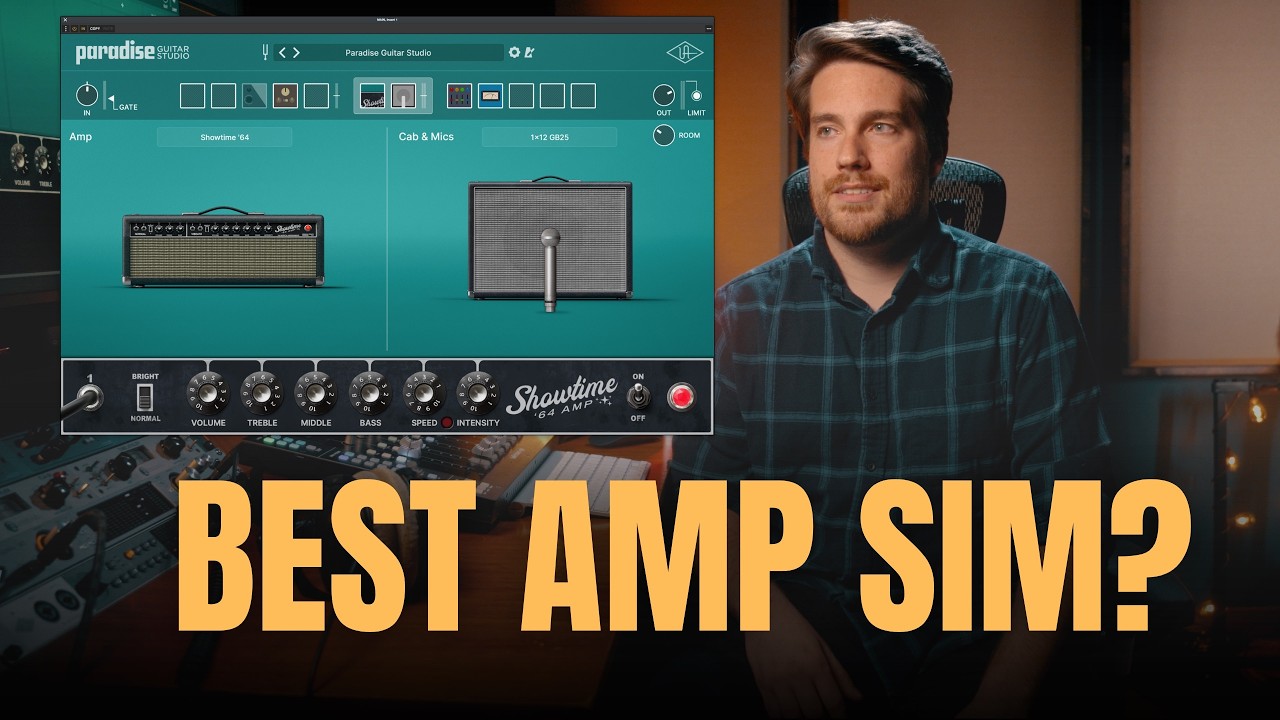
Showtime '64 – Fender Showman
Dream '65 – based on 1965 Fender Deluxe Reverb
Lion '68 - Marshall Super Bass, Super Lead and Brown (modded EVH-style Super Lead)
Enigmatic '82 Overdrive Special - based on Dumble Overdrive Special with Suede, Silver, Cream and Black amp variants
Clicking through to the preset window, some of these are genre-based, for example rock or metal, whereas others are more about the textures of the sounds, like warm, dark, or bright. You can search via text, and you can favorite presets too, which I’m always massive fan of in any software. Overall, it’s very intuitive to navigate, and even though it doesn’t look visually impressive, for me the UA preset browser does the job.
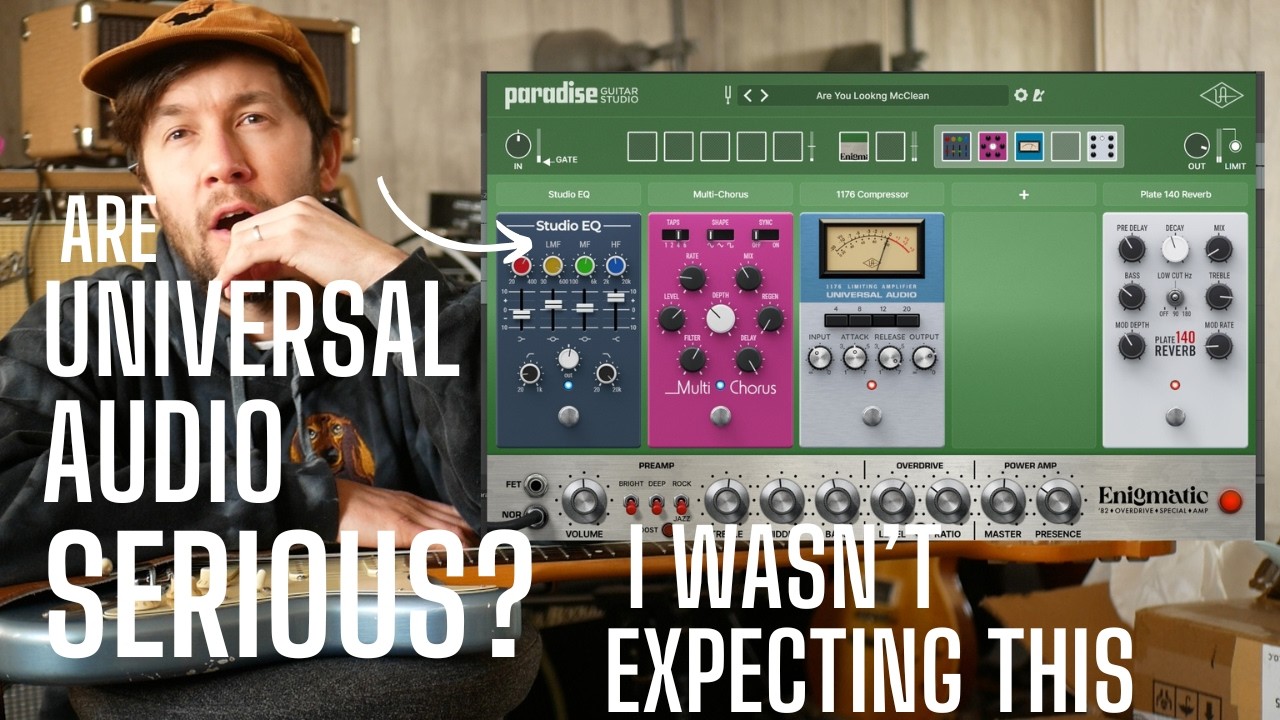
Your signal chain is presented just below the preset name, in a block format that will be familiar to most guitarists. The input stage features a dedicated gate, and a volume knob to set your incoming signal. You then have the option for five different blocks in the pre-amplifier section, the entirety of which can be deactivated by clicking the circular button in the top left, and it has its own dedicated volume control.

Next up is the amplifier section, which features a single block for amp and cab each, again with the ability to deactivate and an individual volume control. There’s no option to run a dual amp setup within the software, but you can easily achieve this effect by running two tracks in your DAW. Finally, we get to the post-amp effects section, which again has five blocks where you can place effect modules. The output features another dedicated volume knob, as well as a limiter.
Adding effects to the preset is just a case of double-clicking on the particular section you want to adjust, which opens up a new window that lets you pick your devices. There are no limitations on where you can place them either, so if you want your reverb before your fuzz pedal, you can do that. One thing I do find here is that it’s not so easy to remove a block once you’ve added it; you have to navigate back to the ‘none’ block at the start of each menu, which gets a little tiresome when auditioning sounds.

Although the headline number is 11 amplifiers, in reality it's actually six core sounds, five of which have been represented in UA’s individual plugins and one which is new to the software world, the Enigmatic ‘82. Each amp has several variations, as well as the ability to make deeper changes to the circuits themselves via changing tone stacks, bright caps, or just utilizing the different channels each amplifier has. The basic amp controls are also always visible at the bottom of the window if you need to do quick edits.
The cab models are set in stone however, so there aren’t tons of tweaks you can make here. The mic choice is pre-ordained for each cabinet, with the only real change you can make to this portion being the amount of room sound you hear. That might be a dealbreaker for some, but you can also remove the cab entirely if you want to use your cab loader of choice or another software with 3rd party impulse responses.
Sounds

Grabbing my favorite Telecaster and plugging straight into the Hi-Z input of my audio interface, I set about demoing some of the tones to see how they compare to the myriad other software I’ve tested from Line 6, Neural DSP, Positive Grid, IK Multimedia, and others. Taking a scroll through the presets, my eye is immediately drawn to the appealingly titled ‘Big Mean Green’ preset.
It’s nicely reactive to pick attack and the volume control of my guitar
It’s a Marshall-based tone with a 4x12 cabinet and a Nobels overdrive pedal at the front of the amp. I quickly deactivate the delay and reverb modules as I want something tighter, which delivers a pleasingly distorted rhythm tone. It’s nicely reactive to pick attack and the volume control of my guitar, and I’m surprised to not have to make any adjustment to the built-in gate when messing with the volume control.
Heading to the ‘Ambient’ tab of the preset browser, I click ‘Clean JBF Analog Ambi’, which delivers a first impression of the Enigmatic model. Having reviewed the Universal Audio Enigmatic 82 Overdrive pedal, I sort of know what to expect here. It’s not too dissimilar to the archetype Fender clean, with plenty of low-end and a sparkly top. It retains a lot of clarity even when I switch to the series circuit on my guitar, giving me plenty of fatness without losing any articulation.

I find myself playing for well over twenty minutes on just this particular preset
With this preset, I get a nice sense of the stereo spread too, thanks to the combination of a 57-style dynamic mic and 414-type condenser alongside the micro pitch delay and a spring reverb. The delay ping pongs around to each side of my headphones, while the core amp tone feels more like it’s sitting in the middle of the stereo field. It’s a beautiful tone, and I find myself playing for well over twenty minutes on just this particular preset.
Moving on to some lead tones, I dial up the obviously Gilmour-inspired ‘Comfortably Sustained’, which utilizes the latest of UA's individual plugin releases in the Showtime 64 amplifier. The tones are absolutely monstrous, aided by both a compressor and Big Muff clone in the front end to lead to some suitably epic lead sounds. I’m straight into big bend territory, eking out every last ounce of sound through vibrato, and no doubt pulling some funny faces throughout.
Verdict

Universal Audio’s Paradise Guitar Studio is a welcome addition to the UA guitar lineup, offering a usability that’s more in line with what Line 6, Positive Grid, and IK Multimedia have been doing for a long time now. The sandbox of great guitar amp tones and a range of effects is pulled off in typical UA fashion, delivering a stunning sound quality that’s easily the match of any other guitar plugin out there.
I couldn’t help feeling it would be nice to switch out mics or change the angles and distances as I can in other software
There are fewer options than others in terms of both amp and effects sounds, and particularly the cabinet section of the plugin. During my testing I couldn’t help feeling it would be nice to switch out mics or change the angles and distances as I can in other software, so this is one place it falls short in comparison to other guitar plugins I’ve tried. The lack of an IR-loader also feels like a bit of a miss for me, as these are getting more and more popular amongst guitarists.
Guitar World: In terms of sounds, Universal Audio Paradise Guitar Studio delivers a utopia of modeled guitar tones that will suit pretty much any guitarist out there. The sounds are simply sumptuous, whether playing clean and ambient stuff or piling on the saturation for lead tones and heavy riffing. It won’t offer tone tweakers much in terms of the cabinets, and there’s no built-in IR loader, but if you want record-ready guitar tones at the click of your mouse button, it’s got them in spades.
Also try
Hands-on videos
John Nathan Cordy
Steve Kinney
Yvette Young