Guitar World Verdict
Some of the usability could be an issue for players wanting to use the Floor Three as a live rig, but I can foresee that many will be swayed by the excellent quality of tones on offer, with amp and cab models that surpass some expensive units from bigger brands. While it’s lacking a little in terms of features and number of sounds versus something like the Boss GX series, the quality shines through, and fewer options mean more time playing.
Reasons to buy
- +
Simply superb amp and effects tones, on par with more expensive units.
- +
Amp-style workflow means you don’t need to use software to sculpt sounds.
- +
Additional footswitches add a lot of flexibility versus the smaller versions.
- +
Focuses on a smaller number of quality amp models, which means less option paralysis.
Reasons to avoid
- -
It’s heavy compared to other multi-effects pedals.
- -
I’m not convinced by the low-profile footswitches, which make banking up and down difficult.
You can trust Guitar World Our expert reviewers spend hours testing and comparing guitar products so you can choose the best for you. Find out more about how we test.
What is it?
You can’t unlock your phone, laptop, or tablet without coming across another multi-effects pedal these days. They’re the hot new product, combining amp modeler, effects pedal, and audio interface into one handy unit. With nearly every major manufacturer offering something in the space, it’s getting increasingly difficult for guitarists to choose the right one for their needs, and that isn’t about to change with the launch of the Blackstar ID:X Floor Three.
Looking very similar to their, in my opinion, underrated Amped series of pedals, these new hardware units do away with the power amp section of the aforementioned pedal and focus on becoming the centrepoint of your rig. As modelling becomes indiscernible from the real deal, the ID:X Floor series seems like the natural evolution from the ID:X amps and Amped pedals, giving guitarists everything they need in a single unit.
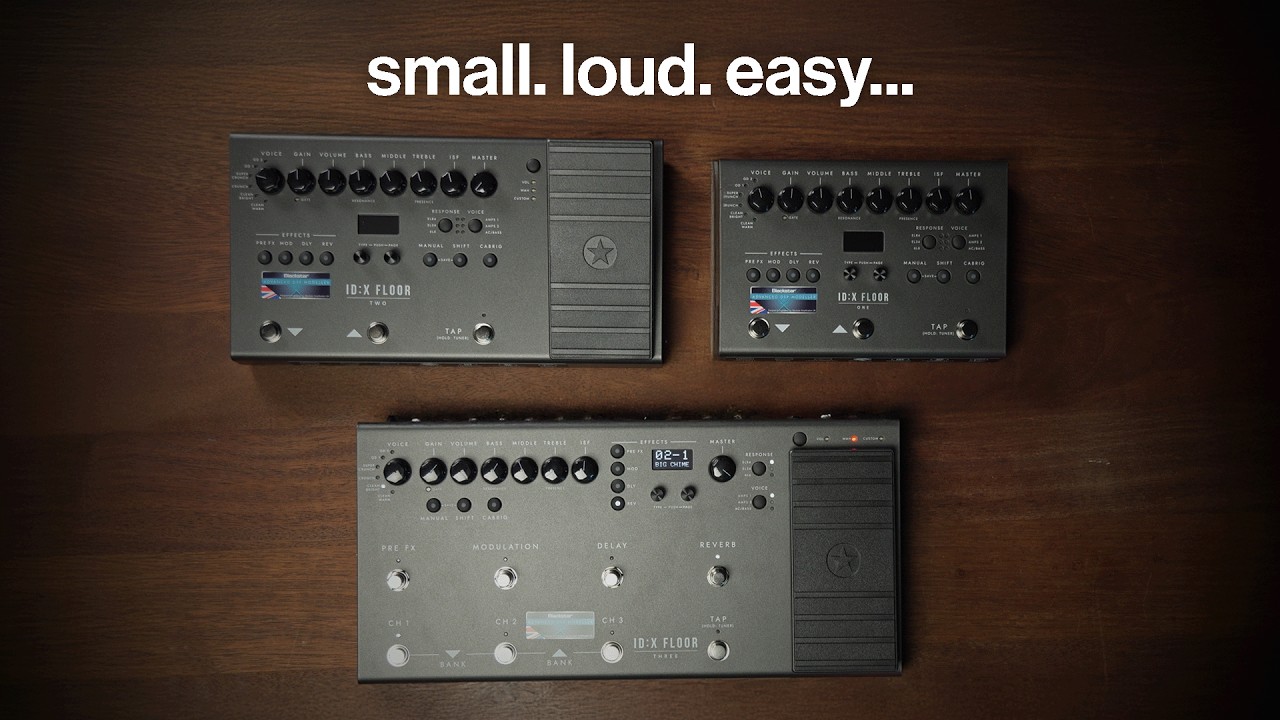
Today I’m reviewing the full-fat version of the series, but there’s also the Floor Two, which features three footswitches and an expression pedal, and the Floor One, which has no expression pedal and three footswitches. All of the versions feature the same sounds, but as you go up the range, you add flexibility with additional controls.

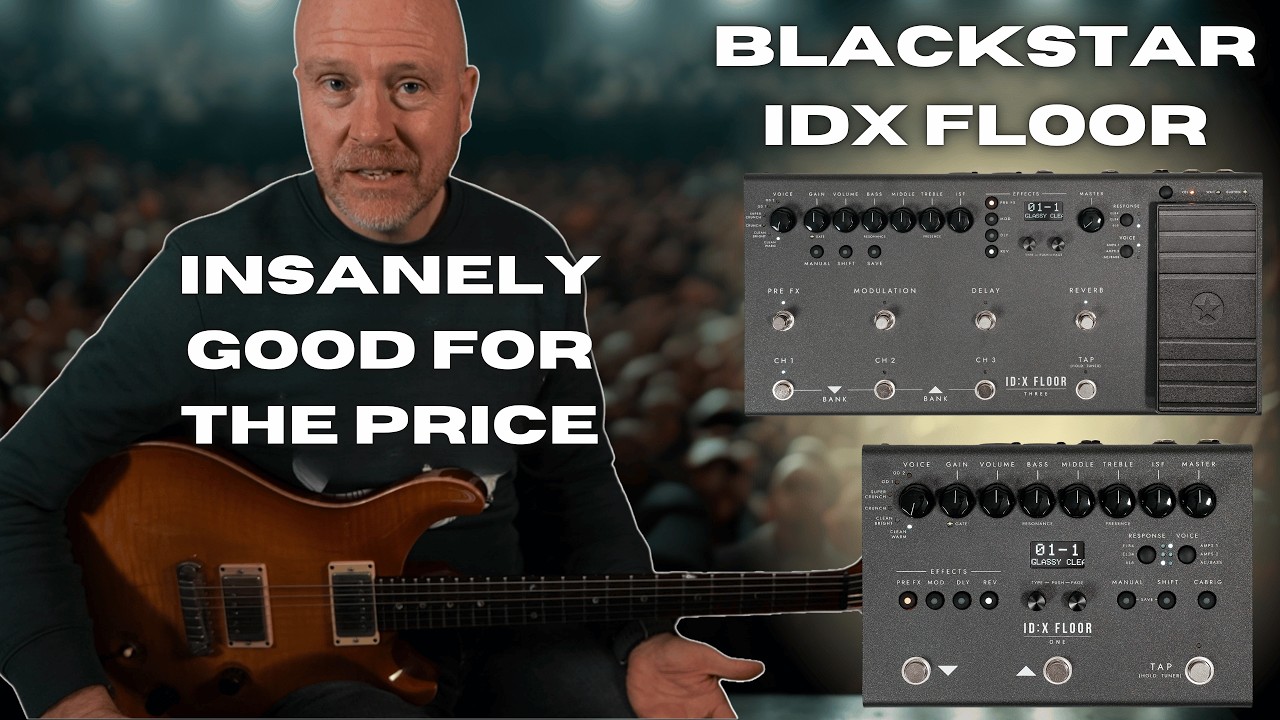
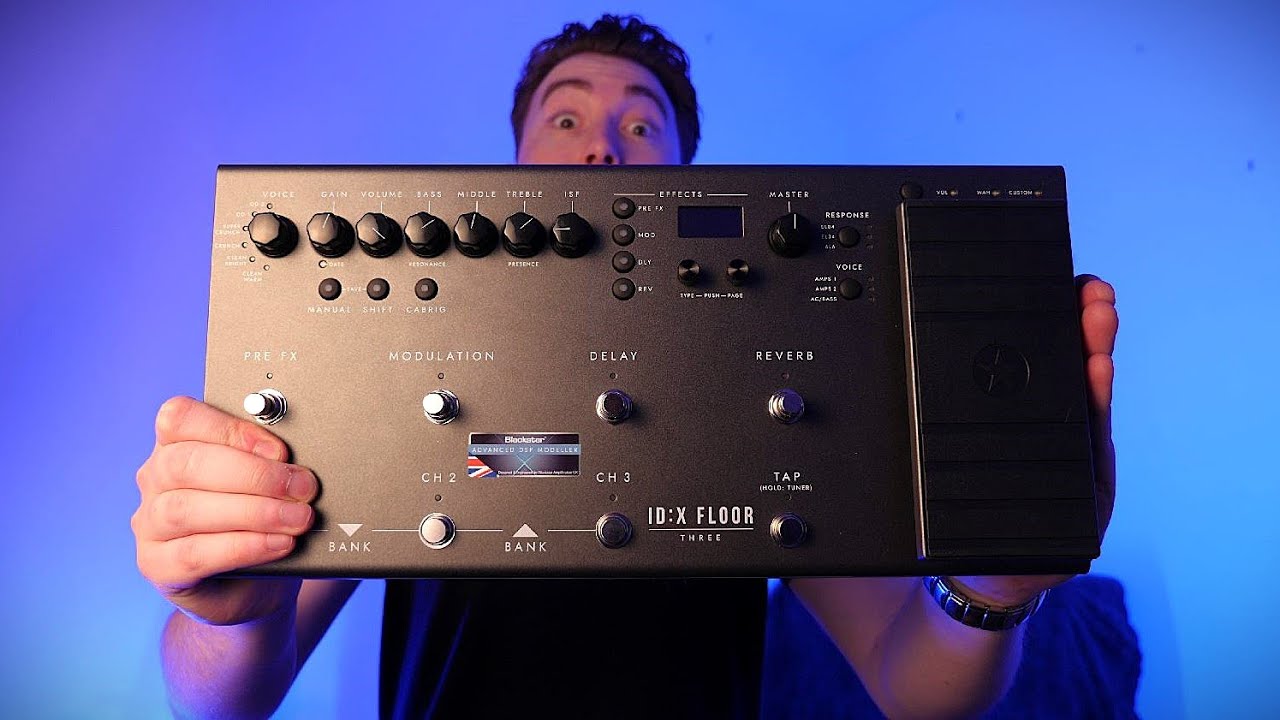
Floor Three focuses on giving you a decidedly more guitar amp style workflow, so there’s just a tiny screen offset to the right for visual cues when changing the settings of individual effects or amp models. 7 knobs deliver control over your amp tones, following a very similar path to that of the Blackstar ID:X 50 practice amp. You can select your voice with the left-most knob, before tweaking the overall tone with gain, volume, bass, middle, treble, and Blackstar’s patented ‘ISF’ control, which changes the tonality from an American to a British amp sound.
There are eight footswitches across the front of the unit, with the bottom row handling channel switching, preset banking, tap tempo, and the tuner. The upper row offers additional control for switching the pre-fx, modulation, delay, and reverb sounds. The lower footswitches are slimline and soft click, whereas the higher row is more like what you’d find on a traditional stompbox. To the right of the screen is a master volume along with additional controls for setting the tube response and further voicing options. Finally, there’s a decent-sized expression pedal, which is about two-thirds the size of my UK size 9 foot.
On the back panel, there are plenty of connectivity options, and it can be run with a pedalboard power supply-friendly 9V, 500mA power supply. A single input is joined by an effects loop, amp or FRFR cab, headphone out, and stereo XLR outputs for connecting to a PA system. MIDI in and thru allow for connectivity with additional hardware devices or integration into more complex rigs, while a 1/8-inch input offers a line in for audio devices. Blackstar’s Architect software offers a way to dive deeper into amp modeling using your laptop or PC.
Specs

- Launch price: $399.99/£279/€299
- Type: Amp modeler and multi-effects pedal
- Controls: Voice, gain, volume, bass, middle, treble, ISF, manual, shift, save, pre-fx, mod, delay, reverb, master, response, voice, 8 footswitches
- Features: Expression pedal, tap tempo, tuner
- Connectivity: Input, send, return, output, headphones, XLR (L/mono), XLR R, MIDI in, MIDI thru, line in, USB-C
- Bypass: DSP
- Power: 9V, 500mA
- Dimensions: 6.8 x 39.7 x 19.5cm
- Weight: 2.88kg
- Contact: Blackstar
Build quality

Build quality rating: ★★★★½
The heftiness implies a certain durability
The ID:X Floor Three feels surprisingly heavy as I pull it out of the box, so much so that I nearly drop it on my kitchen counter. It’s just shy of a kilo heavier than the Quad Cortex, and that’s noticeable from the moment you unwrap it. The heftiness implies a certain durability, though, which means it’s without a doubt well built enough for live performance.
The entire chassis is metal, alongside all metal footswitches, which lend it that weight. The expression pedal is plastic, but feels pretty solid with a relatively easy travel out of the box. It does have a hex key adjustment, which allows you to make it a bit more solid-feeling if you’ve got a particularly heavy foot.

The knobs are all robustly applied, feeling very similar to those on the Amped pedals, which I’ve reviewed previously. Here, there’s a nice feel of resistance to the travel, which allows for finer adjustment. Ten buttons perform various functions like saving and letting you change effects, select the tube response of the particular amp model you’ve engaged, and an additional voicing switch for reconfiguring the overall tonal quality of the amplifier, or setting it for a bass guitar or acoustic.
Overall, I have zero qualms with its ability to withstand punishment, but for players seeking a lightweight travel companion, you’ll definitely feel that weight with this thing in your backpack.
Usability

Usability rating: ★★★★☆
With the lack of a gigantic touchscreen and plentiful knobs and footswitches, it feels right to just get stuck into turning knobs and pressing stuff rather than hooking it up to a smartphone or plugging it into a PC or laptop. I switch the unit on and begin trialling the presets, but one issue that becomes apparent immediately is that it’s quite difficult for me to bank up or down using the footswitches.
From a design standpoint, having shallower switches nearer to you with the more traditionally sized ones further away makes a lot of sense, but in use, the lack of height makes it difficult to gauge what’s actually going on
I am the owner of a pair of UK size 9 feet, but the spacing between the two closest footswitches is such that it’s a bit of a gamble trying to go for it. Sometimes I successfully change banks, other times I just change to either channel 2 or 3, depending on how accurate I am. It’s also made harder because there’s not much travel with the footswitches closest to you, which carry a low-profile design similar to that you’ll find on other Blackstar gear, as well as the recent Boss GX pedals and some of their more advanced loopers.
From a design standpoint, having shallower switches nearer to you with the more traditionally sized ones further away makes a lot of sense, but in use, the lack of height makes it difficult to gauge what’s actually going on. The actual click of the footswitches is tactile enough that you know you’ve pressed them, but due to the spacing, and particularly with socks or bare feet, it’s basically impossible to hit both reliably, even when awkwardly turning my foot sideways to try and get a larger contact patch.
It’s a different story with the switches further away, which bypass or engage the effects on that particular preset. Here, I’m pretty reliably able to switch them on and off at will, which is made easier by the fact that you only need to do one at a time. Having these additional switches certainly makes it a lot more flexible than the Floor One and Floor Two models, giving you greater opportunities to tweak your sounds without having to bank up or down to a fresh selection of presets.

The channel selection can be customized for more subtle changes, like clean, crunch, and drive tones from the same amp, or you can go for completely different tones if you like, say a Fender-type clean, Marshall-inspired crunch, then a high-gain lead preset. The switching is close to seamless, but there is an ever-so-slight gap when you press through the banks and channels. With a well-timed strike, I’m able to get it feeling pretty good, but it’s noticeable enough that you’ll need to be mindful of this if using the channel selection while playing live. It’s also noticeable when engaging the individual effects footswitches, so these need to be well timed to feel seamless.
Every time you make a change to the knobs, the screen displays not only where you’re moving it, but the original position it held on the preset
The ID:X Floor Three stands up well when it comes to diving into a preset and changing it. The surfeit of knobs and switches means minimal menu diving when it comes to the amp tones, and every time you make a change to the knobs, the screen displays not only where you’re moving it, but the original position it held on the preset. This is super handy if you’re moving through a lot of presets and only want to make incremental changes, as the knobs will always be in different positions depending on what you’ve got selected.
The effects can be adjusted in two ways: either by engaging with the dedicated footswitches or by pressing the appropriate button in the effects section next to the screen. Dual rotary encoders allow for changing of parameters, and pressing the encoders can access additional screens. It’s a very different feel to the immediacy of the amp tone controls, but I find it very intuitive to start jumping in and messing around. Everything is clearly labelled, and I certainly don’t need to bring out the manual to work out what I’m doing.
It’s a similar story with the CabRig portion, which also has a dedicated button that unlocks a menu to change settings. Here, I can adjust mic types, room size, and change the type of cabinet the preset is using. Finally, there’s a button for control over the expression pedal, which lets you use it as a volume pedal, a wah pedal, or to control the parameter of a selected effect, like swelling up the mix of a reverb or changing the delay time.
Sounds

Sounds rating: ★★★★½
Cycling through the presets, it’s immediately obvious that serious work has gone into crafting usable tones
For me, Blackstar has been doing an awesome job when it comes to making great-feeling and sounding amp models. I really loved the tones on the Blackstar Beam Solo I reviewed recently, and it’s no different here. With some other amp modelers, I feel a constant need to tweak, but setting up with my baritone guitar and my favourite pair of Sennheiser HD 490 studio headphones, the ID:X Floor Three just makes me want to keep playing.
Starting with, as is customary these days on pretty much every amp simulator, a classic Fender clean tone, the sound and response are just so amp-like that I don’t feel like I want to change anything. Cycling through the presets, it’s immediately obvious that serious work has gone into crafting usable tones, and whereas with so many other modelers in the price range I want to immediately reach for the settings knobs, here it’s so tastefully done that it encourages me to play more and tweak less.

Its mimicry of an amp’s ability to respond immediately to how hard or soft I attack my strings is fantastic
Switching to my Gretsch semi-hollow guitar to get a different viewpoint on the modelling, I begin laying into Grounds for Divorce by Elbow, which I’m learning for a covers gig. The response is there to picking dynamics, and it feels super natural. Its mimicry of an amp’s ability to respond immediately to how hard or soft I attack my strings is fantastic, and while the phrase ‘it cleans up nicely’ is so overused these days, it’s absolutely the case here.
The cabinet response is often overlooked when it comes to floor modelers and multi-effects pedals, and I’ve had success making an average amp sim sound a lot better with third-party impulse responses. It’s a credit to Blackstar then that for once, I don’t feel the need to switch out the already existing CabRig emulations to get something that feels and sounds more realistic to my ear.
The feel of an amp in a room is very present when played through my headphones and studio monitors, and although I didn’t have the chance to try it through an FRFR speaker, I don’t doubt that it would do the job there, too.
Verdict

The Blackstar ID:X Floor Three does a lot of things really well. I love the immediacy of control that doesn’t require endless pressing of touch screens or a smartphone app to make changes. It’s super intuitive to use, focusing on putting good sound within easy reach and ensuring that you can change whatever you want quickly and easily. I never felt I had to reach for the manual, nor did I want/need to load up the companion app to change settings. With every control accessible on the front panel, it works great as an all-in-one practice, performing, or recording unit.
I never felt I had to reach for the manual, nor did I want/need to load up the companion app
It is, however, very heavy for a multi-effects pedal, and the footswitch design on the front row makes bank switching really difficult when you’re not playing in shoes, or if you have smaller feet. There are a few gawky flaws, like the tuner being a bit unresponsive at times, the modulation sounds giving a big jump up in volume versus the other effects, but all of these could most likely be solved with a software update. If, like the big boys of the modelling do these days, Blackstar continues to update this unit; it could have something very good on its hands indeed.
Guitar World verdict: Some of the usability could be an issue for players wanting to use the Floor Three as a live rig, but I can foresee that many will be swayed by the excellent quality of tones on offer, with amp and cab models that surpass some expensive units from bigger brands. While it’s lacking a little in terms of features and number of sounds versus something like the Boss GX series, the quality shines through, and fewer options mean more time playing.
Test |
Results |
Score |
|---|---|---|
Build quality |
Rock solid, but heavy in weight. |
★★★★½ |
Usability |
Amp-style workflow is great, but bank switching is awkward. |
★★★★☆ |
Sounds |
Some of the best modeled amp tones I've heard in this price range and even beyond. |
★★★★½ |
Overall |
An awesome multi-effects pedal that gets very close to greatness. |
★★★★½ |
Also try
Hands-on videos
Cameron Cooper
Noisegate
The Studio Rats