


Jeff Buckley has long been renowned for his hair-raising vocal, but his guitar talents are overlooked by many.
Ella Feingold is one of the most respected rhythm players in the business – with credits including Erykah Badu, Silk Sonic, Bruno Mars, Jay-Z, Frank Ocean and many more.
She’s also someone who has a truly deep fandom of Buckley and – thanks to her background as an arranger/orchestrator, and friendships with many of his peers – a true understanding of him as a musician and person.
Earlier this year, Feingold put out an album Tell a Beautiful Lie With Sound, which was written and recorded in the Memphis house where Buckley lived towards the end of his life.
So, when it was announced that Buckley had been nominated for induction into the Rock and Roll Hall of Fame, we knew exactly who to turn to in order to explain his brilliance as a guitarist and a musician. As ever, it’s fair to say she exceeded the brief...
Knowing the kind of person Jeff was, I doubt he would have cared much for a Rock and Roll Hall of Fame nomination. That kind of spotlight seemed to make him shrink a little – he wore praise like an ill-fitting coat. And yet, as a fan and a musician, I feel a quiet joy watching the world finally gather around him.
The documentary It’s Never Over, his music rising again on the Billboard charts, the song Lover, You Should’ve Come Over finding new life on TikTok, and now this nomination – it feels like people are waking from a long sleep and whispering, ‘Oh. There he is.’

What drew me to Jeff most was not just his voice, but the way he absorbed other artists – not as a mimic, not as an impersonator, but as a vessel. Through him you could hear Nina Simone, Judy Garland, Nusrat Fateh Ali Khan, and Robert Plant – not as impressions, but as spirits moving through him. He didn’t memorize them; he communed with them. He distilled something essential and then reshaped it into something unmistakably his own.
I feel close to him in that way. I’ve done the same with guitarists – fallen deep into their catalogs, lived inside their phrasing, studied every inflection – and then tried to emerge carrying those influences without being consumed by them. I recognize Jeff as a student of music, endlessly curious, reverent before sound itself.
His guitar voice was singular. You can trace echoes of Robin Guthrie – hence the Alesis Quadraverb, that cavernous, dream-drenched shimmer – and of Johnny Marr, in the melodic interplay of open strings ringing through fretted notes. When he was young, he loved Rush, Yes, and King Crimson – and you can feel that architecture in his sense of scale and drama. Yet when it all converges, it does not sound like a collage. It sounds like Jeff.

Imagine him stepping onto his first tour in 1994. In an era thick with grunge pedals and scuffed distortion, he arrives with a rack-mounted shimmer more celestial than gritty. The Quadraverb was not the language of his peers – but it was his. That blooming, reverberated expanse became as much a part of his identity as his voice.
Listen to Dream Brother and you feel the trance of Qawwali music, something incantatory and ancient. Then he turns and sings Hallelujah, inhabiting the quiet ache of the singer-songwriter tradition. Elsewhere – The Sky Is a Landfill, Vancouver – there’s grease and bite, a looser, post-punk shadow flickering at the edges. He refused containment.

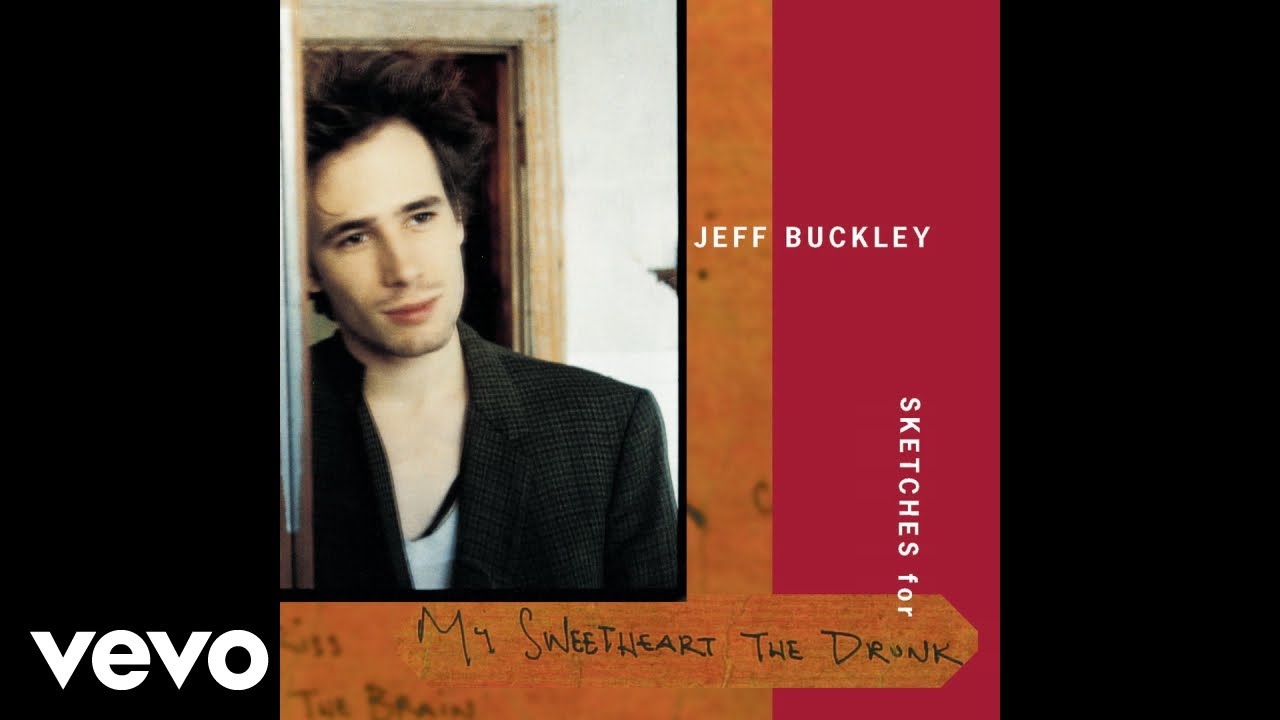
On Sketches for My Sweetheart the Drunk, that tension sharpens: dry, angular, almost English-sounding guitars set against a voice that feels lit from within. And on Grace, he could place the muscular urgency of Eternal Life beside Benjamin Britten’s Corpus Christi Carol. On paper, it makes no sense. In his hands and in the back of his throat, it is seamless.
When I think of Jeff, I think of someone ancient. Not dated – eternal. As though he had been circling the earth for centuries, waiting to step briefly into a body. Jeff doesn’t feel like an artist of the ’90s. He feels like music itself, temporarily personified.
He wasn’t known as a flashy lead guitarist, but he could step into that space when he wanted. The solo in The Sky Is a Landfill is not about scales or machismo. It’s melodic, feral, unguarded. He bends notes as if they are nerves. He plays from chords, from feeling, from somewhere beneath theory. If I were ever to solo, that’s the kind I would want to take – one that feels less like a demonstration and more like a confession.
But what lingers most for me is his touch. The way he held a Telecaster. The vastness he could summon by simply brushing the strings into a Fender Vibroverb. There’s a clip of him in Frankfurt [above], opening Mojo Pin with that prelude he called Chocolate – the decay stretched into near-infinity, almost synthetic, orchestral, liquid. He’d play fingerstyle electric, barely grazing the strings, and the sound would bloom like light underwater.
Even in Hallelujah, his right hand was different – brushing upward with the flesh of his finger, not the tidy geometry of folk technique. He favored skin over precision. You hear the humanity in it.
His arrangements, too, were orchestral in spirit. He understood strings, harmony, texture. He studied deeply – he went to GIT in Los Angeles – yet he wore his knowledge lightly, almost disguising it behind a blue-collar humility.
Vancouver, in open D tuning, layered with 12-strings and shimmering intervals, feels to me like a high-thread-count tapestry – dense yet breathable. He knew how to choose colors. He knew when to leave notes out. Sometimes he would voice only three notes of a chord, letting another guitar or a drone imply the rest. The absence created longing. The silence was part of the harmony. There is a seduction in that.

So Real, co-written with Michael Tighe, feels almost European in its harmony – carousel-like, impressionistic. Though rooted in blues and minimalist influences, to my ear it brushes against Ravel or Satie – something delicate, slightly surreal, and not quite of its decade.
He played guitar like an orchestrator, arranging in real time around his own voice. He knew how to keep the instrument from eclipsing his voice. The Telecaster through a Quadraverb became his orchestra – answering phrases, laying pads beneath long notes, swelling and retreating like breath.
His legacy hums beneath artists who followed. You can hear traces of him in Radiohead’s Fake Plastic Trees, in early Coldplay songs like Shiver and Yellow. But what endures is not just influence – it’s humanness.
On his recordings, you hear everything: the pick against the string, the toggle switch click, the reverb bloom. His Telecaster’s microphonic pickups let the world leak in — amp buzz, breath, movement. Nothing was polished away. It was vulnerable, exposed. It was Jeff – goofy and sacred, sensual and searching, never hiding.
And in the end, perhaps that is his greatest gift. In New Year’s Prayer, he sings, “Feel no shame for what you are.”
That feels like the thesis of his life.
Ella Feingold
The Berkshires, 2026
- Ella Feingold’s album Tell a Beautiful Lie With Sound is out now.

