


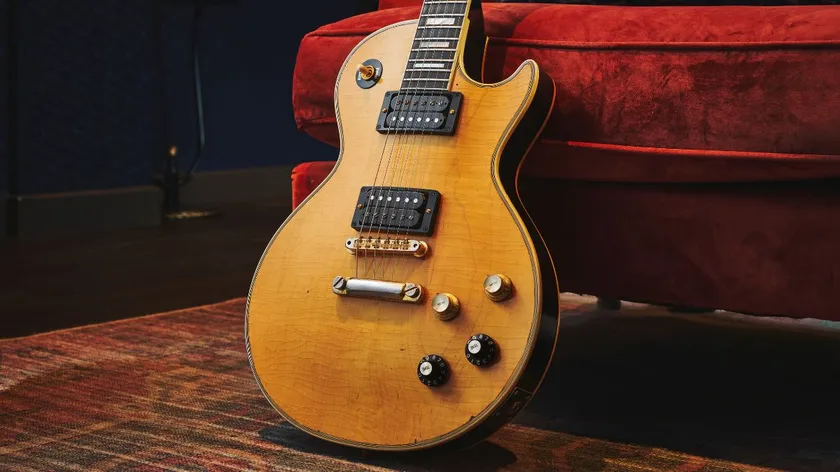


Chris Buck knows he’s caused a fuss among guitarists. There are certain things you don’t do; you don’t speak ill of Jimi or Eddie, you don’t modify a vintage guitar and you don’t talk shit about the Fender Stratocaster. But in a recent sitdown with Guitar World’s Paul Riario, the words just slipped out. Playing a Strat, the Welsh guitarist said, comes with “baggage.”
As the video made its way through the Instagram algorithm, the blowback began. “My brother in Christ, you play blues music,” wrote one commenter. “Maybe you should go play the flute,” snarked another.
The Cardinal Black guitarist watched this all go down with some chagrin. “I’m getting a lot of love on socials at the moment,” he says. He knows he didn’t make his point as eloquently as he would’ve liked. It’s not like he even dislikes the instrument; his first guitar was a Squier Telecaster, but as a lover of players like Stevie Ray Vaughan, Jimi Hendrix, Eric Clapton and Ritchie Blackmore, he had originally wanted a Strat.
He was only talked out of it by his dad, who encouraged him to stand out from the other kids taking lessons and showed him pictures of Keith Richards and Bruce Springsteen to drive the point home.
He didn’t say anything especially terrible. Strats do have a particular sound, and that sound is associated with certain artists. Buck, however, wants to forge his own sonic path, and that’s exactly what he’s doing with the launch of his new signature Yamaha Revstar.

While the guitar got its formal launch at the 2026 NAMM Show, its development began half a decade ago. In 2020, Buck was picking up his first Yamaha custom-shop guitar. Once again, there was a familial connection, as his father had an SG1000 “that was heavier than my car,” Buck says.
“There was kind of a little bit of an association already there with Yamaha, and I just fell in love with the Revstar for the fact that it was different and it wasn’t obviously derived from your T-type, S-type, Les Paul or whatever. There were hints of other guitar models in it, but it was fundamentally fairly unique.”
That uniqueness doesn’t come with a bunch of fancy doohickeys and doodads. Rather, it was the guitar’s simplicity that spoke to him – two pickups, a three-way toggle, a master tone and a master volume. In the course of designing his custom-shop guitar, Buck did a little futzing with the electronics, wiring it up to have two master volumes, but he ultimately decided the original setup was used for a reason.

Using the basic Revstar setup as a launch pad, Yamaha let Buck run wild in their custom shop when it came time to get serious about his signature model.
He started with one of the guitars already in his possession, a black RS502 that was among the first generation of the model. He asked Yamaha to make him the same thing, but in gold, and with the inlays of the later-generation RS720.
“I wasn’t as crazy or as inventive as I could have been, which probably speaks to my personality,” Buck says.
To that end, he also opted for a more traditional wrapover tail piece. While he does admit that using a tremolo bar has crept more into his playing in recent years, that love affair hasn’t gotten to the point of wanting a Bigsby on the guitar that sports his name. A custom-shop model with a tremolo bridge isn’t out of the question for the future, however.

“When I specced my custom-shop model, I was so much in love with RS502 at the time, I essentially wanted a more custom or bespoke version of that,” he says. The infatuation led him to not mess with a good thing when it came to the woods. Once again, he figured it was better to trust the experts.
I think there’s an association that kind of dogs P-90s a little bit, because they were superseded by humbuckers. People tend to think of them as a lesser pickup
“I’ve always kind of been of the opinion that these people probably know more about guitar manufacturing than I do, so if I start trying to spec crazy, hard-to-obtain wood species from whatever part of the world, I’m probably going to make everyone’s life a misery,” he says.
“I guess there was some sort of slightly scheming parts in me that thought, ‘Well, if they’re asking me for a custom-shop model, maybe there is a plan for this in the future to potentially be more widely available, so let’s not try and totally disrupt everything and spec something absolutely ludicrous.’”
The feature that truly resonated with him, and the sound that sets him apart from the other blues rockers, is the Revstar’s twin P-90 pickups.
“I think they’re just such criminally underrated pickups,” Buck says. “I think there’s an association that kind of dogs P-90s a little bit, because they were superseded by humbuckers.
“People tend to think of them as a lesser pickup, because they hum, or they do this or they do that, but I think there’s a versatility and a transparency that you get with P-90s, which I feel is the truest reflection of the acoustic resonance or character of the guitar.”


Rather than once again going stock, Buck did get more particular when it came to which P-90s would go into his signature model. Yamaha sent over six or seven models, and, along with his more soldering-familiar pal (and Guitarist/Guitar World writer) Huw Price, began to run sonic experiments.
With the ideal pickups narrowed down, a minor tweak was made, with the magnets being swapped out in an effort to cancel out a bit of that typical hum. That’s been a necessary evil as Cardinal Black has begun playing in larger venues, and Buck’s volume has risen accordingly.
“They kind of feel like a little bit of a compromise, I guess, between that true vintage P90 thing, which I love, but also with one eye on ‘Let’s not be so vintage,’ so as to invite all of the electronic interference in the world into your signal chain,” Buck says.
“If you’re not needlessly fighting feedback at every point, P-90s can feel more inclined to squeal. These feel like a very good halfway.”

Some of the other tweaks Buck made to the Revstar have found their way into newer generations of the base models. He noted that the higher-end Professional models now come with carbon-reinforced necks to enhance stability, and all models of the second-generation Revstars are chambered.
It’s honestly surreal, especially with Yamaha’s history of signature models that tended to have been for older musicians, or what you would consider legacy artists
But all these features would be for nothing if not for the fact that the Revstar is a fundamentally beautiful instrument. After all, who wants to play an ugly hunk of junk? For now, that beauty will come in just a single variety, as all Chris Buck signatures will be in gold, the color he says he is “for better or for worse” most associated with, but the guitarist didn’t rule out a run of reds if the current model sells well.
With his career just beginning and the future bright, it’s hard to see a reality where the Chris Buck Revstar doesn’t find its way into many hands. That’s a reality that would have been hard to imagine just a few years ago, when his father was thrusting a Tele into his hands.
“It’s honestly surreal,” he says. “Especially with Yamaha’s history of signature models that tended to have been for older musicians, or what you would consider legacy artists; not young whippersnappers who still look like they’re struggling to grow facial hair. It’s just an incredible honor.”
- The Yamaha RS02CB comes with a deluxe gigbag, and is priced $2,180.For more info on the guitar, visit Yamaha.
- This article first appeared in Guitar World. Subscribe and save.

