


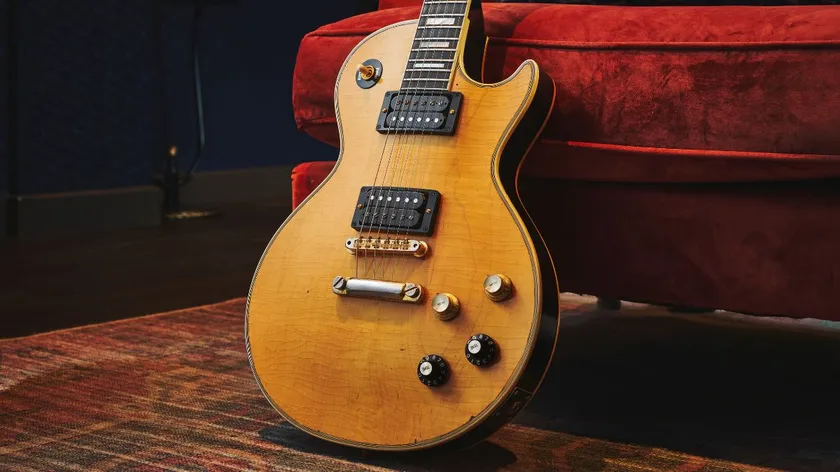


As is often the way, my latest book began with a guitar. It’s a gorgeous ’49 Gibson ES-5N, the one that T-Bone Walker played longer than any other guitar in his career. It’s not hard to see why he loved it so much – and not hard to understand why he was so distraught when it went missing during a tour of France in the late 60s.
As the years dragged on, T-Bone’s Gibson was thought lost forever. A few years ago, however, it surfaced at an auction in France. Its new owner, Patrick Racz, asked me if I’d be interested in writing a book about the guitar and about T-Bone.
I didn’t take long to answer. And so began a long and happy journey into the world of T-Bone Walker, with plenty of surprises and revelations along the way – and the ultimate realization that T-Bone was one of the greatest and most influential blues musicians who ever lived.
Electric Blues!
T-Bone’s glorious Gibson ES-5N wasn’t his first electric. That honor goes to an ES-250 that he acquired, probably in New York City, around 1940. Gibson had started to ship this new model a year earlier, and it was the company’s first professional electric archtop Spanish guitar, marking a distinct upgrade from the groundbreaking ES-150. Only around 90 were built.
T-Bone made great use of his 250, and it’s significant as the first electric he played in a recording studio. For two tracks, at a Capitol Records session in 1942 with the boogie-woogie pianist Freddie Slack and his big-band, the band was slimmed down to T-Bone and his guitar, plus piano, bass, and drums. I Got A Break, Baby and Mean Old World, credited to their composer Aaron T-Bone Walker and unreleased until 1945, were like nothing that had gone before.
Before T-Bone steps forward to sing, on each one he solos for more than a minute, playing independently of the beat, bending strings, repeating phrases for effect. None of this was standard fare at the time.

He plays double-time. He slides unison notes. He generally has a natural ball! His expressive electric playing, more like a horn player in its fluidity and melodic invention, marked a brand-new kind of blues guitar work. There are few instances in music where it’s possible to pinpoint the start of something big, but this is one of them.
During the 1930s and into the early 40s in the United States, there were a number of early adopters playing electrics, many but not all of them lap steels. I devote a whole chapter to this fascinating period in the book, but for now let’s just mention Alvino Rey.
He was one such pioneer, and his instruments – including a Vivi-Tone Spanish and an Electro steel – were probably the first electric guitars that many Americans heard when he played them on national radio, the Electro in a weekly show on NBC with Horace Heidt & His Musical Knights.
A name we all know that looms large in the story of early electric players is Charlie Christian. In 1939, Christian joined Benny Goodman’s hugely popular multi-racial swing big-band, with whom he recorded that same year the astonishing Flying Home. “Amplifying my instrument has made it possible for me to get a wonderful break,” he told DownBeat.

Remarkably, according to T-Bone, the two guitarists who would go on to define and develop the role of electric guitars in jazz and in blues were young friends who grew up together in Texas.
“We was really drop-outs,” he said in a 1972 interview. “Because we were making money, we wouldn’t go to school. We’d go dance and pass the hat and make money. We had a little routine of dancing that we did. Charlie would play guitar awhile and I’d play bass, and then we’d change and he’d play bass and I’d play guitar. And then we’d go into our little dance.”
T-Bone may not have been the first musician playing an electric guitar on disc. But with those two tracks he cut in ’42 for Capitol with Freddie Slack, what matters is what he achieved – nothing less than to show the way forward to a new style: electric blues guitar playing.
T-Bone Gets His Start

T-Bone had left his native Texas in the mid-1930s and settled in Los Angeles, figuring this was the place to make his name. And perhaps more importantly for a newly married musician in his mid-20s, LA seemed a likely base from where he might earn a decent living.
Soon he was dancing, singing, playing guitar, and MC-ing with the Jim Wynn band at the Little Harlem club in Watts. But it was in Chicago in the early 40s where T-Bone found his first real taste of fame, landing a long-running residency at the Rhumboogie. He worked on and off at the club for the next three years, back and forth as extra work drew him elsewhere, and a local paper reported long queues outside the Rhumboogie almost every night.
Even critics who couldn’t yet see the attraction of amplification were swayed by T-Bone’s mezmerising performances.
“One of the finest blues exponents in the business, T-Bone plays electric guitar and shouts the blues,” Dixon Gayer reported in DownBeat. “His blues library could keep him going all night if he could hold out that long. Although I have always been a sincere believer in pulling out the plugs of all electric guitars, I will say [that] as well as an electric guitar can be played, T-Bone plays it.”
T-Bone was doing far better than that. He was developing the language of electric blues guitar. He was refining his distinguished vocal skills. And he was honing his live performances as he noted which of the novelties pleased his audiences – playing guitar behind his head while doing the splits perhaps, duck-walking across the stage, or using a long cable so he was heard before he appeared. He looked the part, too. One observer described the always immaculately dressed T-Bone as the epitome of the slick uptown sophisticate.
T-Bone knew his time at the Rhumboogie had been a crucial stepping stone, recalling later: “This was really where I got my start – 1942.” Now, however, he needed a sympathetic record label and a hit. It was time to return to LA and consider his options.
Classic Cuts & A New Guitar

When he signed to the Black & White label in 1946 and then Imperial Records four years later, T-Bone cut around 50 singles that together form the defining work of his career. His biggest hit was, of course, Call It Stormy Monday But Tuesday Is Just As Bad, but if you don’t know the rest, there’s much more about them in the book, from T-Bone Shuffle to I Know Your Wig Is Gone, Life Is Too Short to Tell Me What’s The Reason.
I urge you to dig into this treasure trove of some of the finest and most influential electric blues guitar playing ever captured on record. You certainly don’t have to hear much of Chuck Berry’s guitar work to know that he’d studied these cuts closely.
Around the time T-Bone made the deal with Imperial in 1950, he decided to treat himself to a new guitar. He’d replaced the earlier ES-250 with an experimental Gibson best known as an ES/L‑7.
That didn’t last long, and now he changed to a splendid ES-5N, which he would use for about 18 years, far longer than any of his other guitars. For amplification, too, T-Bone moved on from his earlier Gibson combos (notably an EH-150) to several Fenders: mostly a TV-front Pro model, and into the early 60s a narrow-panel Bassman.
Production began in June ’49 on the ES-5, the industry’s first commercial three-pickup guitar, which sat at the top of Gibson’s electric archtop price list: the $375 ES-5 in regular sunburst finish; the $390 ES-5N, like T-Bone’s, in premium natural (blonde) finish. These original-style ES-5s continued in production until 1955, when Gibson revised the model’s controls and renamed it the ES-5 Switchmaster.
Notably, he played it at a Manchester date in 1962 where future British rock royalty turned out to see in person the guitarist they’d heard so much about
T-Bone’s guitar had a luxurious vibe, the flamey maple top layer of its laminated body positively glowing through the blonde finish, set off by the gold-plated metalwork and the pearl block markers in the Brazilian rosewood ’board. Its three P-90s were controlled by three corresponding volume knobs down by the bridge and a master tone up at the cutaway.
It was a flamboyant guitar ideally suited to a flamboyant performer, and it served him well for the great Imperial recording sessions and the live shows of the early 50s, and all of his studio and stage work that followed, right through to the late 60s.
Notably, he played it at a Manchester date in 1962 where future British rock royalty turned out to see in person the guitarist they’d heard so much about. If one guitar screams T-Bone, it’s this one.
Lost In France

In 1968, on tour in France, T-Bone lost his treasured ES-5N. The circumstances are wrapped in mystery – some reports hinted at rumors of a theft, perhaps, or the settling of gambling debts, or the meddling of hangers-on.
I unravelled much of this in my book, and in the process I asked T-Bone’s daughter, Bernita Ruth Walker, if she recalled him talking about the loss of that precious guitar. “All I can tell you is what my father said to me: ‘Someone stole my guitar off the stage.’ Those were his exact words,” Bernita said. “He was very upset – especially the fact that he couldn’t find another guitar just like it.”
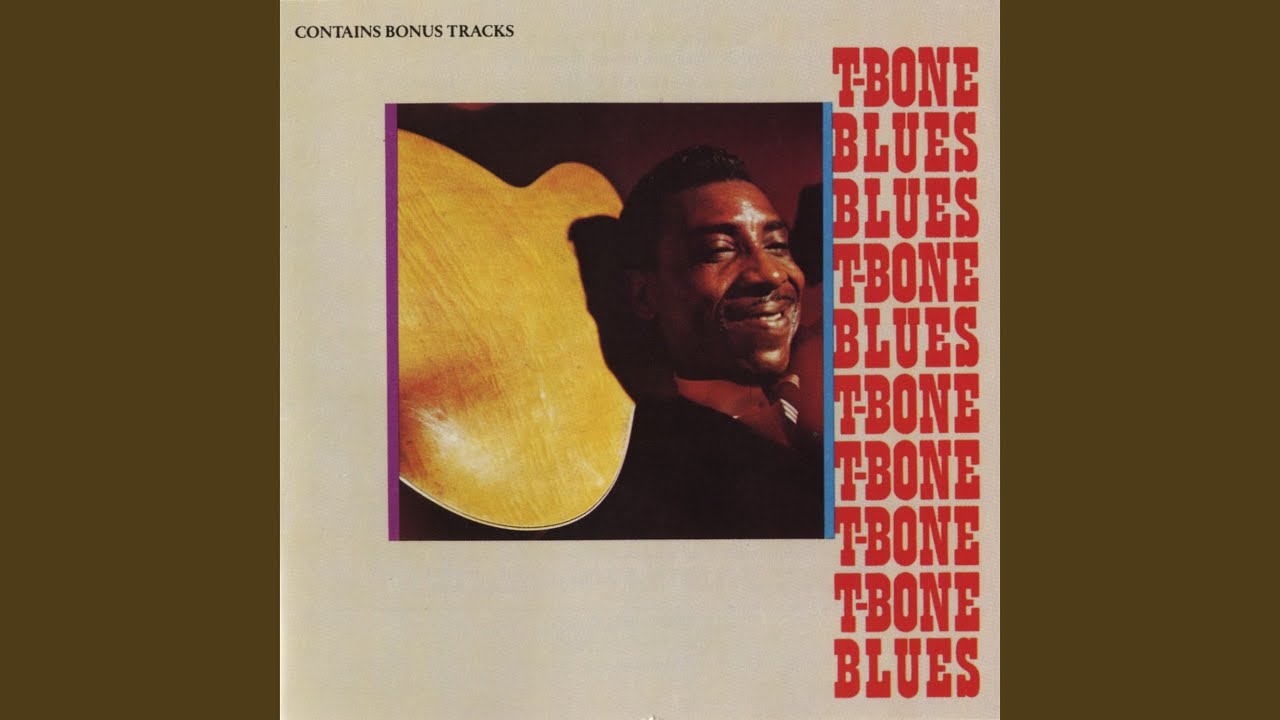
With such a high bar set from his earlier recordings, T-Bone never quite hit the same high spots by the time the album era arrived with its shifts in audience tastes. His finest LP is T-Bone Blues, released on Atlantic in 1959, which Michael Bloomfield succinctly praised as the “best album he ever made in his life”.

When The Allman Brothers Band included a nearly nine-minute interpretation of Stormy Monday on their live album At Fillmore East in 1971, it should have opened up yet more opportunities for T-Bone. But by then his health was failing, and he died a few years later at the age of just 64.
New Life For A Legendary Gibson
As for T-Bone’s beautiful Gibson ES-5N, following its disappearance in 1968, the guitar was thought to be just one more to add to the rather long list of instruments presumed lost forever. But in 2015, a man walked into François Charle’s music shop in Paris with a Gibson ES-5N. He said a mutual friend (and professional guitarist) had suggested it could be the one T-Bone used to play.
Charle was an expert in American stringed instruments for La Compagnie Nationale des Experts, a French society that brings together experts from various fields across the arts. To cut a long story in the book short – including a deep dive into an erroneous serial number – Charle managed to verify that this was indeed the long-lost T-Bone guitar by matching its distinctive maple figuring to photos of T-Bone in action with it.
In 2023, the guitar made its way to auction in France, where it was acquired by Patrick Racz. He was on a quest to apply technology to the problem of lost guitars, with plans to launch the Registry, a central repository to interpret, store, and present data collected from 3D computed tomography scans of instruments, and Ikonic Legacies, which will offer opportunities for fractional ownership of precise replicas of famous instruments by using those scans for reverse‑engineering.
What Racz lacked was a guitar important enough to embody and demonstrate all these ideas. Enter T-Bone’s ES-5N, which fit the bill perfectly. The guitar now has a new home at Crispin Weir’s Regent Sounds guitar store in London, where it’s set to enjoy a whole new life at the center of many new adventures.
Today, T-Bone himself remains an abiding inspiration to anyone who leans into the blues on an electric guitar
Denny Ilett played it brilliantly at the launch of my book at Regent Sounds a few months ago, proving that the guitar still has the power to inspire great playing.
Today, T-Bone himself remains an abiding inspiration to anyone who leans into the blues on an electric guitar. He put it this way: “The blues is the blues, regardless of where you play it. There’s no such thing as the Texas blues or the Chicago blues and all that stuff. It’s nothing new – that’s a whole lot of talk. If you play good, you play good; if you don’t play good, you don’t play good.”
BB King was a young wannabe when he first heard T-Bone. “I knew that nothing about guitar blues would ever be the same,” he recalled. “I didn’t know this man – I wouldn’t meet him till years later – but I felt T-Bone Walker leading me into the future.”
- Electric Blues! T-Bone Walker & The Guitar That Started It All by Tony Bacon is available now in a numbered limited edition.
- This article first appeared in Guitarist. Subscribe and save.
