





Guitar World Verdict
Whether it moves the needle or not, Act Entertainment has taken a worthy stab at transforming its lowly rodent pedal into a king among them — a Sterling Vermin, if you will. With a handsome, mirror-finish and a selectable diode toggle to bounce between the original, filthy RAT tone or an elevated “RAT-atouille” distorted flavor that’s far smoother and more polished, the Sterling Vermin impressively presents itself as an evolved and cultivated RAT pedal dressed in shining armor.
Reasons to buy
- +
The traditional RAT circuit has been refined into a boutique-quality stompbox.
- +
Two selectable clipping diodes.
- +
Hand-soldered construction and premium looks.
Reasons to avoid
- -
It's undeniably expensive.
You can trust Guitar World Our expert reviewers spend hours testing and comparing guitar products so you can choose the best for you. Find out more about how we test.
What is it?
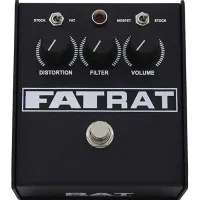
Way, way back, just before the dawn of the Eighties and way before the myriad of distortion pedals we now have the luxury of choosing from, you’d find that distortion — not fuzz or overdrive — as a stompbox was rather scarce. Maybe you had an early “Made-in-Japan” Boss DS-1, or rocked the MXR Distortion+ just like Randy Rhoads and others did, or possibly channeled David Gilmour’s sustained sizzle with an EHX Big Muff Pi. But the ProCo RAT, another soon-to-be-classic, was still an unknown pedal in its nascency.
Having only used amp saturation from a Peavey Bandit 65 up until then, the RAT was different; thick and hairy
Just for context, my first distortion pedal was the Boss Heavy Metal, introduced in 1983. I bought it because, duh!, the name, and also being a die-hard Judas Priest fan, I was firmly convinced I’d get that Screaming For Vengeance tone in a stompbox (close, but no cigar). However, when I finally got around to owning an original big-box ProCo RAT shortly after (a 1981 version), I had to admit it was an eye-opening experience.
Having only used amp saturation from a Peavey Bandit 65 up until then, the RAT was different; thick and hairy. Almost fuzzy, and unlike anything else I’d ever heard, but, in fact, a raw distortion. It was kinda glorious.

Since then, the ProCo RAT's signature molten saturation has captivated countless musicians like me, from gutter-rocking punks to doom metal players, who have incorporated its unique, sludgy distortion into their music. Because of this, its enduring appeal has also led to a few boutique brands offering modern and authentic takes on the classic RAT circuit.
Now, Act Entertainment has taken up the mantle of the RAT brand and introduced a more refined and outwardly ornate RAT pedal called the Sterling Vermin. In all but name, the Sterling Vermin still has the soul of a RAT pedal, but now transcends its predecessors in a shiny, refined form with selectable clipping diodes that expand its dynamic range and signature distortion.
Specs

- Price: $349 / £359
- Type: Analog distortion with LM741 op-amp
- Controls: Distortion, Filter, Volume; Diode toggle (SI/BAT41)
- Features: Mini-toggle offers selectable clipping diodes between traditional RAT silicon “SI” (punchy response) and a modded “BAT41” (smoother/balanced response); high-end CTS pots and oversized knobs; polished stainless-steel enclosure with laser-annealed graphics; hand-soldered in Jackson, Missouri.
- Jacks: Top-mounted 1/4-inch Mono Input and Output jacks
- Dimensions: 4.8" x 2.6" x 1.4"
- Weight: 1.1 lb
- Power: 9V DC center-negative; 9V battery.
- Bypass: True Bypass
- Contact: Act Entertainment
Build quality

Build quality rating: ★★★★★
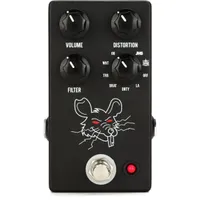
Right off the bat, the Sterling Vermin presents a surprisingly elegant appearance. Unlike the original mil-spec RAT pedal, the Sterling Vermin features a polished mirror-finish on its stainless-steel housing, accented by laser-annealed decorative calligraphic swirls around its chunky, lowercase name.
Sure, you can say its shiny aesthetic looks more like a tchotchke found in a curio cabinet than a utilitarian stompbox, and because of that, it might prompt players to treat it with a bit more care. But don’t be fooled, the SV still has the ProCo pedigree, confirmed by the famous boxed-in RAT logo below the face panel and its famously tank-like construction.
According to its designers, Shawn Wells and Matt Gates, who refined it, the Sterling Vermin is built in small batches and hand-soldered in their Jackson, Missouri, facility, further cementing that the pedal occupies both a “boutique” vibe and space. The pedal features an LM741 Op-Amp and a pair of clipping diodes selectable by a mini-toggle.
The SV also utilizes premium CTS pots and looks complete with the same three oversized knobs for Distortion, Filter, and Volume found on typical RAT pedals that rotate slowly and smoothly, a sturdy footswitch, and a bright red LED on/off indicator. There are dual input and output jacks, and in up-to-date fashion, the power supply is 9V DC center-negative, replacing the outdated 3.5mm (positive tip) DC jack found on older RAT models. And if you want, the same thumb screw/allen key compartment is underneath the pedal if you want to chuck a 9V battery in.
Usability

Usability rating: ★★★★☆
Like most pedals with just three knobs, the ProCo Sterling Vermin is not hard to figure out. The Volume and Distortion controls are straightforward, but the Filter knob is what makes the SV — and all RAT pedals — unique. It's not your traditional Tone control (which older RAT pedals had before 1981) but rather a modified low-pass filter. Unlike a standard Tone control that boosts treble when turned clockwise, the Filter knob works in reverse: turning it clockwise reduces or "filters out" treble frequencies from the signal.
The SV's most notable feature, setting it apart from other RAT pedals, is its selectable clipping diode mini-toggle switch. This switch provides two distinct tonal options: "SI" (traditional silicon diode) and "BAT41." The "SI" setting offers a familiar sound, delivering that aggressive, heavy-midrange grind similar to a standard RAT pedal. In contrast, the new "BAT41" option yields a smoother response and improved dynamics.
Sounds

Sounds rating: ★★★★☆
Lately, my ears have become quite accustomed to the soft-clipping sounds of the many overdrives I've reviewed. With that, it's a welcome change to hear the Sterling Vermin, which is essentially a more refined RAT, offering two subtle variations on the classic hard-clipping circuit.
For this review, I had to dig deep in my effect coffers and pull out what’s left of my RAT collection: a 1988 Rat 2 and a 2002 DeuceTone (unfortunately, I sold my original big box RAT a long time ago) for comparison. Firing away on a variety of classic amps, the vintage RATs all held up nicely, straddling the line between massive distortion and fuzz — or “fuzz-stortion,” with an undeniable dark and grungy overtone on both pedals. It’s no wonder this was a sound favored by Kurt Cobain and still appeals to guitarists who dabble in doom and drone metal.
I found having both the Distortion and Filter set somewhere between the 2 o’clock range is the hallowed middle ground and sweet spot where the SV sounds wonderfully thick, heavy and spongy
Moving on to the Sterling Vermin, the good news is that the pedal is nearly identical in tone to the vintage ones, and successfully preserves the ProCo RAT’s familiar shaggy distortion and fuzz blend on its selectable “SI” diode setting. RAT pedals always had a raucous nature when you attenuate their higher frequencies via the Filter control, and the Sterling Vermin is no exception.
As you turn the Filter control counterclockwise past two o’clock toward noon, the distorted textures can become overly bright and grindingly sharp. Conversely, pushing the Filter past three o’clock introduces the more desired, darker, and bottom-heavy tones that flesh out its wall-of-sludge saturation. I found having both the Distortion and Filter set somewhere between the 2 o’clock range is the hallowed middle ground and sweet spot where the SV sounds wonderfully thick, heavy and spongy — all the hallmarks that make this pedal a bona-fide classic.
Frankly, I don’t hear too much of a contrast between the “SI” and its newer “BAT41” diode setting. What I do hear is the frequencies soften a bit, and there’s an ever-so-slight drop in output in the “BAT41” mode. That’s not a bad thing for me; I can certainly discern the articulate focus and refinement in this setting.
Here, the SV’s thickened distortion sounds smoother, tighter, and more defined, even when I turn the Distortion clockwise toward fuzzier textures. But if you’re not looking for doom and gloom as your tonal backdrop, dialing back the Distortion knob is where the Sterling Vermin can become more of a “Sterling Screamer.” With less grind, the SV imitates a soft-clipping stance, which works best for drawing out nuanced amp-like, overdriven tones, adding perceived weight to chords and single notes.
Verdict

Not everyone is a fan of the RAT’s sludgy and shaggy distortion. Even Jeff Beck, one of the pedal’s earliest adopters, moved on from it at one point in his career. And yes, you can easily dismiss this new pedal as “a RAT in a fancy box,” and undoubtedly, the Sterling Vermin is a premium, boutique take on the traditional ProCo RAT circuit, and quite expensive too. Is it worth the higher price tag? For some, it won’t matter, but for others, it is something to weigh on heavily, considering there are other boutique pedals that admirably ape the RAT circuit quite convincingly.
Guitar World verdict: Whether it moves the needle or not, Act Entertainment has taken a worthy stab at transforming its lowly rodent pedal into a king among them — a Sterling Vermin, if you will. With a handsome, mirror-finish and a selectable diode toggle to bounce between the original, filthy RAT tone or an elevated “RAT-atouille” distorted flavor that’s far smoother and more polished, the Sterling Vermin impressively presents itself as an evolved and cultivated RAT pedal dressed in shining armor.
Test |
Results |
Score |
|---|---|---|
Build quality |
Hand-soldered, premium CTS pots and boutique-built in the USA. |
★★★★★ |
Usability |
The SV's signature sound is still shaped by the familiar RAT controls for Drive, Filter, and Level, with a new selectable diode switch that allows players to change the distortion texture and response. |
★★★★☆ |
Sounds |
Just like the original RAT, the SV deftly projects the same sludgy distortion and shaggy fuzz that can be tweaked as raw and aggressive, or smoothly overdriven. |
★★★★☆ |
Overall |
Refined and redesigned, the Sterling Vermin is a pricey but worthy spin on the original RAT circuit. |
★★★★☆ |
Also try

Hands-on videos
Cameron Cooper

