


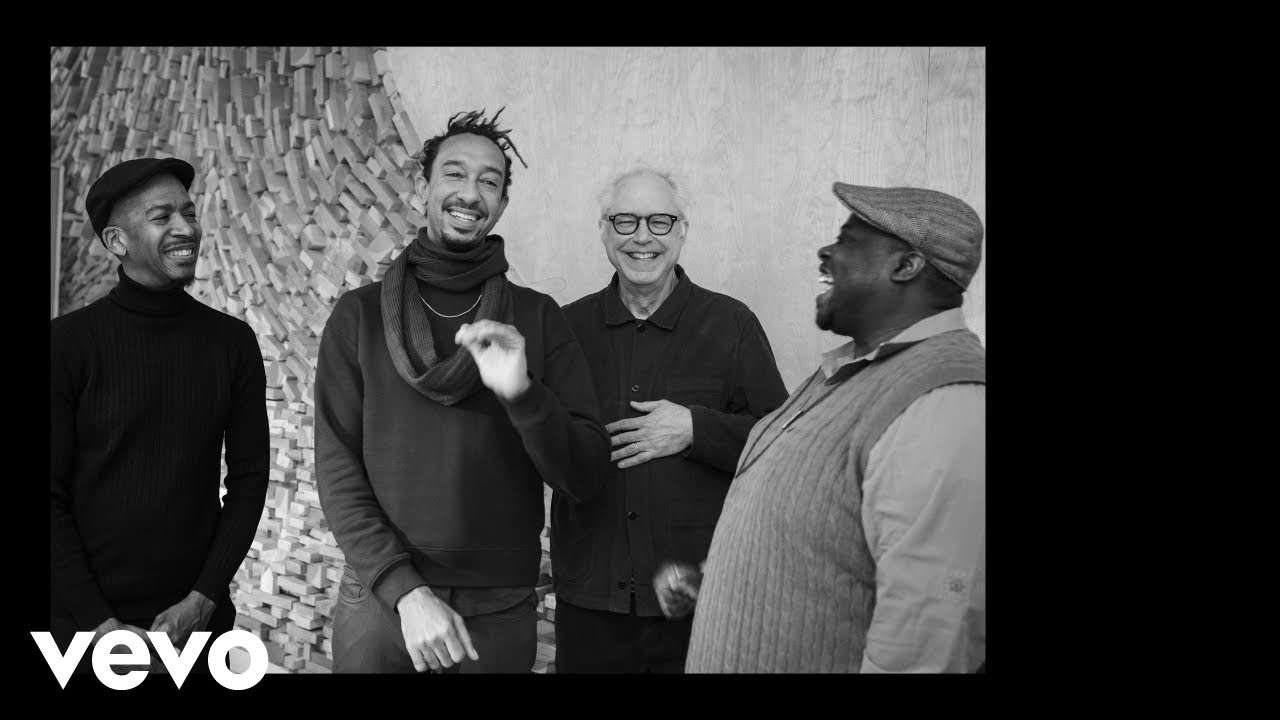
No wonder Bill Frisell had to pinch himself when he assembled the line-up for In My Dreams. After half-a-century pushing the envelope of modern jazz, the Baltimore-born band leader had played in practically every format, from airtight duo to opulent chamber orchestra.
But the 75-year-old is still buzzing from taking the stage last year with a wishlist sextet of his all-time-favourite collaborators – Jenny Scheinman (violin), Eyvind Kang (viola), Hank Roberts (cello), Thomas Morgan (bass) and Rudy Royston (drums) – to record this live album for the esteemed Blue Note label.
Tell us how this amazing lineup came together for the album.
I’ve been playing a lot as a trio with Thomas and Rudy. But it had been some years since I played with Jenny, Eyvind and Hank. I just woke up one day and had this idea of putting both things together. It’s not like I’m out in front of the band, like, ‘This is my thing and I’m the soloist.’ What gets me excited is being in the midst of it, and it’s a conversation we’re all having together.”
How freeform is the band’s performance on this album?
At the beginning, I’ll write out the music and everyone is looking at the same score, and maybe there’s some discussion, like, ‘Oh, you should play this part or that part.’ But I know these people so well and we trust each other.
So what happens after all these years is they start making choices themselves. That’s what’s so exciting. It’s like they’re actually improvising the arrangement, so the lines between ‘solo’, ‘accompaniment’ and ‘orchestration’ start to blur and the music takes on a life of its own.
And there’s no such thing as a ‘mistake’. If somebody goes off the edge, you help them back on, rather than call them out. A recording is like a snapshot of what happened in that one moment.
But that’s not the end of it. That’s just the beginning. The next time we play, we’re trying something else. Even if we play the same songs in the same order, we just keep looking for something else to happen.
How does it feel when the band really falls in step?
It’s like there’s an actual physical sensation when I’m playing with them. Like, if I play a melody with someone else and it really locks in, there’s this amazing thing that happens. You can actually feel it in your fingers, and you’re breathing together and it’s like your fingers start melting into the fingerboard or something.
And it makes a sound where it’s not them and it’s not me – it turns into another instrument. But it’s always weird when I try to describe what happens when we’re playing. I don’t want to mess up the magic. You try to analyse it, but I want there to be some kind of mystery and not lose that.
Did you test yourself and your playing on this album?
“Hopefully, I’m testing myself every time I play. It’s an ongoing thing. From the first moment I ever picked up a guitar, every time you play, you’re taking one more step. With music, I’ll never get to whatever it is I’m trying to get to. But you’re just constantly reaching.
Can you tell us about the dream that loosely inspired this album?
It could be 40 years ago, but it’s so vivid. I go into this old house and up this dark stairway into a kind of library. There are these little people with brown hoods and they welcome me. First, they say they want me to see what colours really look like. So they pull out this red cube and it’s so intense, a red like I’d never seen before.
Then they want me to hear what real music sounds like. Suddenly, there’s this drill going through my forehead into my brain and every musical sound I’ve ever heard in my life is happening simultaneously but with this incredible clarity. It wasn’t chaos – everything was focused into this amazingly beautiful sound that was so complex and so many things moving, but I could hear every little detail.
That dream has stayed with me all this time. And it’s not like I achieved that goal on this album, but it’s somewhere in the back of my mind as something to strive for.

Do you think there are parallels between dreaming and performing music?
I think about that a lot. When you wake up from a dream, whatever was happening, whether it was good, bad, scary or happy, it just evaporates. It’s gone. And that reminds me of what it’s like when we’re playing. When you’re really in the music, it’s like, the moment you become aware that it’s really happening, it evaporates.
I have such respect for Billy Strayhorn as a composer that it’s like sacred ground, and just the fact I could somehow make a statement with that song, with these people, I guess I’m proud of that
It’s an ensemble, of course, but what are your own favourite guitar moments?
I was really happy with Isfahan. I have such respect for Billy Strayhorn as a composer that it’s like sacred ground, and just the fact I could somehow make a statement with that song, with these people, I guess I’m proud of that. It’s taken me years to even feel worthy to play it on a concert.
It’s extraordinary, if you look at it in just a mathematical way, analysing the harmony, melody and the notes he chose. But what takes the time is to get past that and for it to just become part of my blood. So when I’m playing it, I’m not thinking, ‘Well, this is a Bb,’ but getting to a point where you feel like you’re singing the melody on guitar.
What do you remember about recording the album?
The recordings came from three different sources: this really nice old hall in Brooklyn called Roulette, another small place in Connecticut, and a concert in Denver, which the band didn’t even know we were recording – which was kinda great.
Then we had to edit it all together, and I never did anything quite like that before, where there’d be one melody from Brooklyn, another from Denver, and the engineer found a way to make it sound like it was all coming from the same place.

You exclusively used your modded JW Black Telecaster. Why is that such a good recording guitar for you?
“It’s super-comfortable, for one thing, with that slightly shorter scale than a regular Fender. I don’t think I use the bridge pickup at all; it’s all the TK Smith neck pickup. I don’t understand the inner workings. It’s a single coil, but there’s no noise. There’s some kind of metal ring around it – I don’t know if that’s something to do with keeping it quiet.
I mean, I love the sound of single coils, like P-90s or whatever. But sometimes they’re so problematic in different rooms with buzzing and stuff. But this TK Smith pickup is completely quiet. And then it has a lot of low-end, but it’s very clear at the same time. It’s very warm, it’s not muddy and it’s not shrill, but there’s real definition.
For a number of years now, I’ve also been using flat-wound strings instead of round-wound. I think that has a lot to do with the attack on the lower notes.

What amp and pedals did you lean towards for this material?
I just keep trying. I never really intentionally go back and listen to things I did long ago, but sometimes, something will turn up on YouTube and it’s like, ‘Whoa, how did I possibly do that?’
At the gig in Brooklyn, I was home, so I just used my own amp, which is a Carr Sportsman. It’s kinda like a Princeton, that amount of power – maybe a little more – but with one 12-inch speaker. But then, at the other concerts, I borrowed a Fender Deluxe Reverb reissue.
With pedals, it’s not a lot. There’s a Strymon Flint. There’s some loops and weird stuff that I used the Line 6 DL4 for – it’s the newer one that’s sort of smaller. I had the Jam Pedals Rattler, and sometimes I’ll also use [an MXR] Carbon Copy.
This album heralds your 75th birthday. Do jazz players get better with age?
I hope so. I hope I’m not getting worse! I just keep trying. I never really intentionally go back and listen to things I did long ago, but sometimes, something will turn up on YouTube and it’s like, ‘Whoa, how did I possibly [do that]?’
I don’t know if I got better or worse. It’s like, sometimes I can’t believe the things I was able to play years ago. But then I’m also like, ‘Wow, what was I thinking?’ Y’know, about some stupid thing I was playing.

Do you recognise that young player from the ECM label in the ’80s?
I used to use a volume pedal all the time and it kind of drives me crazy when I hear it now
Kind of, yeah. But it’s a double-edged thing. All this time, what I’ve been trying to do is make what I’m doing clearer and clearer, try to get rid of all the excess, whatever doesn’t need to be there. Sometimes, I’ll hear a recording from back then and it’s like, ‘Wow, that’s too much.’ Or it’s the sound. I used to use a volume pedal all the time and it kind of drives me crazy when I hear it now.
You’ve said in the past that players put too much emphasis on gear.
For sure. I think our mind is the most powerful pedal you can get. Our imagination, y’know? Really, if you have the music in your head, that’s the most important thing.
When all’s said and done, are you pleased with In My Dreams?
As pleased as I can ever be. The music is always moving and changing, so it’s something I have to get used to, that thing of, ‘Okay, we need to stop now, we’ve captured that moment.’ So I’m very happy with the album. But it’s always, like, as soon as I’m done, I’m moving on to the next thing.
- In My Dreams is out now via Blue Note.
- This article first appeared in Guitarist. Subscribe and save.

