





Born in a blue-collar region of Canada, Earl Johnson dreamed of more than working in a steel mill. His dream came true with Moxy, whose 1976 self-titled debut album has gained a cult following over the years.
Despite being the primary songwriter and lead guitarist, he only played lead on two tracks, with Tommy Bolin appearing on the remaining six. When it happened Johnson wasn’t happy – but time healed his wounds. “Tommy Bolin played on my songs,” he says. “That’s not such a bad thing!”
“And that didn’t hurt the sales. But the reviews didn’t even mention Tommy Bolin – only the songs and what the band sounded like. Fans didn’t buy the album because of Bolin, they bought it because DJs in San Antonio started spinning it all the time.”
Still, he admits that there’s a curse that goes with the blessing of Moxy’s success. “Having Bolin was a compliment, but artistically it did ruin it for me. Not just because he was on it, but because of how it was handled. It separated me from Buzz [vocalist Douglas Buzz Shearman] and led to a lot of fucking conflict.”
What sparked your interest in guitar?
I took lessons when I was 12 – and I hated it because all my buddies were playing football! So I stopped playing, but then I wanted to learn how to play like Chuck Berry. I remember finding my guitar buried in the attic when I was around 14. After hearing Zeppelin’s Whole Lotta Love I was hooked. By 17 I’d decided I wanted to quit school and be a guitar player.
Once you got rolling, what sounds did you gravitate toward?
I was a huge Eric Clapton fan. When Fresh Cream came out and I heard that tone, I thought, “Holy jeez!” It ripped right through me to the bone. It wasn’t processed; it was really raw and it was great. I think they call the amp a Bluesbreaker now, but it was basically a 50-watt Marshall 2x12.
I had that amp for a couple of years, but when I got going seriously, I got the Marshall. And then, I gravitated towards playing blues, and I basically became consumed to the point where I was playing at home for hours at night.
Your first band was King Biscuit Boy, right?
I grew up in Hamilton, which is kind of like Pittsburgh, where it’s a steel town. It’s west of Toronto, and the deal then was you grew up, and you went to the steel plant. I saw my dad go through it, and it was hell. It’s not a thing I wanted to go through.
And I was consumed by playing guitar and getting a lot of notice as a hot, up-and-coming player. When I was 18, I got an audition for a band called King Biscuit Boy, a band being put together to go to the States. They hired me, and I was with them for three years on the road all over the States. So, by 21, I was pretty vetted and experienced.
What led to the formation of Moxy?
A good friend of mine, who was a bass player, was playing in a band with Buzz Shearman, who ended up being the lead singer of Moxy. And then, I was getting ready to write my own songs, and I left King Biscuit Boy to join Buzz, and we started writing tunes like Moonrider, and a couple of other things. We started getting fired from bars for doing original material. [laughs] They wanted to hear hits, right?
We broke up and took a year off. When I was 23 I went home to Hamilton, and I was writing songs like Sail On Sail Away, Fantasy and Can’t You See I’m a Star in my parents’ basement. I phoned Buzz and said, “I think I’ve got something.” And that’s how it happened with Moxy.
Those four songs ended up on Moxy’s self-titled debut. How did Tommy Bolin ended up on the record?
I was too stupefied to even comprehend what happened. Years later, I discovered bands like Kiss didn’t have Ace Frehley play all the solos, so it was rampant
I have my own conspiracy theory on that! We put the band together in Led Zeppelin format as a four-piece. We started recording demos in Toronto, then ended up getting a record deal in LA, and signed a production agreement with this company in Canada.
When we went to LA we had almost no experience in the studio. We did the first couple of cuts – Sail On Sail Away and Can’t You See I’m a Star. I played all the solos on those two tracks; I did everything.
We were in Scarface territory. I don’t want to disgrace anybody but there was a fair amount of white stuff. I’d recorded those two songs, and we were starting the solo for Moonrider, and all of a sudden I got grief.
The guys in the back room were definitely under the influence. They’d even offered me a song and I’d said, “I can’t play on that stuff. There’s no way I’m gonna do that.”
Then we had a dispute over the solo on Moonrider. I remember saying, “I just played those two solos and now I’m a horrible guitar player? I’m no good?”Next thing I know I’m on an airplane back to Toronto, like, “What the hell just happened?” Then Bolin did the solos on six songs.
How did you react to that?
I was in total shock – complete shock. I was too stupefied to even comprehend what happened. Years later, I discovered bands like Kiss didn’t have Ace Frehley play all the solos, so it was common; it was rampant.
Our manager had been road manager for the James Gang when Tommy Bolin was in the band, so I put two and two together. I was like, “This is too much like a marketing play.” They had it pre-sold, but they wouldn’t admit it.
How might you have approached those solos if you’d had the chance?
It comes down to the style of playing. I was somewhere between Zeppelin and Sabbath, with a heavy grind. I wanted those notes to rip through, and have that kind of raw Gibson SG sound that you can only get out of a Marshall 2x12 tube amp.
My solos and what Tommy did – and I love his playing – it’s night and day. I could have said, “Tell me what you want for the solos.” But at the time I was like, “I’m not having you tell me how to play the solos on my own song.” And that wasn’t egotistical; it was an artistic thing, you know?
But there was too much collusion. Our manager managed Bolin, who just happened to be in LA and could do six songs.
You stuck with Moxy for three more albums, but a thing like that probably stuck in the back of your mind.
It was pretty dramatic. I’d been the principal songwriter, but because of the Bolin situation I was fighting with Buzz about songs and the direction. We were not on the same page at all; that opened a huge rift.
My aim for the band, which was more progressive metal and kind of like Zeppelin, was gone. My idea of songwriting wasn’t normal; I liked off-time riffs, and different things in different slots.
It didn’t click. There was too much distance between me and the rest of the band. I started going, ‘This is not the band I wanted. It’s not the vision’
Before you left, Buzz was replaced by Mike Reno, who ended up fronting Loverboy.
Mike got into the band because Buzz was having vocal problems, He was basically only lasting for three songs, then we’d be jamming to get through the opening set. A girl handed me a tape with Reno singing on it, and he sounded like Paul Rodgers.
So we got Mike in, and he’s a good singer. But again, the musical direction was going toward something different. It didn’t click. There was too much distance between me and the rest of the band. I started going, “This is not the band I wanted. It’s not the vision.”
I remember saying to my wife at the time, “I’m quitting. I’m done.” We were on the verge of the ’80s; I’d been on the road for 10 years, and I got offers to keep playing – but in those days you lived on $150 a week and all the Kraft Dinner you could eat! I got tired of living like that.
I took a whole summer off at my wife’s mom’s cottage up north. I ended up getting a job in retail in the audio business for about four years, then I became a sales manager at Cerwin-Vega.
What led you to reform Moxy in 2001?
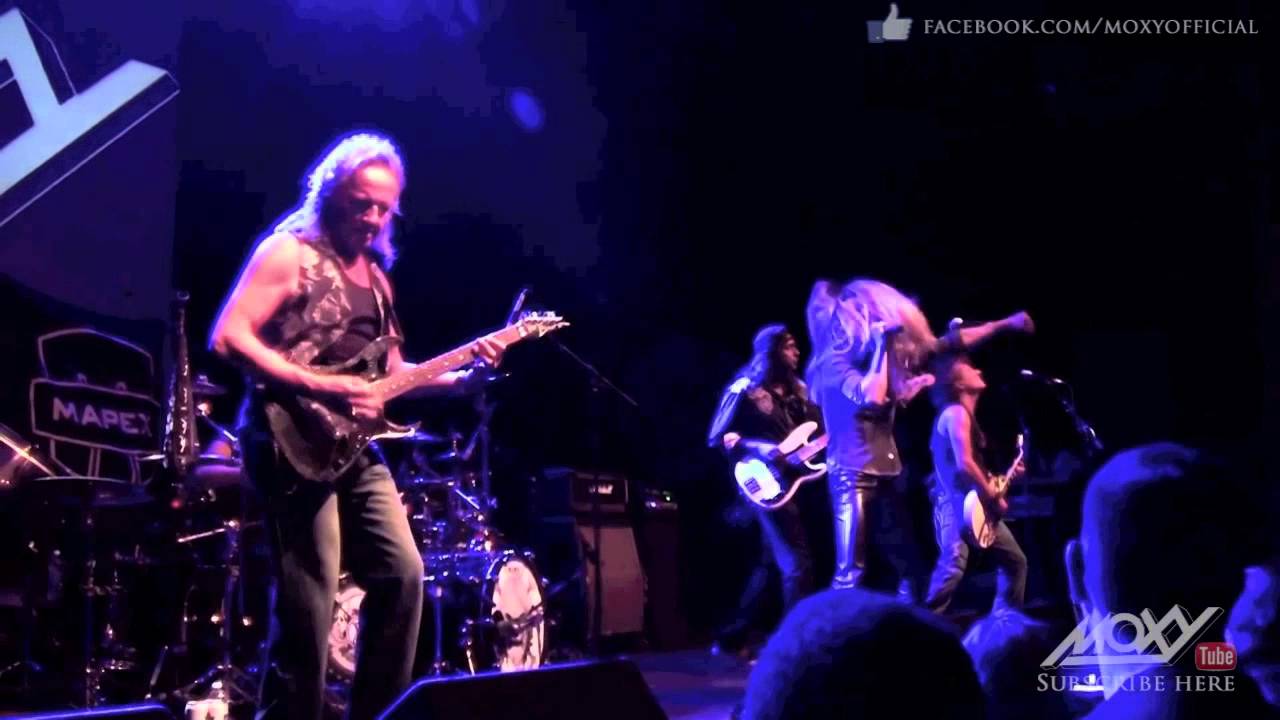
The guys contacted me and said they were going to Texas to record and all that. I was married, but I knew it wasn’t gonna work out, so I went down to Texas and did some dates. By 2005 or 2006, we’d gone down there every year.
Buzz died in the ’80s in a motorcycle accident, so we’d gone through different singers. I just put together a new version of the band, with a singer who was running a Bon Jovi tribute. I can’t believe how strong his voice is! We’ve been getting together for a few weeks now, and we’re putting a couple of tunes out come January. Who knows? It’s like buying a lottery ticket.
Given Moxy’s cult following, there’s a fair chance that your ticket will be a winner.
At this point, we’ll go until we can’t. I’m still a full-time guitar teacher and also a guitar player. That’s what I do. I didn’t think I’d end up finishing my life like this, but I’m living my second childhood – I’m living in a dream world!

