



Some guitar greats are historically associated with one guitar and one amp. But Joe Perry is not one of them. This guy plugs a host of iconic guitars into all sorts of amps; well, let’s make that all sorts of tube amps. Beyond that, he likes to play the field.
“I’m not an amp snob,” he says. “I won’t say I can’t use this or that amp. I’m gonna give everything a try. You never know what you’re gonna discover. Some of the oddest guitars and amps I have are ones I’ve used on some of my favorite songs. You just don’t know.”
It’s that philosophy that has kept Perry merrily bouncing from amp to amp. Be it Ampeg, Music Man, Fender or Alessandro, he has tried – and loved (to varying degrees) – them all. Still, as amp-curious as he is, he always seems to come home to Marshall.
“You can put Marshall down for every decade,” he says, foreshadowing the list below. “There’d be times in the studio or for a one-off gig, and you’d have to rent something, and it was usually a Marshall. Back in the day, it’d be a roll of the dice because you didn’t know if they were taken care of. But if you were lucky, and you got a good one, they were great.”
It’s with that in mind that we turn it over to Perry to guide us through his amp choices throughout the decades.
1970s
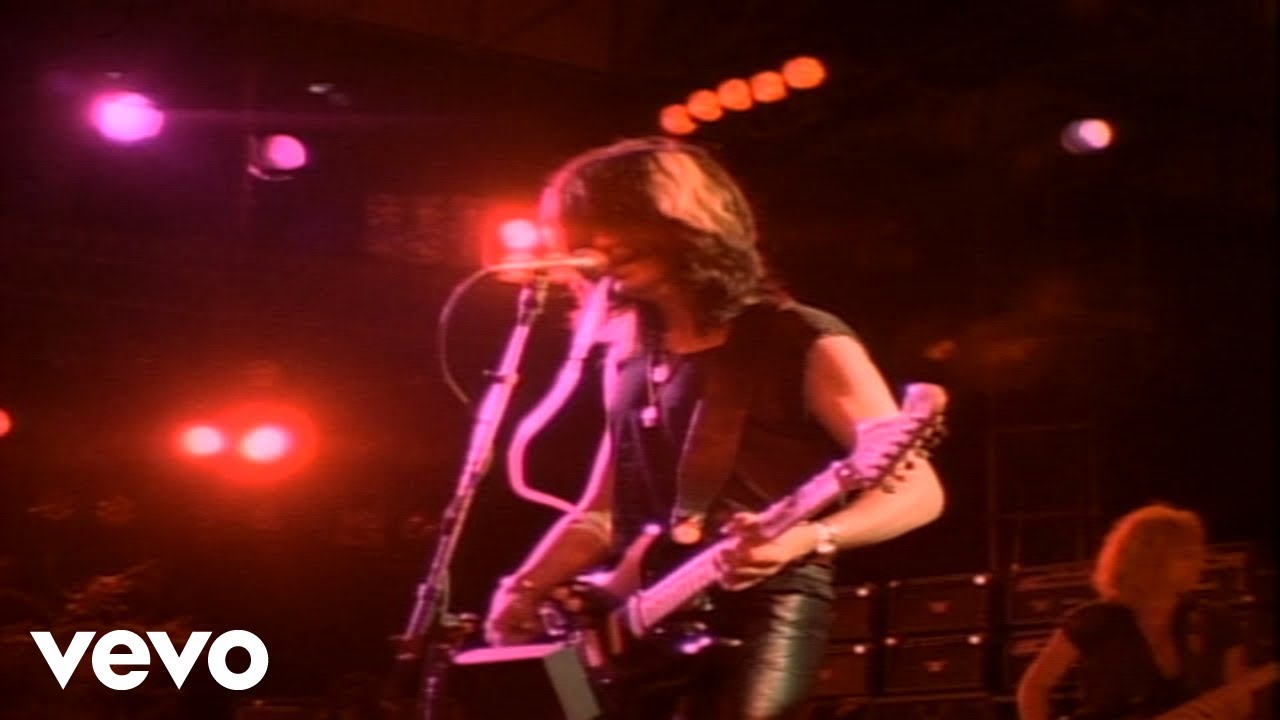
For the first Aerosmith album [1973’s Aerosmith], I used an Ampeg V4. I probably used that for the first couple of tours, too. I didn’t want to sound like everybody else, and everyone was using Gibson Les Pauls and Fender Strats with Marshalls, so I used the Ampeg because you were pretty much in the same range, but it sounded a little different. But it really comes down to how you play.
Everybody sounds a little different, and the go-to amps for the kind of music we were playing were [meant] to give you a little more, to reference This Is Spinal Tap, “11”! [Laughs] But I always liked that early rig because it wasn’t too distorted or too loud. When that happens, you lose the tone of the guitar.
We had Marshalls, too, but in the late ’70s, the longest-tenured amps we had for touring were some of the first Music Mans. Leo Fender had basically sold Fender, and he started Music Man. He put out an amp that was about the size of a [Fender] Twin, and it was a 100-watt head.
We got lucky and had a couple of the first ones, and they were pretty loud. For at least a year’s worth of touring, we were pretty much using only those Music Man amps and heads [HD-130 heads customized by Andy Topeka].
We had them made with LED lights – a string of them – so the harder you’d hit the amp, the more the lights would light up. It was kind of cool. And we had the Aerosmith logo on them; we still have a couple of them around.
1980s

I often had vintage Marshalls, like 100-watt plexis and Super Leads. Everyone was tweaking them, just trying to get a little bit more out of them to get what they were looking for. So my go-to studio amps were always some sort of Marshall or Fender.
When we started playing bigger places, I was really surprised by how loud the audience was. In some buildings, the audience would be cheering – and sometimes it was louder than the band!
Then Fender started reissuing older stuff, and I got some of that, which I still use. When we started playing bigger places, I was really surprised by how loud the audience was. In some buildings, the audience would be cheering – and sometimes it was louder than the band! [Laughs]
It was kind of about a balance of finding the right sound on stage and needing to hear the vocals, and everybody had a different way of dealing with it. But just about everybody was using Marshalls in hard-rock land.
I was trying everything. Someone would come out with something new, and I’d get one and try it – especially in the studio. You never know when you’re gonna come across some kind of sound that would fit.
For example, there was a song called The Movie on Permanent Vacation [1987], and I found a sound on the Roland synth you can hear on the song. It sounds like bubbles coming up in the instrumental.
1990s

Again, I tried just about everything, including transistor amps. Whenever they would come out with something, I’d give it a try. In the early ’90s, Fender put out these dark gray amps with red knobs. I know guys who worked with them, and they made it work, but I never liked them.
Some of that stuff with transistors, as soon as you turned them up, they started to sound like aluminum foil. [Laughs] So I tried a lot of this stuff but would never use it. I still have some of it because you never know if there’s a sound you can get out of it; there might be a place for it on a recording.
We’d go off to record an album, and we’d bring a little bit of everything back then, because you just didn’t know what you were gonna use. But the bottom line is, if I was doing basic tracks, chances are I’d be using a Fender or a Marshall – something high-wattage.
2000s–present
The choices are pretty much infinite now. People used to think that to make a record sound big, you had to have a full-on stack. But it’s really hard to do a record like that because of the volume; you’ll blow out the microphones. So I like to try a lot of boutique amps. One of the standouts is Alessandro.
George Alessandro consistently hits the nail on the head. Someone told me that they were backstage checking out David Gilmour’s latest rig, and Gilmour had an Alessandro amp; it was kind of the core of his rig! Boutique amps are great because you can find something that gives you a different tone or feel, and it’s refreshing.
You wanna keep changing things up because you can get bored, but then you swing back around to the old standards, which is mostly some vintage Fender stuff – Vibroverbs, Twins and [Band] Masters – and Marshalls, like the JCM800, which is at the top of the list.
With modeling, I know guys who swear by it. There’s a lot going for it, and you can get a lot of different sounds, and they’re easy to transport, but I don’t know
And then, with modeling, I know guys who swear by it. There’s a lot going for it, and you can get a lot of different sounds, and they’re easy to transport, but I don’t know. I guess if I were in a jam and had to do a gig, I’d figure out how to make one work, but if I had the choice, I’m gonna use my tube stuff.
Anyway, here’s an example of me following my ear. A while ago, my guitar tech sent me a Fender Champ-size speaker cab with an old Jensen 10” and an Orange Terror Stamp pedal-size amp. It has 12AX7 tubes and transistor power.
It’s a great low-volume practice amp. Since all my bigger “choice, vintage studio stuff” is up in Boston, I've been messing with small Alessandro, Supro and Zinky boutique stuff with vintage speakers. But the Orange was sounding pretty cool, so I used it on the first Aerosmith/Yungblud stuff.

Also, because my backline gear was in a truck going from gig to gig and I couldn’t get to my Alessandro and other stuff, one thing led to another. During the last four months, jumping from studio to studio, I just brought the Terror Stamp with me and used whatever 10” speaker cab I could plug into. By the time we were finished, I had used the Orange on every track on the new Aerosmith/Yungblud EP, One More Time.
I used that along with – say, at Johnny Depp’s studio – one of his vintage Fender amps. And at NRG Studios [Los Angeles], it was just the Orange. For the [2025] Video Music Awards, I used a Fender Vibroverb and the Orange. I used the same rig for the Bad Company induction ceremony at the Rock and Roll Hall of Fame in November. Who knew?
Back when Aerosmith would pack all our “good stuff” to send to the studio at the start of a record, we’d still rehearse but with some of the “not so A-list” gear. After a week of playing through that stuff, I’d be nailing some great sounds out of the “B list.”
It was good stuff to the point of saying, “I’ve gotta bring this, too,” and that would end up being the startup rig when the tape started rolling. If it sounds good, that’s all that matters – no matter what the logo says. That’s probably why it was so hard to give a simple answer to what amps I use, decade by decade!
This article first appeared in Guitar World. Subscribe and save.

