



Guitar World Verdict
The JBL BandBox Trio delivers good amp models and one of the best AI practice tools I’ve ever used in the stem splitting function. It’s an unexpected, but successful venture into the world of guitar amp simulation and very much the equal of the smart amp establishment. It’s a great product, but I feel that the use case will be limited for guitarists, most of whom would be better off with the smaller Solo model.
Pros
- +
Offers plenty of volume for guitar players.
- +
Surprisingly good onboard amp and effects models.
- +
AI stem splitting tool is incredibly useful for home practice.
- +
Plenty of connectivity options and USB recording out.
Cons
- -
Very bass-heavy for a guitar amp – needs tweaking.
- -
The companion app feels little clunky – especially the guitar tuner.
You can trust Guitar World Our expert reviewers spend hours testing and comparing guitar products so you can choose the best for you. Find out more about how we test.
What is it?
AI is in everything these days, from your car and your fridge to your guitar amps and AI-powered guitar pedals. It’s quickly becoming two letters slapped onto pretty much anything to make it sound more enticing to consumers. The JBL BandBox Trio, launched alongside the smaller Solo mode, is yet another guitar product that’s leveraging the power of AI in order to offer musicians a better practice tool. And it's got a very intriguiging USP for an amp.
The Trio, and the smaller BandBox Solo model it's being launch alongside, can separate and isolate a song’s bass, guitar, drums and vocals in real-time. All from streamed audio. A potential game-changer for learning songs - but also part of the BandBox’s bigger picture.

I'm intrigued by what the BandBox might be able to deliver with this kind of technology for guitar players in combination with an amp
I’m sure most of us have had mixed experiences with AI; sometimes it works great, other times the results are laughable. But AI has actually been in music creation and, in particular, music production for quite some time now, and stem separation is something that it’s actually quite good at.
I’ve had great success with AI tools to remove instruments from songs and plugins like Acon Digital’s Remix:Drums that separates drum sounds in real time and allows for individual control over all the elements. Just because something has those two dreaded letters on it, doesn’t mean it’s necessarily bad. Now I'm intrigued by what the BandBox might be able to deliver with this kind of technology for guitar players in combination with an amp.

Buzzwords aside, the JBL BandBox Trio is a mix between a smart practice amp and a PA speaker in a very similar vein to the Positive Grid Spark Edge, giving you four channels, microphone connectivity, and a companion phone app with which to access a myriad of useful practice tools like a pitch shifter, looper, and a metronome.
Outputting a hefty 135W RMS via a 1x 6.5-inch woofer and 2 x 25mm silk dome tweeters, the Trio boasts a frequency response of 50 Hz to 20 kHz, so it’ll sound great playing your favorite tracks at volume. A built-in battery allows you to play it on the go, with a charge time of around 3 hours and a playtime of up to 10 hours, depending on what you’re doing. You can also run it with a traditional IEC cable if you don’t fancy relying on a battery.
Specs

- Launch price: $599.95/£529/€599
- Type: Modeling guitar amp with real-time track stem separation
- Origin: Vietnam
- Output: 135W RMS
- Speaker: 1 x 6.5 inch woofer, 2 x 25 mm silk dome tweeter
- Channels: 4
- Controls: 4x encoders, 4x channel buttons, 1x Stem AI button, 1x master encoder,
- Connectivity: 1 x 1/4", 2 x XLR-1/4" combo, 1 x 1/8" (aux), 1 x 1/4", 1 x 1/8" (aux)
- Weight: 19.27lbs, 8.74kg
- Dimensions: 344 x 265 x 228 mm / 13.54” x 10.43” x 8.98”
- Contact: JBL
Build quality

Build quality rating: ★★★★★
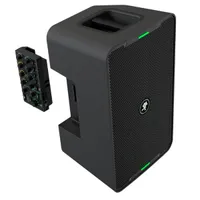
Pulling the BandBox Trio out of the box, my initial thought is that it’s very attractive. It straddles the line between music gear and Bluetooth speaker in a subtle way, and the burnt orange accents on the JBL logo are really classy looking. The front grille is a corrugated mesh, and on the front four and bottom rear corners are curved rubber pads to ensure no sharp edges bash into you or anyone else during load-in.
There are rubber feet on the underside of the chassis, which help it to sit slightly tilted upwards, and they have a little bit of give to them and feel soft and smooth. It isn’t long before they’re absolutely covered in cat hair and dust from being on the floor, however. On the very underside of the BandBox Trio is the battery compartment, which can be unlocked by turning the built-in screw, revealing an orange interior.

The rubber handle is embossed with the word ‘BandBox’ and is a curiously squidgy rubber that flexes much more than you’d expect from a traditional guitar amp. It feels really comfortable and helps make the 8.7kg weight feel reasonably manageable, although I wouldn’t want to be carrying it huge distances, it would be fine to carry from a car to a gig or a busking spot.
The top panel is dominated by the LCD screen with five rotary encoders below. In the middle is a channel and mixer select menu, and a dedicated button for ‘stem AI’. To the right is a large master encoder and the power-on button. On the back, going from right to left, we have two combo-XLR inputs with switches for mic or line level sources, an instrument input, a Bluetooth button for connecting various devices, an aux and USB-C input, and then finally an output section with a 1/4-inch direct out and a 1/8-inch headphone output.
Usability

Usability rating: ★★★★☆
Plugging in the BandBox Trio, the light next to the power button starts pulsing immediately, which I presume means it’s charging the onboard battery. Pressing the power button, it comes on with the sound of deadened guitar strings being struck and a synth riser with some serious bass on it. The display shows each channel input alongside volume controls for each input, including an overall master volume.
It’s always a good measure of a product to see how far you can get before you need to reach for the manual
I start by connecting my phone via Bluetooth to see how seamless the connectivity is, and I’m pleased to report it connects immediately after displaying a pin code I need to confirm, letting me know the pairing has worked with a very MIDI-sounding acoustic guitar triad. It’s the BandBox Trio’s way of letting me know that it’s not just a fancy Bluetooth speaker, but a proper guitar amp.
It’s always a good measure of a product to see how far you can get before you need to reach for the manual, so I grab my baritone guitar and plug straight into the instrument input to see what happens. After a second or so, the corresponding channel on the display lights up, and the volume knob becomes active. I do note that because of the way the inputs are located, the angled head of my guitar cable, which has a large Neutrik connector, won’t plug in with the cable naturally trailing down, and instead has to be turned at an almost right angle in order to get a full connection.

Pressing the channel 3 button, the mixer brings up a selection of guitar presets, with 22 different models, each with controls for drive, bass, mid, treble, and volume available to select. Turning the large encoder runs the gamut of sounds from compressed clean to industrial metal, so on face value, there’s plenty of flexibility. There are then two acoustic guitar sounds, and two bass guitar presets, with the final and 27th sound being a bypassed setting, allowing you to plug in an amp modeler or another line-level instrument.
Channels 1 and 2 have identical settings, with a built-in delay and reverb, as well as bass and treble EQ knobs with a volume control. Channel 4 has a control for playback, so you can automatically get your phone to play whatever was the last used app, which in my case is The Downbeat podcast. It also features Bass, Mid, and Treble knobs alongside a volume control.
Hitting the orange encircled ‘stem AI’ button brings up a new menu, with a button to adjust whether it’s on or off, with settings for drum volume, vocal volume, ‘others’, and a pitch shift option which goes from -5 to +5. I start by playing a song from my phone, going for Radiohead’s Paranoid Android as it’s quite a complex mix with lots going on, so hopefully a challenge for the onboard stem splitter…

It does well, but it’s not perfect. It’s great at removing the drums, because most of their information is transient rather than tonal, but it finds it hard to distinguish between melodic elements that occupy the same space. That means vocals, guitars, synths, and sometimes the bass can get taken out or occasionally pop back in when you’re not expecting. The same with elements further back in the mix, like backing vocals or additional percussion.
For jamming along and practicing at home, players who are depping for other bands, or guitarists playing in cover bands, it is an invaluable tool for honing skills and learning songs quickly and easily
If you want to practice your guitar, however, it’s absolutely brilliant. Dialing the ‘other’ knob down, which removes melodic, non-vocal information, I can play along using the built-in amp models quickly and easily. It works great for a variety of tracks, so I try my hand at Turnstile’s The Real Thing and CCR’s Ramble Tamble to great effect. It’s immediately easy to see just how powerful stem splitting can be for the guitarist who wants to practice, especially as you can stream pretty much any song you like from your phone.
The quality isn’t good enough to record or play live with, in my opinion, unless you’re using a song with a very simple arrangement. For jamming along and practicing at home, players who are depping for other bands, or guitarists playing in cover bands, it is an invaluable tool for honing skills and learning songs quickly and easily. For drummers learning songs, it’s even more powerful, as the drum removal tool delivers fantastic results.

If you wanted to perform live with the Trio, I'd feel more comfortable doing it with a purpose-made backing track that I know isn't going to randomly output a huge burst of low end or occasionally reveal a backing vocal at random.
Another thing that’s not so great is the companion app. It’s not the slickest in action, and in particular, I find the guitar tuner is slow to react to my turning of the tuning machines, despite the very cool-looking interface. There’s a slight delay as well when using the app and the action happening on the Trio, for example, when I use the tap tempo on the metronome, it takes a while for the click to change. None of these are dealbreakers, of course, but in time it would be nice to see the app get some more love in order to be on the level of software like the Spark companion app.
Sounds

Sounds rating: ★★★★☆
For a relatively small speaker, it outputs a lot of volume
Even from the start-up jingle that plays when you power it on, you can tell that the BandBox Trio has some serious emphasis on the low end. When playing my go-to bass test track, Lil Wayne’s A Milli, it’s room-shaking stuff as I start to crank the master volume up. For a relatively small speaker, it outputs a lot of volume.
For music playback, this is great, but I did notice straight away that there’s a lot of additional low-end in the onboard amp models because of this. It makes some of the default patches feel a little unnatural, as there’s so much energy in the bass and sub bass. I find I can easily dial this out with the EQ settings on the amp models; however, I do find it takes a bit of tweaking on a lot of the presets to remove this extra low-end heft.
The amp models are surprisingly good too, considering that JBL isn’t known for modeling amps. There are some really great tones here. The Brit Crunch preset does a fantastic Marshall-style tone, and I really enjoy the Feathered Blue preset, which is a low-gain model great for blues and country-style musings. They’re not all gold, of course, but considering JBL's relative newness to the field, it’s an impressive and comprehensive offering if you don’t already have a modeler to use.

It feels as though JBL has focused on getting the core sounds right rather than pumping up the numbers with hundreds of models, and it really shows in the quality of the tones on offer to guitarists. It's great to hear how reactive the amp models are to my volume knob, and once I dial back the bass on some settings, I can get some really nice sounds out of it.
When jamming along with some stem AI’d tracks, that extra low end actually really helps me feel the groove. The more 'hi-fi' feel of the streamed music, combined with the more regular guitar tones that I'm used to hearing out of a guitar amp, blends really nicely and easily into a cohesive whole.
Verdict

I’ll admit to being skeptical about yet another smart amp boasting AI technology, but the JBL BandBox Trio surprised me with its solid amp models and incredibly useful stem splitting technology. It’s got bags of volume for those who want to busk, and in its dual role as a PA speaker, it could definitely help you be the life of the party, blasting great music.
I’ll admit to being skeptical about yet another smart amp boasting AI technology
That said, I think for most guitarists, the BandBox Solo is a better option for home practice if you want stem splitting. Unless you’re a busking musician or you regularly jam at home with someone else, the Trio is a pretty hefty investment considering the amount of quality available in the field of practice and desktop guitar amps. The companion app also needs improvement if it wants to compete with others from Positive Grid et al.
Guitar World verdict: The JBL BandBox Trio delivers surprisingly good amp models and one of the best AI practice tools I’ve ever used in the stem splitting function. It’s an unexpected, but successful venture into the world of guitar amp simulation and very much the equal of the smart amp establishment. It’s a great product, but I feel that the use case will be limited for guitarists who aren't busking, most of whom would be better off with the smaller Solo model.
Test |
Results |
Score |
|---|---|---|
Build quality |
Absolutely rock solid build, I’d have no qualms taking it on the road |
★★★★★ |
Usability |
Very easy to get up and running, but the companion app isn’t the slickest. |
★★★★☆ |
Sounds |
Great for music listening and offers some surprisingly good amp tones, can be very bass heavy though. |
★★★★☆ |
Overall |
An unexpected success for JBL in the amp market, but for most guitarists I think the Solo is a better option. |
★★★★☆ |
Also try
Hands-on videos
Gear 4 Music

Sweetwater