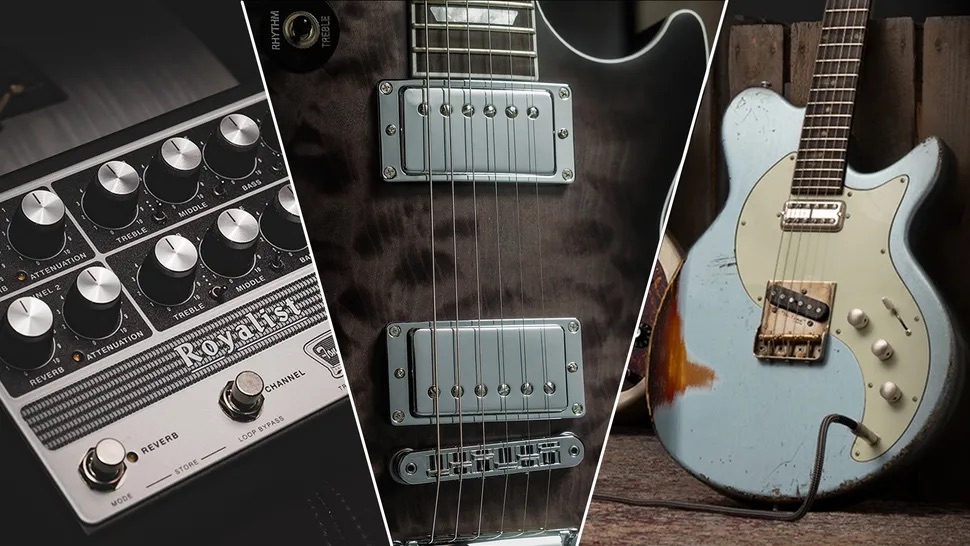


NAMM 2026: So, there we are. Another NAMM in the bag. 2026’s show further cemented 2025’s new normal: smaller booths, not quite as much product, but still a packed-out Anaheim Convention Center.
After making a big splash last year, Marshall was a no-show. Fender held an off-site Custom Shop event, but its only showfloor appearance was to promote its new Studio Pro DAW. Major brands like Gibson, ESP and PRS were in rooms accessible by appointment only.
Yet, weirdly, this all establishes NAMM as an important event in the gear calendar. Brands still value those dealer relationships. And, heck, as media, we can still get in, so we’re not complaining.
But what did we learn? Where is the gear industry heading? And, most importantly, what are we going to be spending our hard-earned dollah on?
Collaboration is the new competition

If there’s an upside to the ongoing tariff uncertainty and its effect on businesses big and small, it’s a new sense of unity across the industry. It’s not just about competing; it’s about growing the market by reaching out to new players and, sometimes, joining forces with complementary companies.
Take Laney. For its new Billy Corgan pedal amp – one of the highlights of the show for me – it joined forces with the Smashing Pumpkins frontman’s amp builder, Brian Carstens. The resulting pedal, the Supergrace, combines vintage Laney Supergroup sounds with the boutique maker’s detailed high-gain distortion. It’s using each other’s knowhow to further both brands.
Synergy debuted its new machine learning tech that makes class D power amps respond like a proper tube power section. But for the actual physical products, it teamed up with Boutique Amps Distribution buddies Wampler and Friedman, who employed the tech into an IR-Load head and pedalboard-friendly power amp, the Pedalhead.
EarthQuaker Devices and Dr. Z made a tube-loaded preamp pedal, ZEQD-Pre – billed as the ultimate end-of-signal-chain tonal tool. Blackstar previewed the BEAM Mini – world’s first amplifier to natively support Neural Amp Modeler (NAM). And Third Man Hardware’s entire booth is a reminder of just how many collabs Jack White has secured with pedal companies big and small.
It’s gratifying to see companies come together to push the market forward. More of this, please… (MAB)
Neural DSP has won the modeling game… or has it?

The conversation surrounding the state of play in the amp modeling market can often run the risk of becoming a bit stale. Firmware updates, hardware launches, everyone trying to do the same thing better than their competitors… modeling fatigue is a real possibility.
But this weekend Neural DSP looked to have all-but put the conversation to bed and taken control at all points of the modeler product chain spectrum. Here, new to the show, was the Quad Cortex mini – a touchscreen-equipped compact modeler that was first believed to be the middle ground between the Quad and Nano Cortex pedals.
However, that’s not really what the QC mini is. Functionally, it isn’t quite a middle-ground, because it is, basically, a full Quad Cortex, with the same processing power and a higher-than-anticipated price tag of $1,399 that puts it within touching distance of the QC.
At first glance, it looked to be the stake in the heart of Line 6, IK Multimedia and even Fender’s chances of wrestling control with their own in the premium, touchscreen-loaded, compact modeler. Those units are still years away. Neural DSP has beaten them to the punch by some distance.
Nevertheless, the story isn’t quite so black and white. At that price, it leaves the door open for rivals to issue a compact modeler of their own at a more accessible price point.
For now, the crown sits comfortably with Neural. But it might not stay there… (MO)
The tube is alive and well – the mid-range amp is not

There’s been a lot of debate about the future of tube amps in recent years. The tube shortages and supply chain disruptions of the COVID era and Russian sanctions forced a re-think for many of the big firms.
However, at NAMM 2026 tube amp builds appeared to be in rude health. High-end, innovative tube designs proliferated, with Magnatone, Orange, Two-Rock, and Divided by 13 all unveiling killer builds.
The latter’s Butch Walker signature, the BW 1969 [pictured above], takes a British amp and let’s you toggle between EL34 and 6L6 power stages, or stack them.
Orange’s OR60 is a single-channel amp that can somehow conjure up a huge variety of tones, Two-Rock’s Studio-Overdrive offers its own flexibility, bringing new levels of gain to a firm renowned for its headroom.
What is notable is that these are all high-end builds. Even the 8-watt Slack signature from Magnatone, the Lil Viper, retails at $1,899. So the tube really is becoming the preserve of the player of means, rather than the masses.
It’s sad in some ways, but it’s also taking the brakes off for boutique builders – and that’s exciting.
Meanwhile, most mass market amp solutions we saw weren’t traditional amps at all – between pedal amps, modelers, and the plethora of clever practice solutions [see below] – there were very few actual amps debuting at the sub-$1,500 mark.
All of which leaves me noting that it’s the mid-range amps that have really died a death. Those products that used to plug the gap between your crappy practice amp and your dream tube head. Those are notable in their absence. (MP)
Innovation takes many forms
Yes, the halls of the Anaheim Convention Center are typically filled with familiar-looking designs, and that shows no sign of abating (heck, even Tokai’s ‘lawsuit-era’ copies are making a comeback). But it felt like there was more innovation than normal on display this year.
Most obvious was the Casio Dimension Shifter – the doohicky that attaches between your strap and guitar and enables you to manipulate the parameters of any pedal with an expression input. That’s innovation in its purest form.
You might expect it to be the type of thing that never catches on, but the fact it was crowd-funded indicates there’s an appetite from guitar players for boundary-pushing devices.
Polyend isn’t a name we’ve mentioned much on Guitar World, but with Endless, its open-source pedal that lets users create effects from prompts, we’re sure to be talking about the Polish firm an awful lot more. It’s essentially ChatGPT in pedal form and the best use of AI in the gear world we’ve yet seen. It sounds spectacular, too.
Technological marvels don’t all require electricity, however. Strandberg debuted an all-new tremolo design, the Arc TILT, which promises smoother motion with more stable pitch control.
Gibson, meanwhile, used the show as an opportunity to gather feedback on a concept offset guitar, the Atomic Age. A brand-new guitar shape from one of the world’s oldest guitar companies? Will wonders never cease… (MAB)
The practice amp game is more competitive than ever – and it's evolving fast

JBL muscling in on the guitar arena was one of the biggest shocks of the show. The audio giant, best known for its ubiquitous portable speakers, debuted BandBox, an AI-powered smart practice amp.
Available as the Spark Go-esque Solo or the considerably larger Trio, the BandBox is most notable for its ability to separate song stems using AI, enabling players to isolate or remove vocals, guitar, or drums from any track in real time.
Shania Twain Strat slinger Lindsey Ell demoed the tech live onstage and it was impressive, quickly switching out the track mix and pitching songs up and down.
Jury’s out on JBL’s own amp-modeling tech – it is, after all, early days. Down the line, it could be worth partnering with more established amp brands to really hone the tonal side.
But as it is, the BandBox signals how much the practice amp market has changed: back in the day, you were lucky to play through something that sounded adequate.
But since the advent of the Positive Grid Spark, players are increasingly looking for something that can help them hone their playing. Finally, practice amps are living up to their name. (MAB)
Prices TBC

Like any manufacturing industry in 2026, the music-making business is heavily reliant on imports, and the tariff/global trade situation continues to have a major impact.
It’s impossible to paint a complete picture of the disruption, as it is in almost every facet of production across the industry – from components to materials and machinery – and there’s little appetite for politics at NAMM, but there are signs of the issues.
More than ever, brands appeared to be keeping info on prices for their 2026 lines very close to their chests, particularly on those products that were not due to hit stores directly.
It’s understandable: trying to predict what costs and, therefore, what viable profit margins and list prices might be in six months to a year has become a huge challenge.
Others are still figuring out how to price existing products – and we’re seeing different approaches.
For instance, Solar’s new ‘Sweet prices’ for the US, which attempt to take the uncertainty off the table by offering one fixed price that covers all shipping, tariff duties, UPS fees etc., so players know what it will actually cost at the point that they order.
Elsewhere, other forces of change are having their own impact, with manufacturers struggling to secure memory chips that are in short supply and being snapped up by cash-rich AI firms. Sadly, it seems there might be further pressure on prices, as a result. (MP)
Nylon-strings for shredders is becoming a new product category
Forget the classical guitar gathering dust in the wardrobe. Nylon-strings just got sexy. Ibanez ushered us into a nondescript meeting room so Tim Henson could give us the lowdown on TOD100, a higher-end version of his best-selling signature nylon with a Fishman Acoustic Matrix undersaddle pickup and fancier tonewoods.
Tosin Abasi, meanwhile, finally made good on his promise of a Larada nylon-string – but he ended up partnering with Cordoba to do it, with a price tag of $1,499. “It was kind of like my dream classical guitar,” he told us. “It's quite thin and it doesn't feed back on stage. You can plug it in, and if you're recording direct, you get a tone that sounds like you’ve mic’d up a high-quality nylon string guitar.”
Neither of these guitars will get you much volume unplugged; rather, they’re designed almost like electric instruments, with body contours and playability to match. And with two of today’s most groundbreaking players putting their own spin on the design, it hints towards the changing face of guitar playing. (MAB)
The headless guitar trend was never a ‘trend’ – it’s a movement

Those who thought the headless guitar resurgence was merely a phase may need to eat their words. They can’t be faulted, though – five years ago, who’d have thought that the headless guitar market would be continuing to grow with every passing month? Not many.
Strandberg, of course, is the biggest reason for that. Ola Strandberg’s firm has reframed what is possible from headless guitars while championing an ergonomics-led design ethos that prioritizes player comfort and health.
As players continue to cotton on to the benefits of headless builds, so too are rival firms. Ibanez, Kiesel and Schecter have already joined the ranks, but now there’s a move to make them more accessible than ever.
Donner’s HLX-500 – dubbed “the ultimate modern headless guitar” – is only $330, and offers an ‘asymmetrical neck profile’ directly inspired by Strandberg.
Cort, whose pedigree in affordable guitar making needs no introduction, has also released its own headless designs. Strandberg continues to set the standard and is the benchmark to beat, but this trend certainly isn’t slowing down.
If anything, it’s speeding up – and finding it’s way into more parts of the market. (MO)
Player wants are leading the charge on new products

One really encouraging trend at this year’s show is just how many manufacturers have actually been listening to players when it comes to the spec of their gear.
It’s an idea companies have paid lip service to for a long time now, but when we see stainless steel frets on Epiphones, or Yamaha finally capitulating to a rare new signature model – in the much-demanded Chris Buck CB502, its first signature Revstar – you get the impression that message boards are actually being monitored in 2026.
They say the customer is always right, but the industry has certainly previously been guilty of spec’ing to a price point rather than a player’s needs.
Now we’re seeing signature models emerge that are more than simple refinishes – and serious component upgrades on firm’s more affordable lines.
You can argue it’s simply a continuation of the premium offshore trend. I’d also wager it’s a response to the challenges and risks facing builders and guitar importers in 2026 – there is simply no room for flops.
Or perhaps it’s simply management really understanding their customers, reading the feedback and meeting them where they are.
Either way, we’re pleased to see it. (MP)

