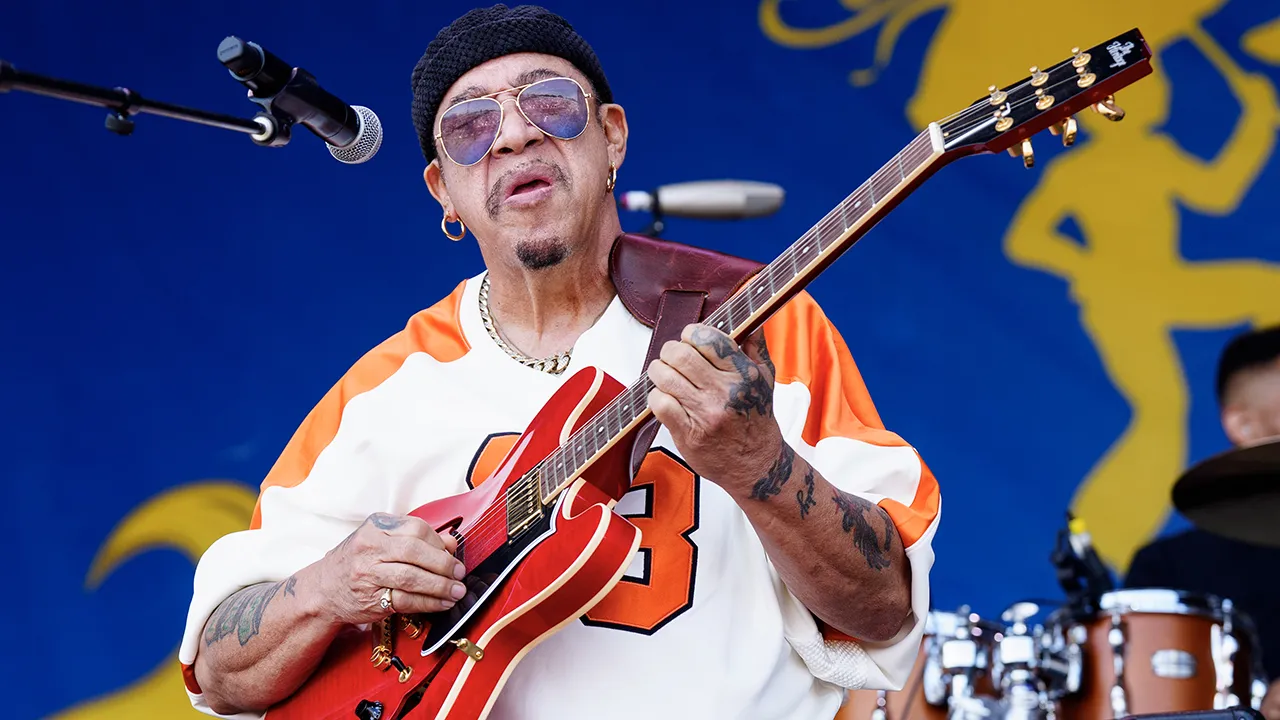
Steve DiGiorgio – who’s lent his licks to Sadus, Death, Testament, and more – seems chilled out. But beneath the surface is a seething four-stringer who loves to push the envelope.
“I’ve always gravitated toward the obnoxious,” he laughs. “In junior high, I I got a referral from band class that said, ‘Dismissed because he likes to blast his horn and play loud!’ That carried through into the nature of how I approach everything: in a slightly aggressive manner.”
Di Giorgio is credited as an originator of fretless bass within extreme metal. “I was just the first to get noticed for doing it,” he says. “I just ran with it. I’m still finding my way. My tone has evolved to where I’ve gotten the most un-fretless tone out of that instrument!]”
He also got noticed for his playing on Death albums Human (1991) and Individual Thought Patterns (1993). But at the time he had no idea he was making history. “When those came out, we weren’t exactly sure of what we did,” he admits.
“We didn’t know the impact they were going to have. We were young and going for it. I was just trying to fill up the gaps. I guess it kind of created a ripple!”
He’s modest about his extreme-metal legend. “People liked it,” he shrugs. “They did the same thing later after us. You have no idea what the impact will be. If you set out to do something special, it can dissipate. We had a light attitude about it, although we were half-serious. I guess we did something right.”
What got you going on bass?
I started off playing upright acoustic bass in the orchestra at school. When I got into the class I’d never played a string instrument before. I was relegated to the rehearsal room with a bass and a beginner book. I just had to woodshed.

The other bass player in the orchestra was really cool – he taught me things the book didn’t. He brought in an electric bass one day; I think it was a Fender. When I tried it, I knew I had to pursue it because it was easier to learn on. It had lines, dots and markers.
Can you remember your first proper electric bass?
I went to a local music store, pointed to this bass on the wall because it was black – I had no idea of the brand or model. The shopkeeper was like, “Okay, what are you gonna plug it into?” He turned me on to a little no-name speaker amp.
I played some Black Sabbath and Judas Priest songs with some friends from school, and I think I blew the amp up right away! So I had a crash course in electronics, tone and volume. To this day I’m being told to turn down. I guess I’m traumatized by shitty equipment!
What led you to the fretless bass?
I learned the fretted instrument pretty quickly. I played basslines by Steve Harris, Geezer Butler, Geddy Lee, Chris Squire and Bob Daisley. I was also a big fusion-head and a lot of bass players were playing fretless there, so it was like a lightbulb moment.

Once you switched to the fretless, what gear were you using?
After playing my Rickenbacker for so long, I called the company and said, “I want to buy a fretless Rickenbacker, but I don’t want any markers on the neck because it’s against orchestra standards.” The guy said, “We don’t do any custom work. What you see is what you get.”
Being young, naïve, and obsessed with the aesthetic, I decided to build my own bass. It first appeared on Individual Thought Patterns. I’d done Human with my old ’81 Ricky, so that’s all fretted four-string bass. I didn’t bring the homemade bass when I moved to Florida – it didn’t seem appropriate for what I was going on. Which was totally wrong! Once I blended with those guys I could have used that tool and made it work.
Some of the stuff we played was in spite of the material. It was a challenge to fuck it up the most we could!
I used it on the Sadus album in ’92 [A Vision of Misery], and the second recording I did with Autopsy [Fiend for Blood]. But those albums didn’t get as much recognition as Individual Thought Patterns.
What was it like putting together Death’s Human?
We jammed a lot. It was easy to do because Chuck Schuldiner was a close friend. He called me and the next thing I knew, we’d rented a rehearsal room in Miami. I would just burn a joint and play whatever came to mind. It was a big improv session most of the time.

You probably didn’t know you were making landmark albums with Human and Individual Thought Patterns.
No, not a clue! We were just doing what we had to do. I look back on it and I wouldn’t have done it any differently. But it’s almost like some of the stuff that we played was in spite of the material. It was kind of like a challenge to fuck it up the most we could!
Like, if something was expected, we purposefully did it the other way. It felt weird at the time, but Chuck embraced that abstract approach. He supported individuality.
We weren’t particularly invested in the genre to the point where it was paint-by-numbers or monkey-see-monkey-do. We almost thought it was a waste of time if we played something that felt familiar, so we were always reaching for something different and strange.
You worked on Chuck’s Control Denied album before moving on to Testament. Did you keep in touch before he died in 2001?
As much as I could. We had some phone conversations when he was going through radiation and surgeries. It was pretty tough. When someone is so severe and so far along in that terminal process, you don’t really know what to say. There’s no advice or experience you can offer.

I just tried to talk to him like everything was – not normal, but I just put aside what was going on. For example, one time we were talking about this problem I was having with the band I was working with. The band leader was such a drama queen and Chuck was giving me advice on how to handle people with these attitudes.
Suddenly I was like, “Oh, man, I’m sorry. I’m talking about these stupid, meaningless problems while you’re going through something so severe. That’s selfish of me.” And Chuck goes, “No, this is exactly what I need. It’s so much more interesting.
I’d run into Testament and they kept saying, ‘Be ready!’ I’d be like, ‘What does that mean?’
“On a day-to-day basis it’s appointments for an hour on this machine that makes me sick, then I’m walking around the neighborhood or taking a nap. It’s really boring. I appreciate you giving me some good, juicy stuff to distract me!”
It must have been hard to see a close friend struggle.
Time started going by and he got worse and worse, and he wasn’t able to talk on the phone anymore. I left him a couple of messages.His caretaker said that even though he couldn’t speak very well, he still liked to listen to his messages. But that was even more awkward because you’re just talking to a machine, trying to be positive and realize he’s in a bed, fading away. It was horrible.

What was it like joining Testament in 1998?
That was a growing process. When I came into the band they were on a comeback mission. Their idea was to hire guys who were recognizable – they got Dave Lombardo, James Murphy, and I got brought in last. That’s why the album was called The Gathering.
You left Testament in 2005 but returned in 2014.
When they got the original lineup back together, I was out doing my own thing. I’d run into them and they kept saying, “Be ready!” I’d be like, “What does that mean?” But sure enough, when they lost the OG bass player [Greg Christian], Chuck Billy was ringing my phone off the hook, and I went back.
When Dave Ellefson was fired from Megadeth in 2021, Dave Mustaine called you.
When Ellefson was having – I don’t even know what to call it – his online episode, we were all watching to see what was gonna happen. It was a very new and different thing. People have been exposed in the press for embarrassing things that led out of bands like money issues, drugs, or common things. That stuff comes with the territory, but what happened to Ellefson was pretty unique.
I felt like if you put yourself in the guy’s position, how horrifying to be so exposed like that. We were all watching, and when he was booted from the band, and he made his statement about him doing nothing wrong, it just kind of faded away.
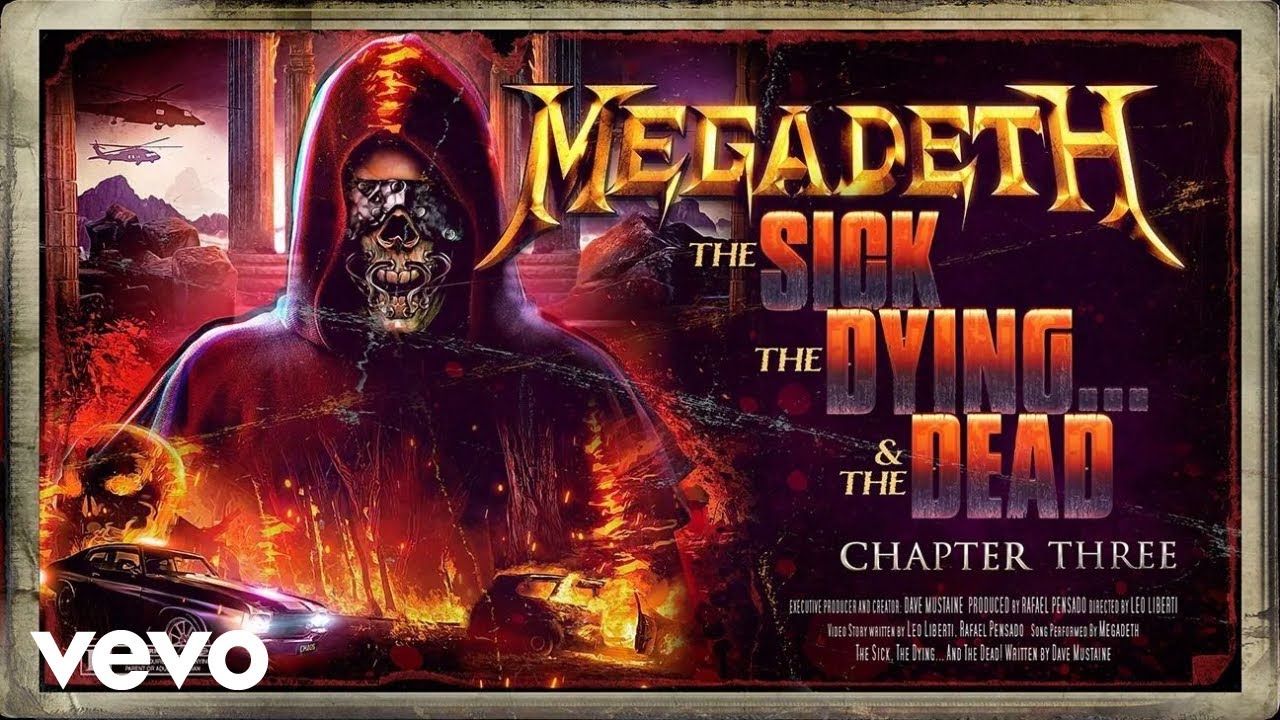
Were you surprised when Dave Mustaine called you?
Once the main impact was gone I stopped paying attention. So I was surprised when the phone rang, and it was Mr. Mustaine looking to get me to replace Ellefson. I was like, “What the hell?” I just didn’t picture it happening. I felt like there were so many other deserving bassists who would have fit the role better. So I declined.
Then Dave said he needed to hurry and finish the album because whatever Ellefson had contributed had been erased. They were looking for someone to do that and continue touring. I said, “Well, I’m not gonna leave Testament. If I were to help you guys, it would have to be some kind of a juggle where I don’t mess up my Testament plans.”
I know people wanna hear that Dave Mustaine’s some kind of dictator. It was totally not like that
They were like, “No, we need a full commitment.” I was like, “I can’t do that.” So I declined again. And then, the third time, and they said, “You have a reputation for coming in and getting recordings done on the spot. Come to Tennessee, do the record, and we’ll see if this is meant to continue.”
I said, “Okay, that’s definitely something I’m used to doing.” I got on a plane, went out there, and I finished the tracks. But the more we talked about the potential success of the record, and the business of the schedule, It just didn’t seem like it would be fair to either band to split my time.

So I just said, “I’m happy where I am. I’m just gonna stay loyal to my bros.” I knew I was kissing a good gig goodbye, but I was fine where I was. Everybody understood and we parted as friends. It was a great experience.
What was it like working with Dave Mustaine?
I mean, Megadeth is Megadeth, man. Nobody’s gonna go in there and reinvent it. That’s Dave’s world. He has a specific sound and way of everybody contributing to make that sound. I just put my session hat on and approached the job the way it needed to be approached.
I listened to his advice and I was wide open to be guided. There were times when Dave would stop and say, “This part needs a little decoration. What have you got in your toolbox?” He opened some stuff up. I even played a part on the title track on fretless, which was something new for Megadeth!
I know people wanna hear that Dave’s some kind of dictator. It was totally not like that. He was super cool and a very chill dude. I didn’t come in there all brash, thinking I was gonna reinvent the wheel. He felt relaxed around me and he opened me up. It was a totally positive and an unexpected experience.

Testament’s latest record, Para Bellum, is doing well.
It’s off to a better start than the last two! There’s a lot of energy, and when the fans start reporting back to you with what they feel about it, and you start seeing the chart and sales results, you go, “Wow, this thing really has a ball of steam to it, man.”
We have a lot of tour dates coming up in 2026 – I think my whole calendar is booked. It’s exciting that this far along in the band’s career and at our age, we’re still making music that people get really excited about. I didn’t expect it! But like they say, good things happen when you least expect them.
- Para Bellum is on sale now. Testament are currently on tour.