




Guitar World Verdict
I doubt Orange could have made this unit any simpler or more reliable. It is a joy to use, mainly due to the speed of tests lasting only two to three minutes. For more in-depth reports of specific characteristics, a traditional multi-dial unit may still be the way to go but for reliably testing valves quickly and without ambiguity, this valve tester from Orange can’t be beat.
Pros
- +
Easy to use.
- +
Gives pass, worn or fail results.
- +
Offers performance matching and microphony tests for preamp valves.
Cons
- -
Not all additional modules for the various rectifier valves are currently available.
- -
12ay7 valve not on the test list.
- -
A full valve list with all the historic equivalent codes printed in the manual would be a big help.
You can trust Guitar World Our expert reviewers spend hours testing and comparing guitar products so you can choose the best for you. Find out more about how we test.
What is it?

In the same way that a tree's age may be calculated by the number of its rings, a guitar player's history with tube amps could be represented by the size of the pile of used valves we’ve hoarded away. If you are anything like this humble reviewer, you’ll have a cupboard stuffed with these critters in all types and states of repair.
Repopulating an amp with any failing cast-offs could invite costly damage
It’s been a common practice historically for amp technicians to recommend replacing valves when performing maintenance and repairs. Rather than trashing said valves, we’ll often pop them on our growing pile of decommissioned glassware. However, the nagging reality is that we have very little idea of their condition, and repopulating an amp with any failing cast-offs could invite costly damage.
A well-made, high-quality valve from the mid to late 20th century may very well outperform current production valves from the dwindling amount of factories still manufacturing them. But all things must pass eventually and without warning a valve can expire in a number of ways, depending on its type. Whilst a preamp valve may perhaps only reveal its declining health by producing noisy and extraneous microphonics, a power valve such as the EL34 or 6L6 may end its days by frying expensive components such as transformers in an expensive blaze of glory.
The fear that catastrophic failure could occur in a gig is often cause enough to warrant purchasing fresh stock. However, when we consider that those old valves on the subs bench are made by titans of 20th-century valve excellence, with manufacturing standards unlikely to be repeated, perhaps it is worth assessing what life they may have left in them.

Up until recently valve testing was exclusive the realm of equipment technicians and repairers
Failing valves don’t always give perceivable audible or visual clues as to their ailing condition so if we are serious about reliability and performance from our valve amps, it’s worth going through your valve stock to avoid potential damage of the expensive kind.
Up until recently valve testing was exclusive the realm of equipment technicians and repairers, who could justify the cost of the large valve testers manufactured by the likes of Millard, Hickok and others. Cryptic and somewhat off-putting to the average untrained user, they required a more than passing understanding of electronics and the tester’s many controls would need to be set up for the specifics of each valve. Quite a time-consuming endeavour with plenty of potential for errors.
In steps Orange with its MK II valve tester, allowing the average non-technician valve user to perform over 20 automated tests on their valves to gauge their operational condition. Rather than set up the plethora of dials and controls we would find in a traditional analog valve tester, the settings needed for the various valve types have been programmed into a very simple digital interface requiring little to no knowledge.
Specs

- Price: $1079 | £849
- Origin: UK
- Options: Plug-in expansion modules for EF86, 300B, 6SN7, EZ80, 5AR4/GZ34 ($249 | £199 each)
- Dimensions: 180mm [W] x 165mm [D] x 70mm [H]
- Weight: 3.3lbs / 1.5kg
- Contact: Orange
Usability and sounds

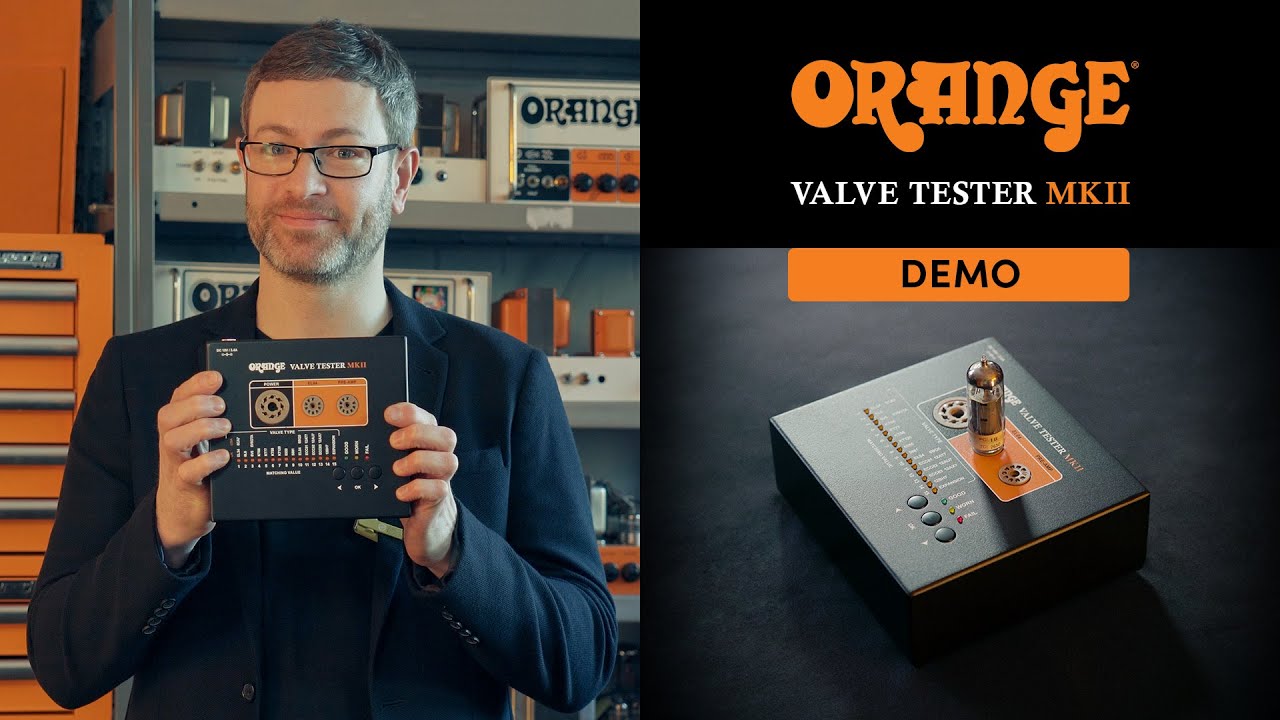
Deciding - in uncommon fashion - to read the manual before commencing, it became quickly obvious that Orange has designed this to be instantly usable for the non-technically minded. We have three sockets clearly labelled for the various valve sizes and I begin tests on a quad of Mullard EL34s.
After selecting the EL34 setting from the two arrow function controls and I switch the valve, press go and see various flashing LEDs until, after around two minutes, the unit makes an audible click and displays a stable reading for the results. It’s worth waiting for the valves to cool before repeating, as a hot valve is a fragile valve.
There's a very basic set of three traffic light-style indicators for Pass, Worn, and Fail to keep things clear. Furthermore, a rating is provided that tells us the operating power available from the tested valve. This number can then be used to match up valves used in pairs, triplets or quads for increased performance.


The Orange Valve Tester is able to show the results of both halves of the valve, a real help when both operate in conjunction, as a phase inverter does
Testing preamp valves is just as simple, but with two important extra tests. Preamp valves, such as the ECC 83 and variants, are actually two units in one, both able to function separately. The Orange Valve Tester is able to show the results of both halves of the valve, a real help when both operate in conjunction, as a phase inverter does.
Finally, a microphony test can be performed on the preamp valves, requiring a few taps to the valve from the supplied Orange-monogrammed pencil. Again, the LED display shows a value rating commensurate to the condition.
Additional plug-in modules are available to buy for some of the less common valve types, such as those used for rectification purposes in some vintage and reissue amplifiers.
Verdict
Verdict: ★★★★½

The Orange Valve Tester MKII isn’t a cheap device, and will be of most interest to professionals or owners of collections of amplifiers. Whilst the results reveal everything a guitarist may need to know, it’s possible a more knowledgeable technician may wish to read values such as thermal leakage individually. But as an overall investment, it demonstrates form and function in full alignment.
Guitar World verdict: I doubt Orange could have made this unit any simpler or more reliable. It is a joy to use, mainly due to the speed of tests lasting only two to three minutes. For more in-depth reports of specific characteristics, a traditional multi-dial unit may still be the way to go, but for reliably testing valves quickly and without ambiguity, this valve tester from Orange can’t be beat.
Hands-on videos
Orange Amps