




Guitar World Verdict
The quality of tones on offer, for something designed for on-the-fly and silent practices, is highly impressive. Armed with just the device and its partner mobile app, I have a great set of tools for tone building, practicing, and capturing ideas in the dead of night, or on the move. It starts to lose its way once you get into the nitty-gritty of the desktop app, but if you’re after a high-quality travel rig, this pocket-sized gadget is a killer option.
Pros
- +
Incredibly dynamic amps.
- +
Vast array of tones across genres.
- +
Easy to set up.
- +
Long battery life.
Cons
- -
Preset loading could be a little faster.
- -
Desktop app isn't great.
- -
A little pricier than its main rivals.
You can trust Guitar World Our expert reviewers spend hours testing and comparing guitar products so you can choose the best for you. Find out more about how we test.
What is it?
IK Multimedia’s Tonex range, which takes in amp modeller pedals like the best-selling Tonex One to plugin software, has been racking up the plaudits with wild abandon. Joe Satriani and Alex Lifeson, two players with high tonal bars, have also teamed up with IK Multimedia for signature releases, which should be considered a badge of honor.
Consequently, the promise of all of its modeler magic crammed into a portable, quiet practice-friendly headphone amp is sure to whet the appetites of those after a practical solution to riff time, and those who want to rip guitar solos atop mountains.
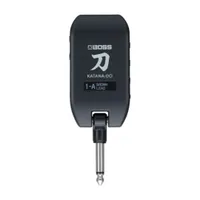
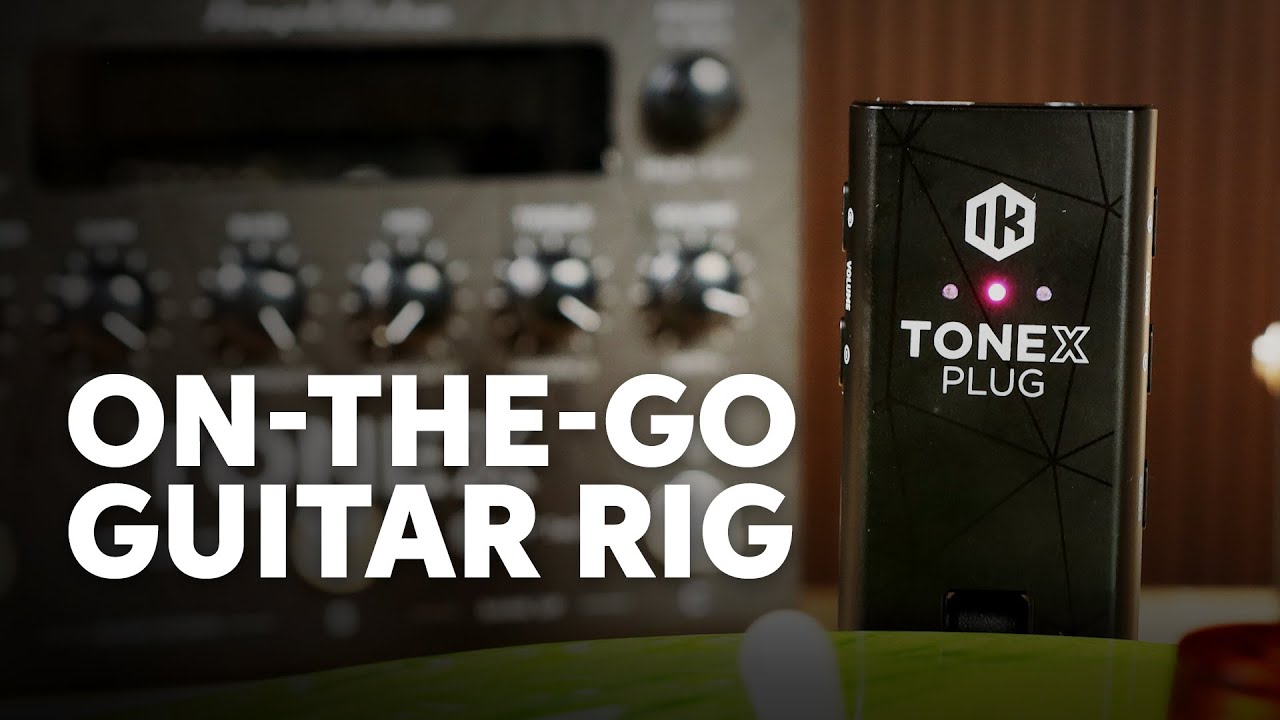
The Tonex Plug is the firm’s first headphone amp, and it’s looking to deal some big blows to leading competitors, including the Fender Mustang Micro Plus and Boss Katana: GO with 40,000 tone models accessible, buoyed as they are by AI machine modeling.
IK Multimedia is throwing the kitchen sink at its version
There are 30 customizable slots and a stock of virtual pedals, spanning classic overdrives and fuzz boxes through to modulations, delays, reverbs, and compressors. IK Multimedia wants to remove the limits of what headphone amps can do.
From parents to those who find their neighbours don’t like them burning the midnight oil with a cranked tube amp, and ever-travelling musicians, the concept of an amp the same size as a car key fob has plenty of benefits. But, traditionally, they’ve been a little stunted in their scope. The Fender rival, for instance, packs just 25 amp models, the Boss's 13 are split between electric guitar and bass. For a tiny box, those counts aren't exactly measly, but IK Multimedia is throwing the kitchen sink at its version.

As such, the Tonex Plug is said to be just as powerful and gluttonous in its specs as the rest of the Tonex range, with Bluetooth connectivity for jamming along to tracks, a swivelling jack plug for comfy fitment whatever the instrument, a six-hour battery time, and low-noise performance, leaving it well-equipped.
In recent years, headphone amps have been getting some serious upgrades, turning the market into a highly competitive place – these devices are no longer primitive little ‘make dos’ for when we’re away from our go-to gear, and the bar is getting continually raised.
IK Multimedia has already proven itself a key player in the amp modeling world, so does its magic translate to this unassuming little box, and where does it stand amongst its direct competitors?
Specs

- Price: $149/£149/€149
- Type: Headphone amplifier
- Controls: Preset, Tuner, Volume, Bluetooth, Power
- Features: 40,000 tone models with 30 preset slots, EQ, gate, compressor, delay, modulation, and reverb
- Connectivity: 1/4" swivel jack and 1/8" stereo headphone output, Bluetooth, USB-C
- Power: 5V DC, 700 mA via USB-C
- Dimensions: 40 x 20 x 75mm
- Weight: 2.50z / 0.07kg
- Contact: IK Multimedia
Build quality

Build quality rating: ★★★★★
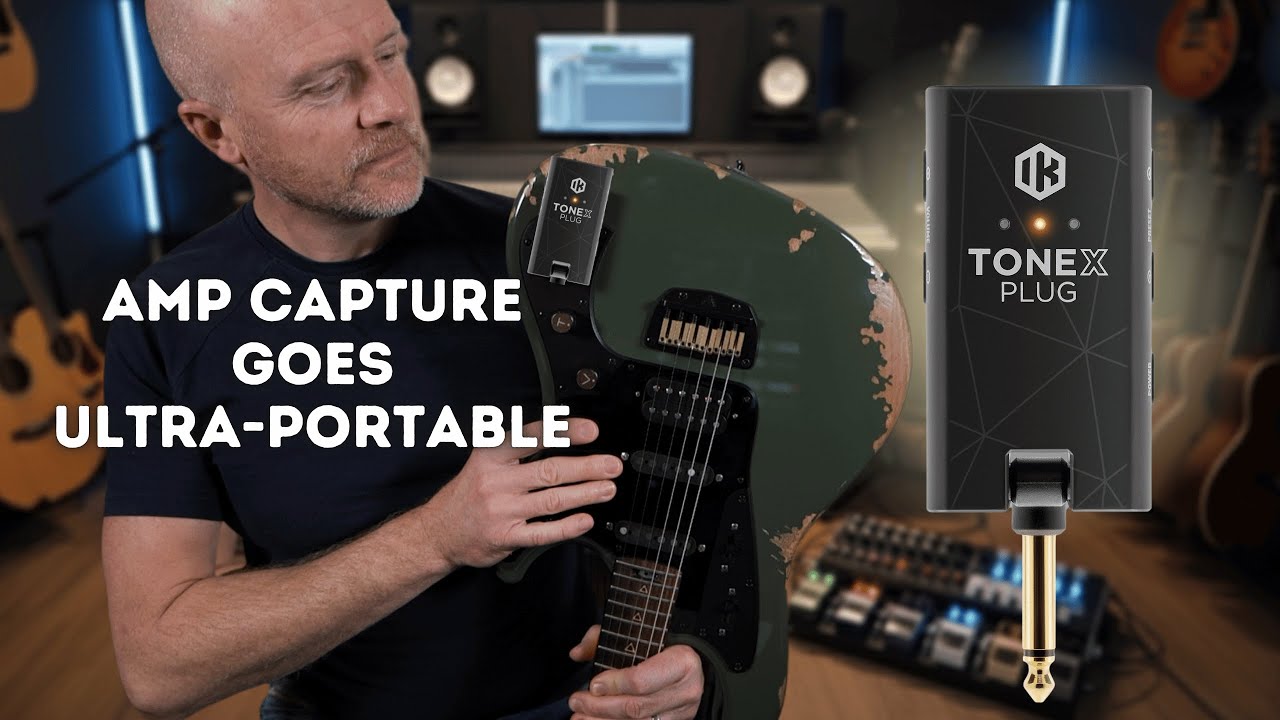
There’s something of a paradox to the Tonex Plug. It’s lightweight, as you’d expect, and its casing is made of plastic, yet there’s sturdiness to it. The hinges of its jack feel like it could take a beating, and it allows me to have it sit snug against all my guitars, regardless of their shape and the style of the input.
It also swivels ‘closed’ in a nice, compact way, meaning it could easily slip into my jeans pocket. Portability is paramount, and it’s most certainly that.
The button count on the unit itself is minimal, following the general theme of headphone amp design, making it sleek without lacking the essentials. I’m struggling to find any real gripes here, although some may feel the curves of a Boss Katata: Go make it a little less boxy and prettier to look at. But does that really matter?
Usability

Usability rating: ★★★★☆
I have three ways to use the Tonex Plug: on its own, or controlling it via my phone or desktop computer. The device itself is easy to use, with buttons often doubling up for various roles. But vitally, it was effortless to get playing.
I have three ways to use the Tonex plug, and it's effortless to get playing
There are some minor teething issues, though. The three lights on its body do their best to play the role of tuner, but it requires a lot of neck craning and putting myself in some uncomfortable positions to turn the tuning peg and then pivot back to see the lights flicker. Plus there’s no indication what note it is you’re tuning, so a little know-how helps – the in-mobile app tuner is far better.
Pressing the volume +/- buttons for two seconds makes the device discoverable via Bluetooth, allowing me to stream audio from my phone for playing along to tracks on Spotify, YouTube, Google Drive, and pretty much anywhere else I’d want. After a quick line check of the rig versus the backing track, it proved a genuinely useful feature and allowed me to lock into my practice fast.
While Bluetooth playback isn’t unique to the Tonex Plug, it works a charm here. I ran multiple practice sessions straight from my phone for tone tweaking and jamming, and never once felt restricted—or tempted to jump back into the DAW sitting open in front of me.

When browsing between presets, I often found loading times to be a few seconds, which is pretty quick, but can make leafing through its banks a little tedious. Switching between pre-saved presets on the device itself, though, is near instantaneous.
I ran multiple practice sessions straight from my phone for tone tweaking and jamming, and never once felt restricted
One big plus is its metronome, which is also easy to use and handles a variety of time signatures, with customizable tempos and toggleable accents. So, if you’re struggling to nail a certain part during your practice session, like I was, it’s a great way to quickly and easily get some dedicated practice in. But there’s no visual aid like some other apps have, which is a minor letdown.
Another handy feature I found was that the metronome continues playing with my in-phone recording app, which is really great for quickly and accurately laying down ideas on the move.
What I do wish it had was the chance to build a tone from nothing, selecting amps and pedals from lists and really going back to basics outside of the desktop app. Instead, the mobile app encourages you to find a preset as a starting point and go from there.
For the most part, this worked fine for me, but if you want to get really granular, then you’ll want to plug into a computer, which is where I found some latency issues to be a real pain. Plus, you have to save a preset before what comes out of the headphone port of the device changes. You’ll need to use the computer’s audio source for experimenting with different sounds, which I found created some feedback issues. It’s a shame, because everything else up to this point has been very plain sailing.
Sounds

Sounds rating: ★★★★★
IK Multimedia has spent a lot of time championing the dynamism of its modelled amps, believing players won’t be able to set them apart from the real, tangible things. So, I went straight into one of its Dumble presets, Dumbell Drive, to test it out, and I was immediately impressed.
Everything responds with a fantastic sensitivity, as a good tube amp should
The preloaded tone floats like a butterfly when I play lightly, but stings like a bee if I really dig in, with pinch harmonics and double stops having a real bluesy sweetness to them. Everything responds with a fantastic sensitivity, as a good tube amp should, with its character changing with the volume dial and the velocity of my playing.
Thankfully, that’s a trait that carries through all the amps I tried. Although one model, based on a Marshall Plexi, was a little muddy for my liking, the Orange head and JCM800 are top-class and highly versatile. They handled all my rock rhythm needs.
Other stock presets include a pretty mean Van Halen-esque lead tone, complete with a wobbly chorus and delay, although it took some minor adjustments for the amp to get it to bite and snarl like a 5150 proper. It might not be the most convincing model of the infamous high-gain amp I’ve ever heard, but it packs great tone nevertheless.

Having such a great-sounding, generously large rig at my disposal while I’m out of the house is incredible
In fact, I never encountered a bad amp per se. Not all were to my tastes, which is exactly the point of such a large library, but the bar across the board is very high.
It doesn’t feel like it excels in certain genres while suffering in others, either. It’s Boosted DZL, based on a Diesel amp head, for instance, is a great choice for gritty metal guitar rhythms, and quickly turns into a fair soloing beast with the delay engaged. But the Tonex Plug has glassy cleans, blues crunch tones, and weird space-rock etherealness in equal measure.
The biggest issue I found is that amps, overdrive, and fuzz pedals all take up the same slot in the signal chain. That means it's one or the other; there is, unfortunately, no way to push a clean amp into dirty territory, which I love to do, and would have loved to have done here with the amps being so dynamically responsive.
This offers the quality of tones I’d expect from a high-end plugin. So, having such a great-sounding, generously large rig at my disposal while I’m out of the house is incredible; it’s a concept that would have blown my mind when I bought my first modeller – a Peavey Yvpyr combo – in my teens.
Verdict

Armed with just the device and its partner mobile app, I have a great set of tools for tone building, practicing, and capturing ideas on the move.
Guitar World verdict: The quality of tones on offer, for something designed for on-the-fly and silent practices, is highly impressive. Armed with just the device and its partner mobile app, I have a great set of tools for tone building, practicing, and capturing ideas in the dead of night, or on the move. It starts to lose its way once you get into the nitty-gritty of the desktop app, but if you’re after a high-quality travel rig, this pocket-sized gadget is a killer option.
Test |
Results |
Score |
|---|---|---|
Build quality |
As rugged as a plastic unit can be. Hard to fault. |
★★★★★ |
Usability |
The device itself and mobile app are superb, the desktop app slightly less so. |
★★★★☆ |
Sounds |
Bestowed with almost too much choice,it has a war chest of tonal delights. |
★★★★★ |
Overall |
A little pricier than some of its main rivals, it helps justify that with such a wide range of amps. If the desktop app was better, and I could add an OD before an amp, it'd be a 5/5,.
|
★★★★½ |
Also try
Hands-on videos
Sweetwwater Soundcheck
The Studio Rats
Jimmy Franklin