


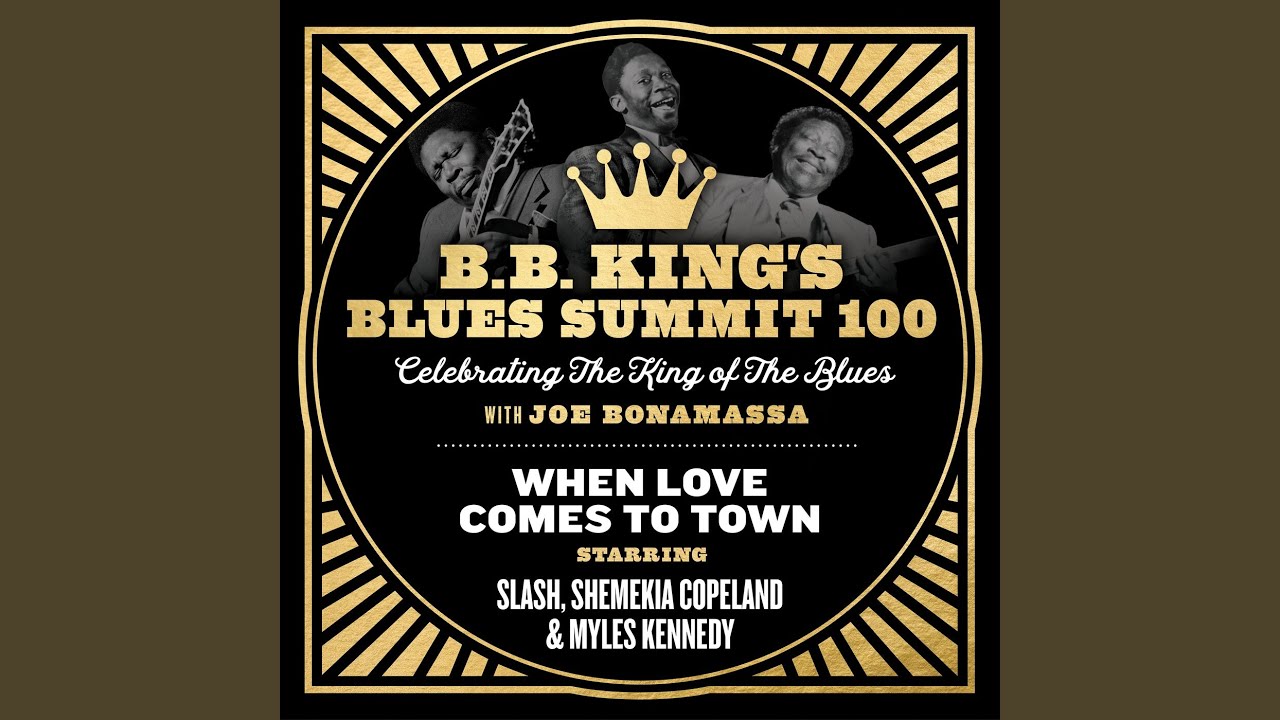
One of the standout tracks from my new album, B.B. King: Blues Summit 100, is a cover of the iconic tune When Love Comes to Town, which is a song King had recorded with U2 in 1988, an unlikely pairing that worked out phenomenally well and became very popular when it was released the following year.
Bono had written the song specifically with B.B. in mind, and they recorded it together at Sun Studios in Memphis. B.B. would subsequently perform the song live with U2 nearly 50 times.
There are many really cool guitar parts in this song, not only from B.B. but also from the Edge, who played a solo, which was delightfully surprising, as it is very unusual to hear him play in this type of blues context.
The Edge’s solo has his signature ethereal sound, so in approximating it, we plugged in a TC Electronic 2290, an AMS reverb – using anything we could find from that era at Sunset Sound in L.A. – and the results are sonically appropriate.
Using that sound, I played a solo in his style, along the lines of Figure 1. The solo is based on simple combinations of quarter and eighth notes, incorporating the open low and high E strings and the open B string, as well as a strummed E5 chord, with all notes allowed to ring into each other.

When it’s B.B.’s turn to solo, he gets right to classic B.B.-style phrasing, like Figure 2. Played in the “B.B. box,” the fret-hand is rooted in 5th position, starting with a big vibrato on an E root note and followed by succinct phrases that draw notes from both E major pentatonic (E, F#, G#, B, C#) and E minor pentatonic (E, G, A, B, D).
Figures 3 and 4 are based on the same approach, this time moving from the tonic chord, E, to the IV (four) chord, A, without changing positions. All of these improvised melodies are played in the same 5th-position box.
The original track offers a great lesson in the power of simplicity in the parts of both guitarists. The Edge played in his style and B.B. played in his, and the two work so well together.
When we set about to record our version of the song, we invited Slash, Miles Kennedy and Shemekia Copeland to contribute their talents, and they all did a fantastic job, putting their own stamp on this classic song.

There are many approaches Slash could have taken for his solo, and I thought it was cool that he did his own thing, utilizing his signature “rock” approach along the lines of Figure 5.
In this example, the first three bars are based on E minor pentatonic in 12th position, shifting in bar 4 up to 15th position then back to 12th position heading into bar 5. Moving into bar 6, the lines shift up to 17th position then back down to 5th position at the end of the bar.
The beauty of soloing over this song’s progression is you can stick with E-scale riffs the entire time, moving simply between the I and IV chords, as the tune never goes to the V (five) chord, B. I encourage you to make it your own, which is the approach Slash took quite effectively here.
- This article first appeared in Guitar World. Subscribe and save.

