




It was once written of the Wedding Present that they are a band “whose world you either buy into fully or not at all.” Founder-frontman David Gedge takes a beat to consider this, then smiles at the idea.
While British alt-rock’s cultest heroes have at times skirted the mainstream – 1989’s major-label Bizarro and 1991’s Steve Albini-produced Seamonsters were staples of college radio – it’s been entirely possible to avoid ever hearing a note of their output, especially on this side of the Atlantic.
On the flipside, playing for a tighter but fiercely loyal fanbase has allowed the Leeds-born band to follow their natural trajectory. From the warp-speed charge of the early years (with Gedge’s right hand pumping like a locomotive piston) through their turn-of-the-millennium dissolution and reunion, that journey is forensically tracked by The Wedding Present 40 boxset, a four-LP cinder block gathering singles, curveballs, and curios.
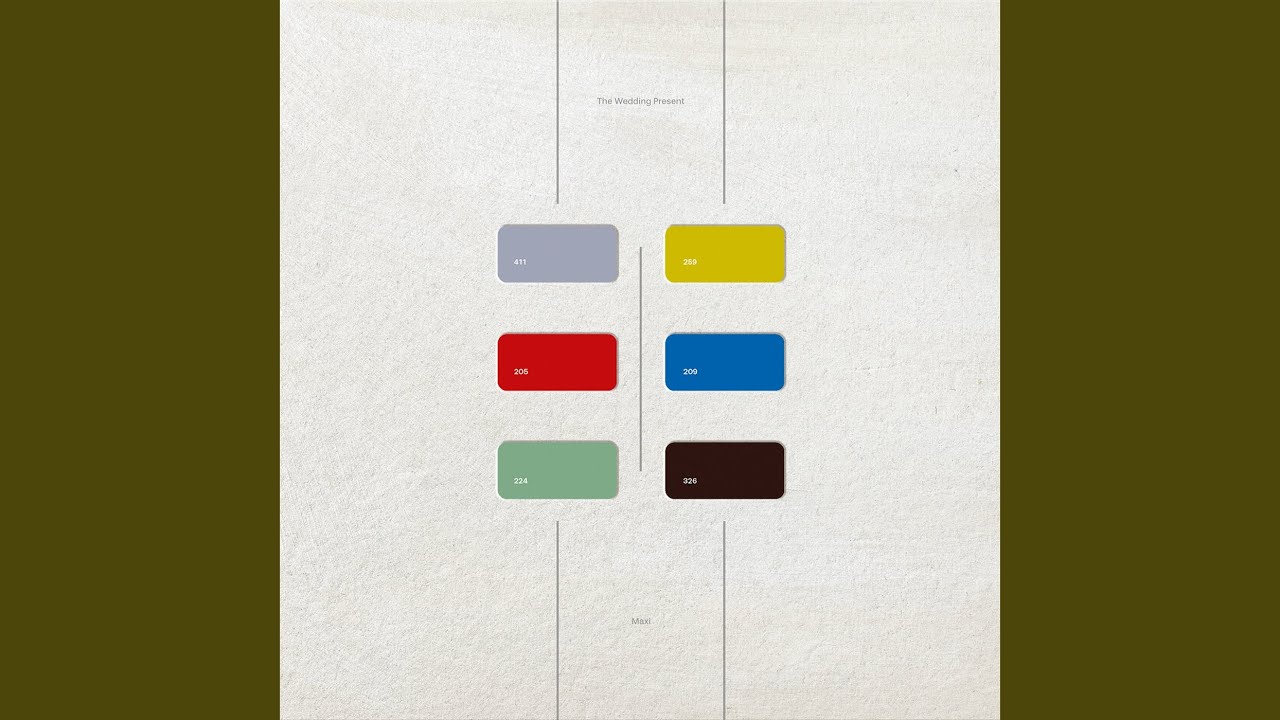
For completists, it’s the final word. But for a capsule-sized introduction to the band, there’s new EP Maxi, spiced with the widescreen pedal textures of incoming guitarist Rachael Wood.
“I know bands always say this about their latest release,” Gedge says, “but I’m really pleased with this EP. It’s big, exciting, rocky, and varied. We had a lineup change and that always helps, because you get people coming in with new ideas…”
We associate the Wedding Present with blistering speed. But EP opener Scream, If You Want to Go Faster begins slow and mellow.
David Gedge: Yeah, it’s quite an odd start for a record. I wouldn’t start a concert like that. But then, other songs like Hot Wheels and Two for the Road are very Wedding Present, ya know? Since 1985, that super-fast, energetic playing has always been our backbone.
When we first started, it was all just a hundred miles an hour. Over the years, we’ve incorporated more textures, tempos, and dynamics. But I still don’t think we’re a studio band. Every record is basically us trying to capture the sound we’ve got live.
What are your own favorite guitar parts on Maxi?
Rachael Wood: There’s a moment in Interceptor where it suddenly becomes a huge heavy riff. I was using a Les Paul and we added a baritone to make it really fat. I love the tremolo line on Scream, If You Want to Go Faster. It’s so lush and sweet and not very Wedding Present-y. We did layering with EBows, which is always a favorite moment for me.
Gedge: It sounds a bit like Sigur Rós, that ethereal quality. It’s like a little orchestra.
How has Rachael’s arrival broadened the band’s horizons?
Gedge: Somebody said on our social media that Rachael was born to be in the Wedding Present. Which is ironic, because she was born at about the same time as the Wedding Present. A lot of this band’s sound is jangly indie pop, but we can be darker and rockier, and Rachael comes more from that side.
Wood: I don’t think I intentionally did that, but I do play quite aggressively live. I love Sonic Youth – so hitting a Telecaster hard is something I really like. We’re complete opposites as players. I have a guitar degree. Whereas David’s always teasing us, saying, “I never bothered learning scales.” He clearly has an excellent ear and his right-hand technique – that speedy playing – is so exciting to play off. So that might be why I’m digging in.
David, can you talk us through your rig and how it’s evolved?
Gedge: When they asked me, “Do you want to speak to Guitar World?,” I had to say, “I don’t know anything about guitars.” To me, a guitar is like a screwdriver, just a tool to write songs. If someone said, “We haven’t got a Strat for you today, you’ll have to use a Tele,” I’d be like, “Yeah, alright.”
So my setup is pretty simple. I started off with an Ibanez Artist semi-acoustic. And I used those until 15 years ago, when another guitarist said, “Epiphone do one [the Sheraton II] that’s cheaper, easier to play, and has a nicer sound.” I also have a U.S. Strat, with the bottom three strings all tuned to E for drone stuff.
I started off with HH amps, because I’d seen pictures of the Buzzcocks with them. Now I use a Fender Hot Rod Deluxe. In the very early days, it was just a clean semi-acoustic into an amp. Eventually, I bought a Yamaha OD-10MII, and that’s the only pedal I’ve ever used. The only thing I’ve added is an Electro-Harmonix Nano POG Polyphonic Octave Generator.

How about your setup, Rachael?
Everyone has to use a Rat in this band
Rachael Wood
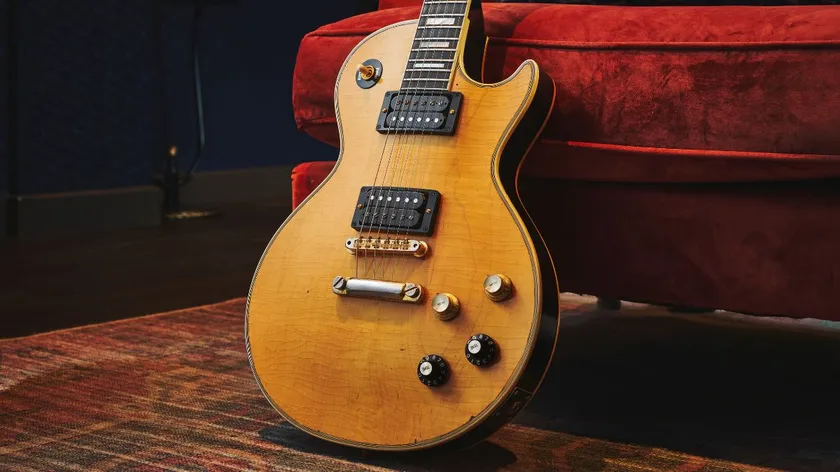
Wood: I recorded with a 2000 Les Paul Custom and a ’71 ES-335, which I wouldn’t use live on this gig because it’s slightly fragile. I used a ’74 Tele a lot as well, and I acquired a new American Standard Jazzmaster just ahead of working on the songs, so there’s a little more trem, slightly surf-sounding in areas. There was a Fender Vibroverb that made a lot of appearances. And David used an Orange head for clean sounds, whereas I’d use that for dirty sounds.
The new EP sounds like more effects are involved.
Gedge: Because Rachael plays with other bands, she’s got a board about the size of this table. And she told me, “That’s my small board.” So I made her slim it down a bit. On tour with us, it’s pointless, because you’re probably using a third of it.
Wood: David thinks I’m a master of pedals because he hasn’t got that many! I really like the Strymon Flint and BigSky… and everyone has to use a Rat in this band.
Who were your founding influences as guitarists?
Wood: My dad turned me onto blues stuff, so Peter Green is my favorite guitarist for his feel. Blur’s Graham Coxon, too – such inventive parts. I went through a shredding phase – Steve Vai and all that – which you wouldn’t really think now.
Gedge: For me, it was the Velvet Underground – Lou Reed and Sterling Morrison. But I don’t know anything about guitar. Rachael, Stuart [Hastings, bass], and Chris [Hardwick, drums] are all better guitarists than me.
They’re in the dressing room talking about blues guitarists. And I’m like, “Who are these people?” I’ve just not been influenced like that. I might be influenced by the sound of Metallica, but I wouldn’t know anything about the guitar player.
What was your founding vision for the Wedding Present?
Gedge: I was interested – to the point of obsession – with pop and rock music. So the Wedding Present was an amalgamation of all my influences growing up, from Sixties pop and Seventies punk to John Peel’s radio show and alternative music. I hated mainstream music in the Eighties, all those gated-reverb drums and terrible synths. But there were a lot of likeminded, punky bands like us who operated in this different world.
What was it like starting a band in Leeds?
Gedge: Leeds had a big goth scene. We didn’t fit into that and it was a struggle getting gigs until we released a single called Go Out and Get ’Em, Boy! John Peel played it about 10 times on his show and at that point, my life changed.
For the first few years, at radio sessions, the engineers would be like, ‘The guitars are too loud, it’s no good.’ But what’s ‘good’?
Even then, for the first few years, at radio sessions, the engineers would be like, “The guitars are too loud, it’s no good.” But what’s “good”? Our sound is really guitar-heavy, to the point where sometimes people say, “I can’t hear the vocals.” But that’s the Wedding Present sound.
How did the Wedding Present start playing so insanely fast?
Gedge: We had this drummer called Shaun Charman who was instrumental in speeding up the songs. When we hit on that, it was really exciting. Playing like that felt like almost driving off the edge of a cliff.
There’s a live recording of What Goes On by the Velvet Underground where they’re just strumming away, and I think we were influenced by that – but playing it twice as fast, like you’ve put the LP on at 45 rpm instead of 33 rpm.

But it is difficult to play guitar like that. I’m not a great guitarist when it comes to riffs and plucking and all that. But I can play rhythm guitar in time, very quickly. That’s probably my chief contribution to the world of guitar. [Laughs] It’s funny; this guy came up after a gig recently and said he was a specialist in repetitive strain injuries. He told me, “What you’re doing there is exactly what we tell people not to do!”
Rachael, what’s it like working with a rhythm player that fast?
Wood: When I joined this band, I had to work a lot on my right-hand technique, because some of it is so quick. And live, they’re even quicker. I can’t believe David hasn’t had tendonitis. It’s mad that he’s been playing that way for 40 years.
You must have broken a lot of strings, David?
Gedge: Back in the old days, all the time. The poor roadie. Sometimes, both guitarists would break a string in the same song, and he’d be like, “Argh, whose guitar do I change first?” I don’t seem to break strings as much these days. I think it’s the advent of in-ears, because I can hear things clearer. When it was just wedges onstage, I used to hit it harder.

Did your hands look pretty wrecked by the end of a tour?
I heard about a guitarist who superglued their cuts and he ended up in the hospital with blood poisoning
David Gedge
Gedge: They still are! There’s cuts all over them. Before our last tour, we did a production rehearsal, and on the last song, I slammed my guitar and caught my thumb. So playing was quite painful. And not only playing. It’s painful to turn on your electric toothbrush. One injury from one aggressive strum, and every night on that tour, I was like… [Winces]
You’ve never tried super glue, like Stevie Ray Vaughan?
Gedge: No, because I heard about a guitarist who superglued their cuts and he ended up in the hospital with blood poisoning. I guess it doesn’t make sense to be putting those chemicals into your bloodstream, does it?
Do you think Maxi will surprise long-standing fans?
Gedge: No, because we’ve already played all these songs live. And yes, it is a different-sounding Wedding Present, but they’re used to us moving on. They might be surprised by the first track and ask, ‘Why is it so quiet?’ That might throw a few people. But hopefully they’ll get into it.
- Maxi is out now via Clue.
- This article first appeared in Guitar World. Subscribe and save.

