


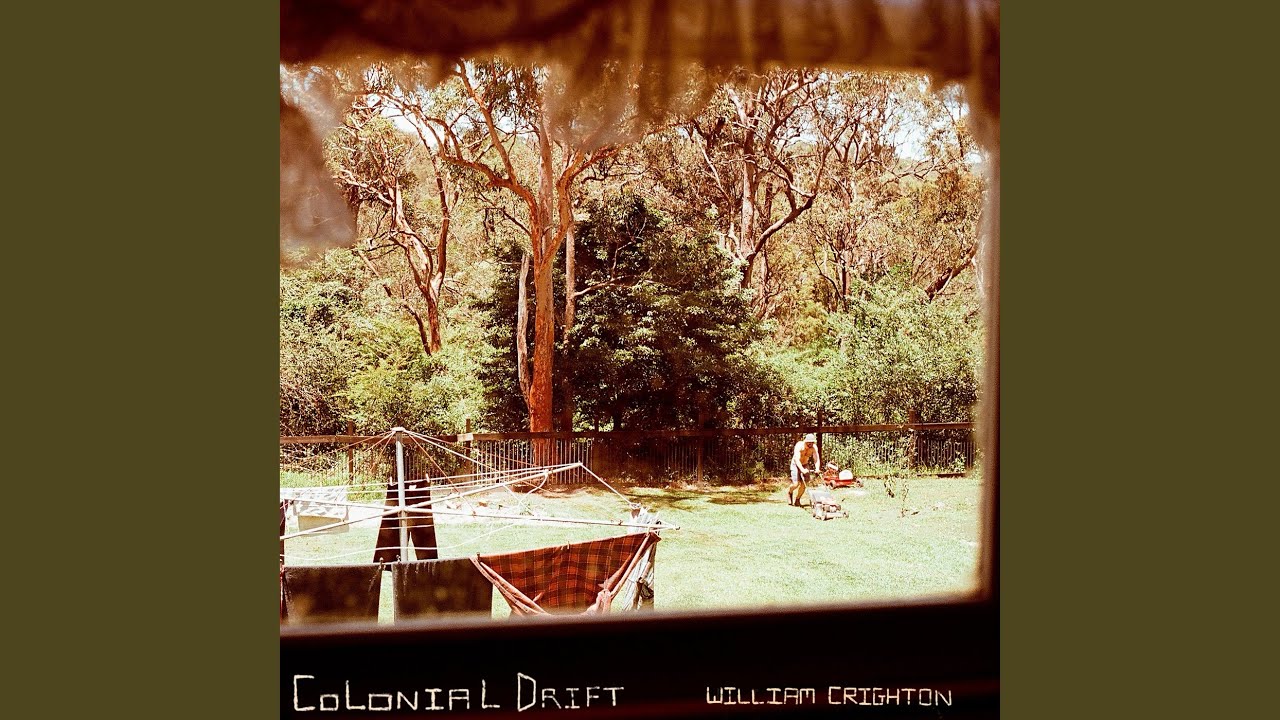
William Crighton's songs feel loosely aligned to the tradition of country rock, but anyone averse to that style – or anyone protective of it – will likely be shocked by the way the Australian songwriter approaches it. Crighton has plied his "bush psych" sensibility across four albums, culminating in 2026's Colonial Drift, which sounds like Steve Earle by way of Godspeed You! Black Emperor. The Hoodoo Gurus' Dave Faulkner considered Crighton's 2018 LP Empire "the best album of 2018, domestic or international".
It's bracing stuff: you won't receive it ambivalently.
But what is bush psych? "The feeling of connection and experimentation influenced by the soundscape of the bush in all seasons and weather," Crighton says, "from lyrical songs about our history to psychedelic experimentations and wild sounds. Always evolving, always changing."
Crighton recorded Colonial Drift in part in Jim Moginie's Oceanic studio, with creative input from his wife Julieanna Crighton and the late Midnight Oil drummer Rob Hirst. We sat down with Crighton to talk about its creation, gestation, his collaborations, and more.
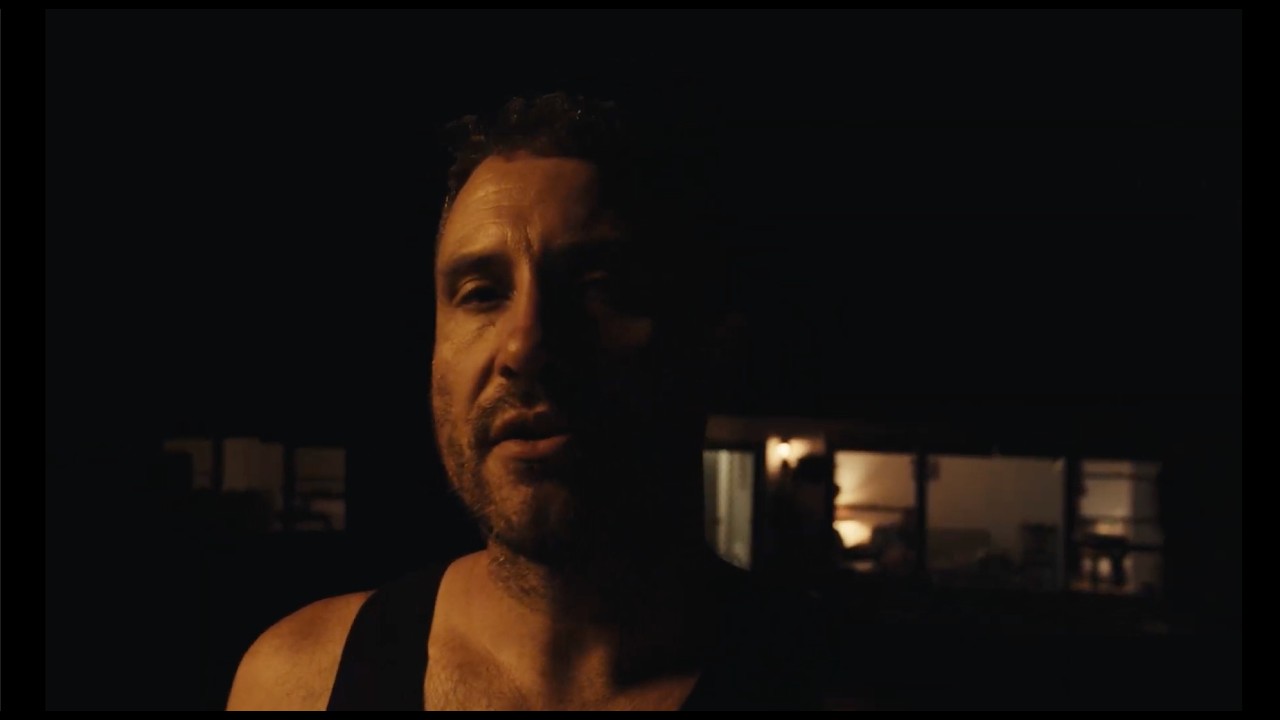
How did the landscape of the Central West, and your hometown Dubbo, influence your approach to music and writing as a young man?
I was born in Dubbo, but we left that area when I was one. I did spend time in the Central West as a kid, but I mainly grew up in the Riverina area (Wiradjuri Country). Muddy rivers, long plains that stretch out to meet rocky hills, big purple and red sunsets. Lots of birds and animals too. Space and long drives. The wildlife soundscapes of dawn and dusk — whether it be a kookaburra calling before a storm, a big flock of white cockatoos swarming and screeching around an old river gum, or the low hum of a distant diesel engine, even the roar of the pub when you’d ride your bike past the open door as a kid. All of it’s in me, one way or another, in everything I do.
Nowadays you live in the Hunter Region. How has that part of the world affected your outlook, and your approach to songwriting?
Life’s changed a lot since moving up here to the Hunter (Awabakal). Not as much time as I had as a kid, now that I have kids of my own. Where we are at the moment, the eastern side of the Watagans, is equally as inspiring as down there. I spend a lot of time in Yengo and the Watagans and love getting on the rivers around here too. I also like being able to get in the ocean a bit more.
Going bush is directly inspiring, but it also forces you to take the time to listen, think, process, and conceptualise things that maybe you don’t get time for in other scenarios. I love listening to the soundscape around me wherever I am; it affects my songwriting and production quite a bit.
The Hunter is where Julieanne, my wife, is from, and she is overwhelmingly my main songwriting collaborator. There’s also a great music community up here, with Dashville at the forefront of that. I don’t know how all of the above has affected my songwriting, but I’m sure it has.

[I] might sound like a pretentious wanker, but to me a song takes me down whatever path it takes me down. A song also takes on a new life every time I play it if I don’t get in the way
Water and Dust was recorded for the most part at Jim Moginie’s studio, Oceanic. What's the deal with Colonial Drift? Was it a similar situation?
This album was recorded across four studios. The live band tracking was done at The Grove by Damien Charles and at my home studio by Christopher Dale, Luke Davison, and me. Some extra things were done at Oceanic with Jim and Rob, Church St Studios by Luke Davison, and Jeff Lang’s studio in Melbourne. There’s also some soundscape stuff that was recorded on phones and other portable recorders.
How do you feel about this new record, now that it's complete? Was it challenging work? Did it come naturally?
It’s always a weird one — getting to the end of a record. A part of you is proud, excited, and invigorated, and another part of you can be tired, over it, and ready to start something completely new. For me, it’s a bit of both. But I have to say, overwhelmingly I feel a sense of pride for Colonial Drift as a body of work, and I feel grateful to everyone who contributed to it.
Everyone involved stepped it up on this record, and that was an exciting and inspiring journey to be a part of. There were challenges, but we overcame them. It was a very natural-feeling process. I make music with friends and family for the most part, so there’s a level of comfort that gives everyone licence to be as explorative as they like.
There's an explosiveness and spaciousness on this record that feels like a rural electrical storm. Does that sense of scale exist in the songs when you're writing them, before they've been tracked, layered, etcetera?
I would say that’s more in the arrangement and production choices. We wanted to achieve a sonic texture across all songs that not only “served” the song, but also resembled the environment we’re living in.
There are some genuinely strange sounds on this record, far from what I'm used to hearing on a country-leaning rock record. 'Poor Ned' comes to mind: what's that sound, or instrument, after the choruses? And what was the thinking behind its inclusion?
That’s “bush psych”. Christopher Dale was messing around with the Prophet synth, moving through sounds, and that sound stuck. He then doubled it with an old organ. Damo (Damien Charles) manipulated the sound a bit further, and the sound you hear is the result. The bush can make you whacky, especially if you’re running from a few coppers who are shooting at you. We were channelling that.
'Beautiful Country' has some fascinating treatment of electric guitar. To my ears, the way it's sampled and heavily manipulated oddly resembles the accompanying didgeridoo. Did you write this one entirely in the studio?
I wrote the bones of this one in the caravan one afternoon at our old place in Bellbird. It was very synth-heavy. Luke Davison and I were jamming a few weeks (or months?) after that in my little studio with just electric and drums and came up with a more refined feel and structure for it. I think the drums on there are from the very first time we jammed it.
Jeff Lang added some nylon string, which I chopped up and made the riff out of. I wanted a glitchy tech sound to juxtapose the electrics I’d done and the beautiful lap steel he had done. We wanted to bring out some classic corrugated iron and chain sounds for the bridge, so one afternoon when I went into the gaol (Jules and I run a music program in prison for inmates), Luke and Chrisso spent the time recording those sounds from old bits of stuff they found around the yard. I was stoked when I heard it later that night.
The yidaki played by our dear mate William Barton really added a great emotional weight and rhythm to the song too. The song works solo on an acoustic guitar, but we wanted to create more of a soundscape that matches the feeling you get when you’re moving through this country. Jules and I finished the lyrics as the song evolved.
Is "rock music" critical to your approach to writing? Could you see yourself wandering further down the path of 'Beautiful Country' and beyond?
Not critical to my approach at all. Might sound like a pretentious wanker, but to me a song takes me down whatever path it takes me down. A song also takes on a new life every time I play it if I don’t get in the way. That said, I’m only capable of what I’m capable of, and sometimes the idea outruns one’s capability. I guess we’ll see.
Rob [Hirst] had an incredible sense of melody and also identified fat in a song like no one I’ve ever worked with
Colonial Drift was co-written with your wife, Julieanne Crighton. To your mind, how does her input affect the tone of the record?
Julieanne’s input adds another whole dimension to the album. It wouldn’t be the same without her. In my opinion, her lyric writing rivals any of my heroes. She’s also a vital editor and filter of what I write.
Songs like 'Sex, Death and Choices' from this album and 'Killara' from Water and Dust, where I’d originally written too many verses, she has helped me get rid of the fat and also contributed some one-liners that end up being my favourites of the song.

For Colonial Drift, we worked as one brain a lot. A good example of this, and one of my favourite moments, was when I was trying to work out and sing the bridge for 'Further Down the Road'. I had some vocal rhythms and a bit of a melody, but nothing really in the way of lyrics. I was going around in circles a bit when she came into the room and handed me a piece of paper with some lyrics — I added a couple of words, and then we sang it, and that’s the take you hear on the recording.
Another moment was when she handed me the second verse of 'WarZone' in its entirety. I thought, “Bloody hell, that’s a world in a verse.”
Sonically, her voice adds a unique flavour to the album, both when she’s singing lyrics and in the interplay between her and Jeff Lang’s guitar when she’s not.
The late, great Rob Hirst also had a hand in Colonial Drift. How did collaboration with Hirst play out? What were some of the qualities he brought to the songs?
I can’t speak highly enough of Rob. He’s one of the most talented and gracious people I’ve ever encountered, and it was a bloody great honour to have known and worked with him. He was a mate and a mentor to me. We worked together for the first time on Water & Dust, writing and recording 'Stand' amongst other things, and we talked about collaborating more whilst I was supporting Midnight Oil on their final tour through Europe. When I began working on this latest record, Rob mentioned he had started a couple of songs with Julieanne and me in mind.


We got together once every couple of months and kicked around those ideas, as well as ideas we had. Two songs, 'Horizon' and 'WarZone', ended up on the album. Rob had an incredible sense of melody and also identified fat in a song like no one I’ve ever worked with. He was a big fan of The Monkees and bands of that era, which all had very concise arrangements, and of course the Oils’ material never has any “fat”.
When it came time to record his parts, we went down to Jim Moginie’s studio, Oceanic. Despite the horrible situation he was going through, he was his usual positive, powerful, and vibrant self. Both Jules and I learned a lot from him. One example is 'WarZone'. We had cut it at The Grove and it was sounding pretty good to my ear, but in the haze of making a record I had forgotten some things. When we pulled the session up at Oceanic, he said, “William, that’s not how we wrote it… it’s major, not minor there…” (or something to that effect). I felt like a complete idiot, but in his positive, comforting, no-bullshit way he said something like, “Go with me, let’s get it up to scratch.”
Of course, we were up for it. So under his guidance, we stripped off the bass, drums, and rhythm guitars. As usual, we had recorded it live and not to a click when we put it down at The Grove, so there were a few challenges, but under Rob’s guidance — and with some “Mo-genius” electrics — the song began to take a new shape. The original vocal, intro, and outro still worked, so we rebuilt the track to that and Rob put down his BVs.
We left Oceanic that day with a much stronger song, but it didn’t have any drums or bass and we all knew it needed them. I told Rob I’d figure that out; he jokingly said, “Don’t forget.” Determined to bring the song to the completion it deserved, I called up my bandmate Luke Davison and he was up for the challenge and nailed it. Originally there was upright bass on it (which is still in the bridge section), but now the verses needed electric bass. I’d been wanting to get Corey McCormick on a track or two for a while, so I thought this would be a good opportunity. We’d met when I toured with Lukas Nelson, and at the time of sending him 'WarZone' he was playing with my hero, Neil Young. He was flat stick in rehearsals with Neil Young, but he made it happen. I was stoked with the result.
I sent it to Rob for approval and he was incredibly happy with the whole thing. We’d got there in the end. To sum it up, though, this album definitely wouldn’t be the same without Rob’s spirit. Even when he wasn’t on a track, the things we’d learned from him influenced things as if he were there.
Julieanne and I got news of his passing an hour before we were set to record the video for 'WarZone'. His voice and spirit are all over that record, and he’ll influence me for the rest of my life in one way or another.
The radio samples, the strange, pitch-shifted voices, the direct references to current and recent events… There’s a sense of dizzying crisis and urgency stamped across Colonial Drift, but there’s also a sense of love and gratitude. Do you feel a responsibility to channel the pressures of the moment in your art?
The soundscapes (“Drifts”) throughout the album are there to paint a picture and tell a story. Over the last few years, I’ve really gotten into capturing sounds and creating soundscapes — they can tell a story that the music can’t. We live in a really bizarre time, and I created them to help tell the story of Colonial Drift.
What do you listen to at home? What's on high rotation lately?
Jules and I have been running a prison music program for about eight years. As a result of that, I find myself immersed in all kinds of music. At the moment, I’m working up a soul music set with the boys in gaol, so I’m immersed in soul from the mid-’50s to the ’70s — Otis Redding, Wilson Pickett, Sam Cooke, Percy Sledge, Aretha Franklin. All of the classics. Not sure what it’ll be next week.
What guitars, amps, and pedals were your go-tos on Colonial Drift?
My go-to pedals for this record were spring reverb, an MXR Phase 90, and a purple overdrive pedal I’ve had for years. It’s made by a bloke in Canada, but all of the writing has rubbed off and I can’t remember the name of the pedal or his name. It’s decent, though. Jeff Lang had a great pedal rig there too — he always pulls an incredible tone, and I’m always learning from him.
CJ Stranger, who also played on a bunch of tracks, always pulls interesting sounds; his setup was impressive too.
As far as amps go, I used a Fender Bandmaster, Fender Twin, and an AC30. I used CJ’s Gibson SG on a couple of tracks, as well as my Tomkins electric that Al made for me when I was 18. He was such a great luthier, and his guitars sound uniquely Aussie, I reckon. I was very sad to hear of his passing in January. I used my old brass resonator on a few tracks too — Langy set it up real nice. Martin, Takamine, and Gibson acoustics were the go-tos. The Martin was used the most because it had the sound we were after.
- William Crighton's Colonial Drift is out now on vinyl, CD and digital. The Colonial Drift album tour kicks off in early April.
- This article appears in Australian Guitar #167. Subscribe and save via TechMags or iSubscribe.
