
In my opinion, you can play metal on any guitar, really. Iron Maiden has managed fine for years using Stratocasters, so just because you don't have an all-black angular axe with active humbuckers doesn't mean you can't play heavy. That said, the best metal guitars definitely make playing savage riffs and shredding lead licks a lot easier.
I've been playing in heavy bands for over 20 years now, so no matter what your particular subgenre of metal is, you'll find an axe in this guide to suit your style. We've reviewed countless metal guitars over the years here at Guitar World, putting them through their paces with a variety of techniques from all-downpicked power chord riffs to drop-E tuned staccato breakdowns.
My top picks

The ESP LTD EC-1000 is one of the most common guitars on the metal gigging circuit, combining playability with tonal versatility to cover pretty much any style of metal you can think of.

If you want a guitar that lets you get heavy without spending loads of cash, the Ibanez RGA42FM will hit the mark with its excellent playability, great-sounding pickups, and decidedly metal aesthetic.

If you're looking to play rapid-fire shred licks, the Strandberg Boden Essential is one of the fastest-playing guitars money can buy. A versatile pickup configuration means it can cover a lot of ground too.
Best overall

✅ Buy if you want a great value all-rounder: There's a reason you see heavy bands using the EC-1000 so often. It's versatile, well-built, and excellent value for money.
❌ Avoid if you want a shred guitar: As it's more traditional in its design, it isn't the fastest-playing or sleekest guitar out there.
With Fishman’s Modern Fluence humbuckers, ESP/LTD’s flagship single cut can perform metal of all eras. The switching is all very state-of-the-art, with push/pull coil-split for single-coil tones and enough firepower to add serious weight to your riffs.
The Tune-O-Matic bridge offers a fuss-free performance, plenty of sustain, and a solid platform for your punishing right-hand attack, but we wouldn’t want you to think of this only for rhythm.
The thin-U neck is an exceptional profile for lightning leads, with the extra-jumbo frets and 13.8” radius providing us an easy ride up to the top end of the fretboard during testing, where you’ll find a neatly sculpted heel. Oh, and the finish is incredible. It’s called Violet Andromeda and looks different depending on how the light hits it.
Read our full ESP LTD EC-1000 review
Best budget

✅ Buy if you want a metal guitar on a budget: The RGA42FM is phenomenal value for money, making it perfect for beginner players or those who need a reliable backup.
❌ Avoid if you want versatile tones: The budget pickups here do a great job on metal tones, but they don't have as much depth as other, more expensive models.
Ibanez’s RG series was launched in 1987 and with sharp horns, thoughtful body contouring, and being a testing ground for the super-svelte Wizard neck profiles, it fast cemented itself as one of the world’s favorite S-styles.
You can find the RG at all prices but the stripped-down model is very financially accessible. It has a speedy Wizard III maple neck, measuring just 19mm thick at the first fret and only 21mm at the 12th.
Okay, it doesn’t have a Floyd Rose tremolo, the hard-tail format is a good stable platform, ideal for aspiring shredders who don’t yet want to worry about spending time adjusting their bridge. The 5-way blade selector offers a wide sweep of humbucker and split-coil tones.
Best for shred

✅ Buy if you want to shred: With its ultra-fast playing neck and silky smooth ergonomics, this is the perfect guitar for those who like their metal avant garde.
❌ Avoid if you like traditional necks: The Strandberg neck profile is very unusual, and can take some getting used to if you've never played one before.
Looking very much like the future of the electric guitar, the Strandberg Boden Essential is our top pick for all the shredders out there. For a long time, Strandberg solely catered to the higher echelons of the guitar market, but the Essential is here to give us regular metal guitarists a taste of the future.
Although it’s going to appeal to shredders and those who like their metal more eclectic, it’s a really adaptable guitar that can do everything from Strat-spank to full-on mid-range gut punch. The two OEM humbuckers paired with a 5-way switch ensure you’ll have more than enough tones onboard for clean passages, djent-y rhythms, and soaring lead tones.
The EndurNeck features a very unique profile that really has to be felt to be believed. The idea is that it gives you a bigger space to place your thumb, thus keeping your wrist straighter and promoting better technique. One thing we can attest to is that you can absolutely rip on that Rosewood fretboard, and although it takes some getting used to, once you’ve warmed up to it you’ll never want to go back to a regular profile guitar neck.
Read our full Strandberg Boden Essential review
Best 7-string
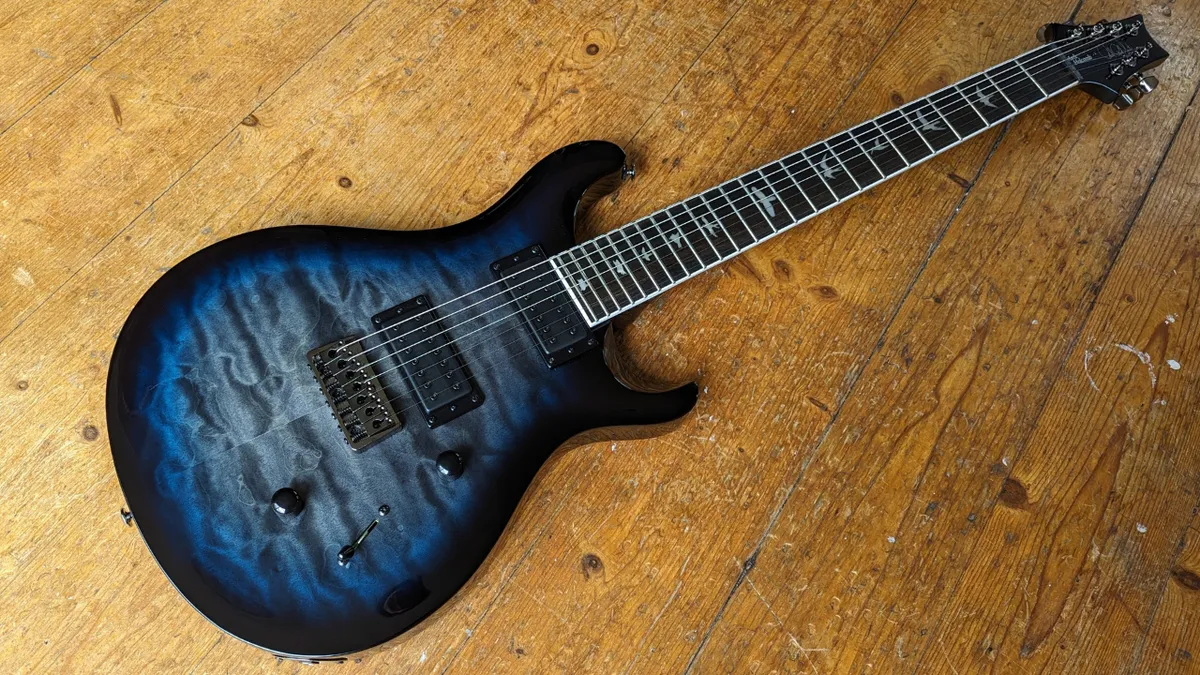
✅ Buy if you like prog metal: With its versatile pickups and extended range, the Holcomb SVN is perfect for prog-metallers who need heavy riffs with good cleans.
❌ Avoid if you like high output pickups: The pickups on this guitar are less hot than you'd expect, particularly the neck, so avoid if you prefer a more intense sound.
As one-third of Periphery’s three guitar assault, Mark Holcomb certainly knows a thing or two about drop-tuned riffing. His signature PRS SE Mark Holcomb SVN is just as versatile as Mark’s own playing is, giving you savage downtuned distorted riffs alongside crystal clear cleans.
With a Seymour Duncan Scourge in the bridge and Seymour Duncan Scarlet in the neck, you’ve got a surprisingly versatile set of pickups that aren't quite as 'hot' as you'd expect from a metal guitar. The bridge is aggressive sounding, but the neck pickup delivers excellent clean tones with the addition of a push/pull coil split to give you even more options.
The longer scale length will take some getting used to if you’ve never played one before, and for those with smaller hands, the first five frets could end up feeling monstrous. PRS’s neck profile is also slightly different from other guitars, but we found it ultra-comfortable here, at times forgetting we were playing a guitar with an extra string!
Read our full PRS SE Mark Holcomb SVN review
Best 8-string

✅ Buy if you want ultra-low tunings: With a huge 29.4" scale and 8 strings, you can take the Ibanez M80M down to drop-E if you want.
❌ Avoid if you want easy playability: 8-string guitars are already difficult to master and that's before you take into account the ginormous scale length.
Made for the band that popularised ultra-low tunings and extended-range guitars, it makes total sense that the Ibanez Meshuggah Signature M80M is our top pick for an 8-string guitar. It’s not subtle, but if you want the lowest of the low riffing, this is the guitar to go for.
The bonkers 29.4-inch scale length takes it close to bass guitar territory, and ensures that it plays great no matter how low you go. It’ll take some getting to used to if you’re coming from a regular scale guitar, but once you get over that initial period you’ll find it’s brilliant for those syncopated riffs and lightning-fast leads Meshuggah is renowned for.
It’s a big instrument and you’ll feel that resonance when you play it unplugged. The star of the show here though is that Lundgren humbucker, the gold standard for extended-range guitars. It's brilliantly articulate even on the lower strings, giving you plenty of ability to cut through the mix.
Best baritone

✅ Buy if you want low tunings with six-string playability: This baritone will get you down to drop-F with the right strings, whilst retaining those familiar scale patterns and chord shapes.
❌ Avoid if you've got small hands: With a 27-inch scale, reaching from the 1st fret to the 5th will feel massive on this guitar and takes some getting used to.
Available in black and absolutely nothing else, the Jackson Pro Plus XT Soloist Baritone is perfect for guitarists who want to get low but don’t want to deal with the extra strings of a typical extended-range guitar. Modern baritones are great for all sorts of metal, as you can take them down to the lowest tunings while keeping all your chord and scale shapes the same.
With two of Seymour Duncan’s most metal pickups, the Nazgul and the Sentient, you’ve got the perfect pair for ultra-low riffing that still retains a lot of clarity. The neck pickup is claimed to be more ‘vintage’ but we found it to be very high output and perfect for silky smooth lead work or clean-picked arpeggios.
Locking tuners provide excellent stability and rapid-fire string changes if you happen to chug a little too hard, and the hardtail bridge makes it a very stable guitar even if you’re tuning down to F. The arcade button kill switch is a nice touch too, and great for adding stutter effects during a crushing breakdown or livening up your lead work.
Read our full Jackson Pro Plus XT Soloist SLAT HT6 Baritone review
Also consider
FAQs

Do I need a specific metal guitar to play metal?
Contrary to popular belief, no - you do not need a specific metal guitar to play metal. Having a guitar that's up to the job definitely helps you achieve the crazy gain tones you're after, but you don't need any specific type of guitar to do this. Sometimes, single-coil pickups sound killer in a metal setting. It's all about experimenting with tones and seeing what you like.
But, for that super-heavy, drowning-in-gain tones you’re after, one of the best metal guitars is designed specifically to make your life easier. The hardware, electronics, necks, fingerboards, and bodies are all built specifically to draw out the best metal tones possible from that guitar - and who doesn’t want a purpose-built shred machine?
What are the best brands for metal guitars?
Most guitar brands make instruments specced out for metal, but there are definitely a few firm favorites that you’ll see onstage more often than others. ESP, Schecter, Ibanez, and Jackson are the ones that spring immediately to mind. Playing metal demands a lot from your instrument and these brands all make some epic high-output axes that will play fast and let you get heavy.
So why don’t big brands like Fender and Gibson make metal guitars? We reckon it’s because they both own sub-brands where they can better market axes catered towards the metal player. Fender owns Jackson and Charvel, who both make loads of extreme, pointy-shaped guitars, whereas Gibson has both Epiphone and Kramer where they can manufacture instruments for metal.
Are 7-string or 8-string guitars better for metal music?
It all depends on what you want to play really. If you’re into more traditional forms of metal like thrash, heavy metal, power metal, or hair metal then a six-string instrument will likely do the job for you. You can tune it down if you want to get heavier, but it’s not a must-have as you’ll likely be playing closer to standard tuning.
If you’re into more modern metalcore, djent, or progressive metal, then an extended-range 7-string guitar or 8-string guitar is definitely the way to go. It gives you that super low end and these guitars usually feature longer scale lengths to deal with lower tunings. You also get the ‘regular’ range of a guitar, but it will take some getting used to thanks to the extra string.
If you’d like to keep the playability of a regular six-string but still want to tune low, then you should have a look at the best baritone guitars. These guitars feature a longer scale but keep the six strings, so you can still play open chords as you would on a regular guitar, but in a much lower tuning.
Which pickups do I need in my metal guitar?
High-output humbuckers will do the job nicely because you are going to need to have plenty of gain and harmonic excitement to get those really crazy tones. Pickup manufacturers such as EMG specialize in active pickups, which are powered by one or more 9V batteries in your guitar - meaning that their output is sky high, and their tone is highly precise - making them some of the best pickups for metal.
Companies such as DiMarzio, Seymour Duncan, and Bare Knuckle specialize in passive pickups, which have a slightly lower output and don’t need any extra power sources to operate. They often sound a little more organic and classic, but still create enough noise to boil blood. Many of the best metal guitars will be equipped with something from these manufacturers.
What is the difference between active and passive pickups?
A lot of guitars on this list will feature active pickups, due to the association between metal and high-gain tones. Active pickups require an outside power source (usually a 9V battery) and tend to compress your sound more, great for complex riffing played really fast. Active pickups are also very quiet, which is again useful when playing with high gain.
On a passive pickup if you roll down your volume knob, you’ll find that you get less overdrive and a warmer tone as the high frequencies are rolled off - provided it’s not fitted with a treble bleed kit. For some guitarists, this is a desirable trait, as it allows you to warm up your guitar sound without going over to your amplifier. Active pickups don’t do this however, they tend to retain pretty much the same frequencies through the whole range of the volume knob.
Us guitarists aren’t great at change, and even though from a technical standpoint an active pickup is better, a lot of ‘tone purists’ don’t like active pickups because they aren’t as reactive. It’s best you try both out for yourself and see what you like, but players like Dave Gilmour and Steve Lukather both have guitars with active pickups, so they can’t be all that bad!
What is the best tuning for metal?
A lot of metal features down-tuning. Regular tuning is E-E which is fine for some metal players, however, some like to tune one, or all six of their strings lower. A slightly longer scale length can help with tuning stability if you’re tuning way down to around C or B. Baritone guitars can be a good option as they have a much longer scale length – usually around 27”, and have a regular tuning of B-B.
Some of the best metal guitars have more strings. 7 and even 8-string guitars provide a much wider frequency range. You’ve still got the high end with your top strings, allowing you more space to solo but when you need that earth-shattering low end, you’ve got it at your disposal with an additional low string.
Does guitar body shape matter?
Believe it or not, there’s no law that states all metal should be played on a pointy guitar. Of course, a guitar that can double as a weapon adds to the metal aesthetic but, they don’t always make for comfortable instruments when you’re sat down. So, if you do a lot of your riff writing at home, sat down before you take it to the rehearsal room, then you might want to look for something with a body shape that allows for that.
Sometimes though, simplicity can do the job; a black guitar with a standard body shape can be just as metal as a pointy V – it’s all down to the player!
Should I choose a hardtail or locking trem?
When looking at a range of metal guitars, you again need to think about which styles of metal you want to play, and your overall playing style.
Are you a rhythm guitarist who needs something super solid and reliable? If that’s the case, a hardtail is probably the bridge to go for, as the strings won’t be able to slip out of tune as easily as they would if you had a tremolo. Either a string-thru or tune-o-matic style bridge setup would work best for you.
If you’re more of a lead player who loves doing dive-bombs and crazy trem-based effects, then something with a locking Floyd-Rose style tremolo system should be your go-to. A locking trem stops your strings from slipping out of tune, by – you guessed it – locking the strings at the nut.
Read more about our rating system, how we choose the gear we feature, and exactly how we test each product.
How we choose the best metal guitars

At Guitar World, we're not just writers; we're devoted metalheads with a wealth of live and studio experience. Our process of selecting the best metal guitars involves a meticulous examination of tonal aggression, playability, build quality, and value for money. Rigorously tested across various metal genres, our recommendations meet the demands of that most discerning type of guitarist; the metalhead.
Precision and power define the metal genre, and our selection mirrors this ethos. We'd never recommend something that we wouldn't use ourselves, and having played in many metal bands over the years, we know what's expected of a properly good metal guitar.
Whether you're a beginner or a seasoned shredder, the products in this guide will cover a spectrum of metal guitars, from affordable options to extended-range instruments. Each recommendation has earned its place through rigorous testing, ensuring it aligns with the uncompromising standards of the metal genre.
Related buyer's guides
You can trust Guitar World Our expert reviewers spend hours testing and comparing guitar products so you can choose the best for you. Find out more about how we test.
- Protect your hearing with the best earplugs for musicians
- Play it loud with the best amps for metal
- Play faster with the best guitars for shredding
- Keep the cost down with the best budget guitar amplifiers under $500
- Stock up on the best electric guitar strings
- Lose your head in the best headless guitars
- Bring the noise with the best guitar strings for metal

