




Guitar World Verdict
There really isn't anything else on the market quite like this that combines a high-quality stereo DI with an onboard headphone amp for your amp pedal, so if your needs fall into that Venn diagram, the PCH has you covered. Just be aware it's probably going to have to sit on top of your pedalboard.
Pros
- +
A unique DI and headphone amp combo for your pedalboard.
- +
High headroom.
- +
Stereo and dual mono out options.
- +
Usual quality Strymon build and components.
Cons
- -
It's too large to fit under most pedalboards.
- -
It's fairly pricey.
You can trust Guitar World Our expert reviewers spend hours testing and comparing guitar products so you can choose the best for you. Find out more about how we test.
What is it?

Do you remember when amp pedals were a kind of niche concern? With the leaps made by amp modeling and players' embrace of the concept, things changed massively a few years ago. Even if guitarists weren't willing to replace their backline just yet, they were seeing the advantages of having an amp pedal for certain applications – and their neighbours were probably relieved too.
It means we now have a booming market for compact amp pedals – some fully digital, others even featuring tube technology. But things have moved so fast that there have been a few oversights that have now left gaps in the market and our signal chains. Strymon has noticed too.

The company was one of the big names that entered the amp pedal market in 2019, its Iridium boasted three different amp and IR cab choices with a headphone-out. Foo Fighter Chris Shiftlett was among the many players wowed by its charms. Other pedal amps followed from the likes of Walrus and Universal Audio. Some had headphone-outs and onboard effects loops, some did not. This presented a problem.
Players who wanted to place their delay and reverb after their amp pedal on the pedalboard could do so – it's just a matter of moving it in the chain but if they wanted to use that 'board at home with headphones plugging into the amp pedal, they'd lose the reverb and delay from their sound.
With effects loops rare on the smaller amp pedal units, there was no workaround. But some amp pedals don't even have headphone outs to start with (UA, we're looking at you). Clearly there was a gap in the market for something. It couldn't really just be a headphone amp because that wouldn't justify its place on the 'board when it came to gigging and recording. It had to be more than that – enter the PCH.
Specs

- Price: $279 | £259.99 | €299
- Type: Active direct Interface with headphone amplifier
- Origin: USA
- Connectivity and controls: Left and right XLR out, left and right 1/4-inch in, left and right 1/4-inch thru, ground left switch, mic and line level switch for XLR, switch for Sum Thru / Stereo mode.
- Features: Stereo and dual mono, internally converts to 24V for high headroom, defeatable ground lift for XLR outputs, defeatable sum for thru outputs
- Contact: Strymon
Build, usability and performance

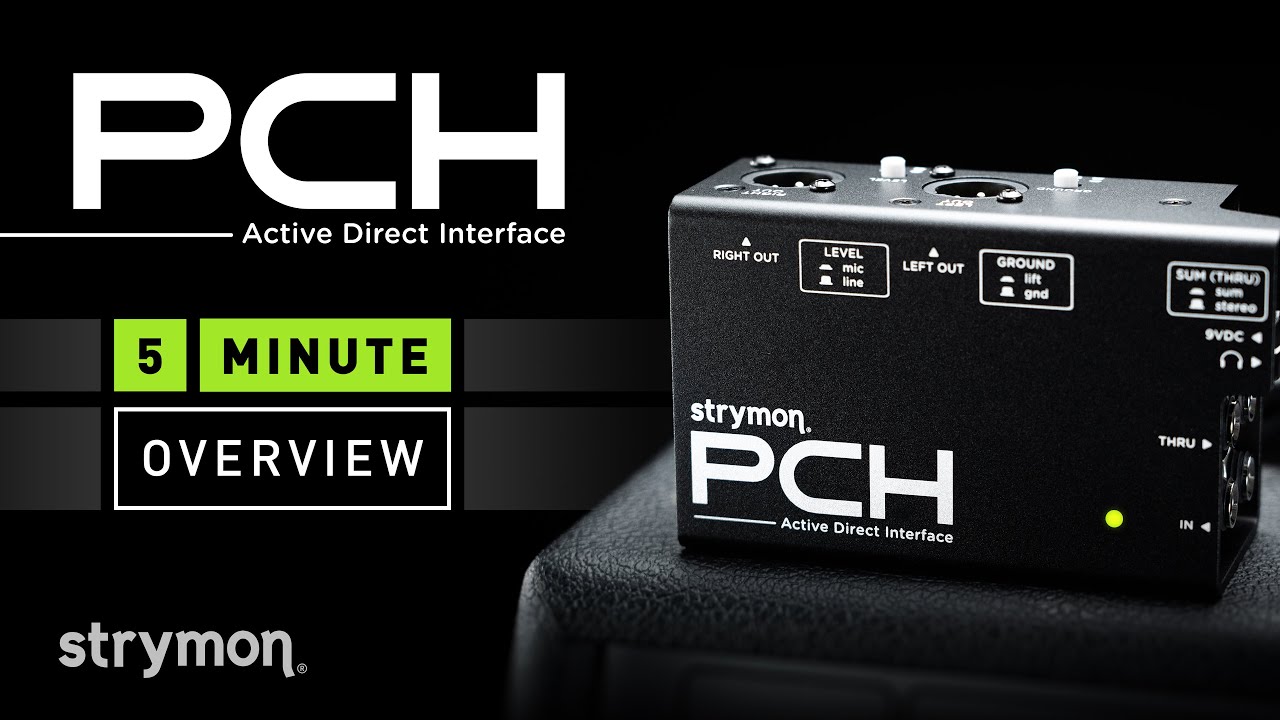
The PCH is an active direct interface with a built-in headphone amp – and as far as I'm aware that's a unique combination on the market. It also won't fit under most pedalboards, so if you are committed to adding it to your rig, it will need to occupy a place usually reserved for an effect, or sit separately off the 'board. The latter isn't really a neat solution, especially as the PCH needs to be powered by an isolated output with a 500mA minimum current draw – I.E, your pedalboard power supply.

My experience with Strymon has been a company that doesn't release its products until they're ready, and when they're ready, they're road-ready. There's definitely a peace of mind in buying Strymon's premium products in build and operation. The PCH is no exception, though as a DI box it can't really match the company's pedals for stylish aesthetics.
If it's far from the most exciting looking pedalboard addition Strymon has put out, the PCH makes up for it to some degree with chassis strength; a 3mm thick extruded aluminium external shell framed with 5mm ribs. Yep, it's sturdy, alright. But with (L x W x H) 124mm (L) x (W) 76mm x (H) 50mm dimensions and the XLR line ports on the side with thru 1/4 inch jacks on the top, the end of your pedalboard really does make the most sense for the PCH in practical use. However, it's designed so it can be placed physically before your time-based effects if required. The challenge here will be making space for the XLR outputs if needed.

As Strymon points out, a pedalboard being connected to a DI presents a different set of challenges to a guitar going direct. Anyone who has used a chain of pedals will know; it gets loud. Drives and compressors can raise the noise floor further and with that, unwanted hum.
The PCH has an internal converter from 9VDC to 24V to make it "virtually unclippable" – good news when it comes to amp pedals being thrown into the mix, and for the PCH's unique feature; an onboard headphone amp. Clean headroom ahoy.
When it comes to dealing with unwanted noise, a defeatable ground lift can be switched on for the XLR outputs. Something that came in useful when I took the PCH into a band rehearsal with in-ear monitors, running the XLR out to a Zoom LiveTrak L-20R.

I found Strymon's claims of the PCH being virtually unclippable held true
The option to run stereo or dual mono out will be much appreciated for some players; the Sum switch effevively allows stereo rig players to send their sound to the front of house, while having both channels via a dual mono monitor signal through a cab onstage if they wish. But with quality choice around for DIs elsewhere, the big sell here is the integrated headphone amp.

Testing with my Yamaha studio monitor headphones and a Universal Audio Dream '65 (a pedal that does not offer a headphone-out of its own) I found Strymon's claims of the PCH being virtually unclippable held true. Even with stacking two overdrives in front of it, the PCH's headphone amp proved unflappable. I really did get a sense of what my pedalboard actually sounded like.
Verdict
Verdict: ★★★★☆

The quality of Strymon's build is as undeniable as usual here, but I do feel that it's a shame the PCH won't clear the underside of most players' boards, forcing them to clear a space that might have been occupied for a pedal. In that respect the sense of flexibility is hamstrung to an extent, but if you're an amp pedal owner in need of headphone monitoring offstage, as well as more routing options onstage, that space will be justified. It's really the combination of both those utilities that makes the PCH a unique proposition.
Guitar World verdict: There really isn't anything else on the market quite like this that combines a high-quality stereo DI with an onboard headphone amp for your amp pedal, so if your needs fall into that Venn diagram, the PCH has you covered. Just be aware it's probably going to have to sit on top of your pedalboard.
Hands-on videos
Strymon