


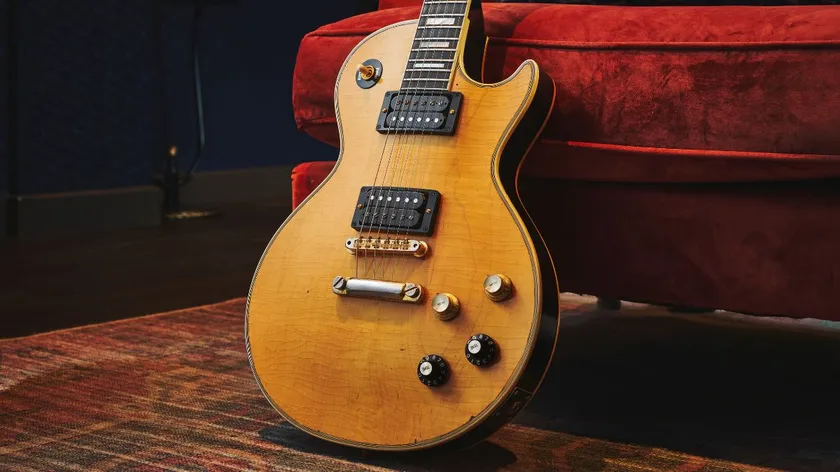


This month on Bought & Sold, we welcome a bona-fide funk-master to the conversation about all things gear, as Cory Wong joins us for a discussion that ranges from the philosophical (what is a serious guitar?) to the practical (how to find the gear that works for you), and takes in some biographical detail, like the time he found a vintage Gibson for chickenfeed.
What was the first serious guitar that you bought with your own money?
“That depends. It’s kind of a deep question because what qualifies as a serious guitar? To me, the first serious guitar that I bought with my own money was my first electric guitar, which was a Gretsch Traveling Wilburys [TW-100T] model that I got for 45 bucks at a pawn shop down the road from where I lived. It was serious because I was like, ‘I’m finally gonna play guitar.’
But in the way that you’re probably asking, my first serious guitar was a Highway One Stratocaster. I still have it to this day; it’s my blue Strat. That was the first one where I was like, ‘I really want to do this thing.’ I played that Highway One Strat for years and still play it all the time when I’m not using my signature Strat.
I love it to this day. It was one of those things where it was the first American Strat – and the only one – I could afford. I don’t claim it to be a perfect guitar; I’ve done a ton of mods to it. And I’m playing my signature guitar a lot more because it fixed a lot of the problems that one Highway One guitar had.
What was the last guitar that you bought and why?
I bought an old 1940s Martin from Carter Vintage Guitars in Nashville. I made the mistake of going into the vintage room… that’s where I get tempted. I played this guitar and kept thinking about it. I was like, ‘All right, man, my rule is I gotta give it 24 hours.’ I told the guy, ‘Hey, can you just set this aside and give me one day to think about it?’
I went home and I couldn’t stop thinking about it. I went back the next day, brought my other acoustic to see if I was solving a problem I couldn’t with my current guitar, and I was like, ‘Yeah, it’s got this thing to it. It’s a different sound.’ So I had to have it.
What’s the most incredible find or bargain you’ve ever had when buying guitars?
This is also the one guitar I wish I’d never sold, and the best find I’ve had. I was going up to Northern Minnesota for a camping trip with friends. On the way up to the North Shore, I went to this little music shop – like a used shop, if I remember right, they were selling records and instruments – and there was a 1970s Gibson S-1 in a butterscotch colour.
Now, I’m not a Gibson guy. I’m a Fender guy through and through. But I was like, ‘Oh, that’s a weird guitar. It’s cool.’ I played around with it. The pickups were unique and it had this cool vibe to it. So I’m playing it, and I’m like, ‘Dang, this thing is a sick vintage guitar.’
I’d never had a vintage guitar. I was 22 and never owned a vintage guitar in my life. I just figured they’re way too expensive. So I get up to the counter and the guy’s like, ‘Ah, you know what? I just don’t like that guitar. I’ll give it to you for a few hundred bucks.’
So I bought it for 300 bucks. I loved that guitar. It was amazing. But coming out of college, I didn’t have any money and needed to sell some gear to be able to pay my rent. Unfortunately, that was one of the casualties. The legend of rent is way hardcore, as they say in School of Rock [laughs].
What’s your best buying tip for somebody looking to buy their ultimate guitar?
You don’t need to use a piece of gear just because somebody else uses it. Certain gear is right for some people and not others. Some people have very specific ways they play or approach things. So whatever works for you, gets you excited and gives you those butterflies in your stomach, that’s the right gear for you.
We’re enamoured by the mystique of gear. Like, yeah, I’ve played through real Klons, and guess what? They’re great. But I’ve played through other overdrives that have given me that feeling in my stomach where I’m like, ‘Oh, my gosh, this is great.’ And that’s nice because now I have an overdrive that’s less expensive than a Klon [laughs].
I’ve played through really expensive amps – and it’s cool that other people like these amps and that famous people like these amps – but they’re not really the thing for me. So my biggest piece of advice is to find what gear gets you excited and motivated to play. And buy what’s most effortlessly able to express your voice on the instrument. That’s the gear for you.

When was the last time you stopped and looked in a guitar shop window or browsed online, and what were you looking at?
Well, I’ve been trying to prevent myself from doing this lately! The last piece of gear I was actually looking at and interested in was that ’40s Martin I mentioned earlier that I bought. But I mean, I look at every pedal that comes out. So if there’s a pedal, a new amp or a guitar that comes out, I’m checking all of them out. That’s just because we’re guitar players, and we just love gear [laughs].
But also, as someone who’s in the industry and in the business, I’m curious: ‘Why did those companies make this thing? Does this solve an issue? Is this a creative endeavour or is this a money-making thing?’ If it’s any of those, that’s okay. But as a consumer and as an industry person, I’m interested in: ‘What problem does this piece of gear solve? Why do we need this?’
If forced to make a choice, would you rather buy a really good guitar and a cheap amp or a cheap guitar and a top-notch amp?
What level of cheap are we talking about here? [laughs] I have to say I’m gonna go with a nice guitar. At the end of the day, I can always go direct; I can always just pass through the amp. The way I play, a lot of times, I just like DI guitar tone, anyway. The type of tone I’m looking for is pristine, like the highest-quality clean tone. So if I have a nice guitar playing through a relatively inexpensive amp, I can normally make the amp work.
What ends up happening in the end to the listeners is I can make it sound pretty good, whether it is a combination of amp settings, the mic placement, or how you EQ the mic in the PA. With those things, I can do a lot.
But I definitely want a nice guitar. I want it to feel good under my fingers. I want it to stay in tune. Because as nice an amp that you can have, it doesn’t matter if the guitar doesn’t play in tune up and down the neck. The amp is not going to fix that.
If you could only use humbuckers or single coil pickups for the rest of your career, which would it be and why?
That’s easy – single coils. I’m a Strat guy.

Cory’s Go-to Rig
I have two different guitars. One is the Fender Cory Wong Signature Stratocaster. The second guitar is a Music Man StingRay II; that’s my humbucker guitar. I use a [Shure] GLXD16 wireless unit, which has a tuner on it that goes into a Neural DSP Quad Cortex, and I’m running the Archetype Cory Wong plugin on that. That’s my amps, cabs and some effects.
But in the effects loop of the Quad Cortex I have the Hotone Wong Press volume/wah pedal, which I helped develop with them. It’s my favourite volume/wah on the planet by far. And I have a Wampler [Cory] Wong compressor, which, go figure, I worked on with Wampler. It’s my favourite compressor out there and it also has a clean boost and a DI out if you want.
That goes into the Jackson Audio Optimist, which is a dual overdrive and EQ. There’s two sides of the overdrive that go into each other. Then, if you press the two buttons, there’s an EQ function to it, which, honestly, is amazing. From there, it goes into the effects loop and returns back to the Quad Cortex, and the Quad Cortex goes direct to front-of-house. That’s what I use.
- Cory Wong’s Syncopated Summer Camp takes place August 13-16 in San Francisco.
- This article first appeared in Guitarist. Subscribe and save.

