


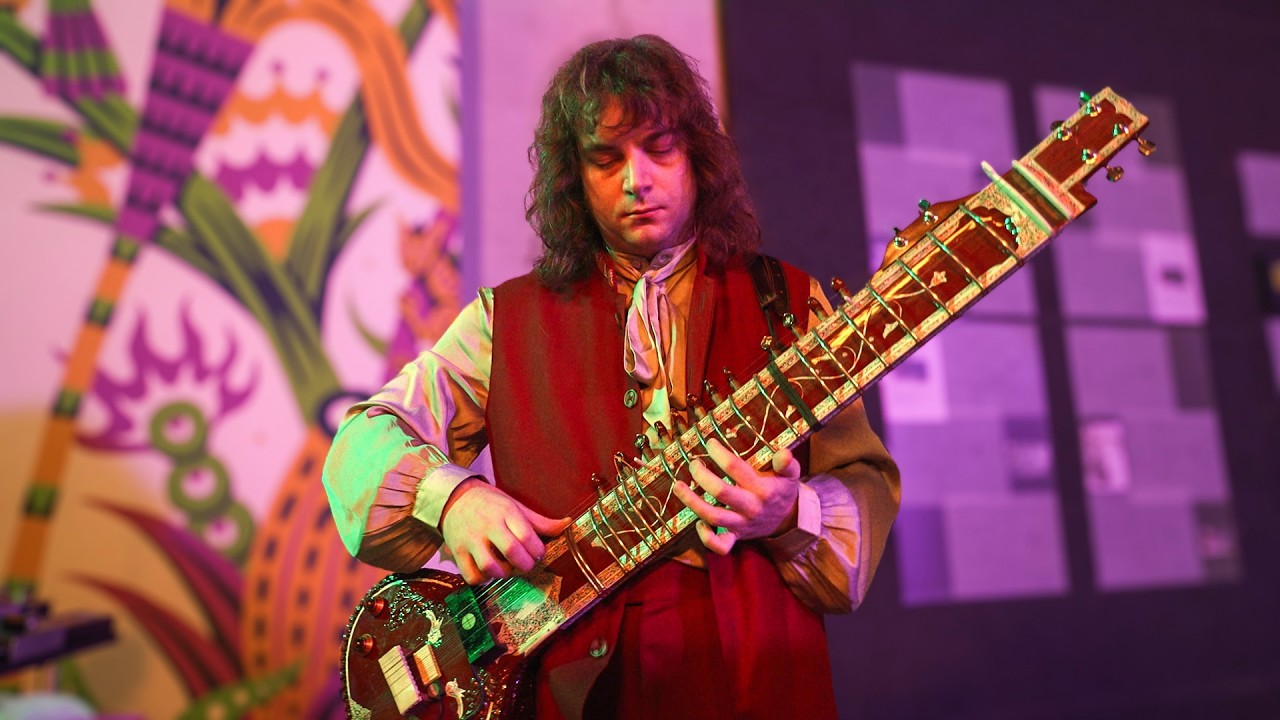
Witnessing Karma Sheen live is transcendental. The gritty tone of a ’60s Les Paul melds with the unmistakable sparkling sound of the sitar, as frontman Sameer Khan switches between vocals, harmonium, and bansuri, which all pay homage to a 600-year-old Hindustani classical music lineage.
The band undulates in tandem, crafting a colorful tapestry of sounds and textures that’s as inspired by Sufi lyricism and Indian ragas as it is by Jimi Hendrix and ’60s psychedelia.
Indeed, the London-based outfit – led by Khan, and composed of Rod Bourganos on sitar, synth, and theremin, Amad Chima on guitar, Grisha Grebennikov on bass, and Arun Dhanjal on drums – somehow manages to bridge an ancient musical lineage with contemporary subcultures and diasporic experimentation – a captivating pairing which has made a fan out of none other than Jimmy Page.
“The first time that Page saw us was in 2017, in this very embryonic stage of Karma Sheen,” recalls Khan of his first encounter with the Led Zeppelin maestro.
“That was quite nerve-wracking to play in front of him, but I said, ‘You know what? I’ve just got to get on with it, because we've got all these people that are here to see us. Rock royalty is sitting in the room, but I know I've got a job to do.’”
Page’s seal of approval was completely unexpected. “At the end of that show, he goes, ‘The way that you mix rock and Indian music is something of the likes I've never seen before.’
“This is coming from someone who was the first white musician to have a sitar in the UK. He used to listen to Ravi Shankar at the Indian Embassy before Hindustani classical music became very Woodstock, hash, and harem pants. So for him to say that to me was all the assurance on a personal level that I needed.”
Take us back to the moment you first picked up the guitar.
I grew up watching pro wrestling. I’d listen to Kurt Angle’s music, Shawn Michaels, D‑Generation X – all that. I just thought, ‘I really love this kind of music.’ All this rock and alternative rock sounded amazing.
I picked up a guitar in 2003, when I was about 11, turning 12. That was when School of Rock came out. I watched the film, and it made me want to play guitar – I wanted to be Zack Mooneyham, basically.
There’s that scene where Jack Black has all the rock genres and band names on the board. I remember pausing the DVD and writing down all the band names, then going off to find and listen to them. I even started practicing guitar the way Jack Black tells the kids to practice: listen to the music and figure out what the guitar is doing.
How did you end up discovering – or, should I say, rediscovering – Hindustani classical music and seriously pursuing that?
Karma Sheen’s music is 99 percent based on the structure of Hindustani classical music
My family has always been into music, but they were always into traditional music – classical folk music from Pakistan. They were always friends with Ustad Shafqat Ali Khan [legendary classical singer of the khyal vocal genre from Pakistan and the custodian of a centuries-old legacy of traditional music].
My parents would hold concerts in their house, and according to him, when all the other kids would be laughing and running around, I would just be sitting there listening and absorbing it all in.
Then I got into Ravi Shankar playing on the sitar. I got into ’60s music. I got into my final guitar hero, which is Hendrix, and I started learning how he played stuff. I tried to find ragas [melodic framework for improvisation in Indian classical music] on the guitar. As I was learning singing, I was trying to match everything on the guitar with my voice.
Then one fateful night happened. The nephew of my teacher [Ustad Shafqat Ali Khan] was visiting London. And whenever they would visit, we would always spend a lot of time together. My old bandmate in Karma Sheen, Martin, said, ‘Do you want to sing with us?’ And he sang Bageshree [a Hindustani raga that depicts the emotion of waiting for reunion with one’s lover].

There's this absolutely beautiful photo of me and the old bassist, Samuel, and Shujat Ali Khan [the nephew]. Me and him are both looking at Shujat in the middle, just smiling, knowing that what we're witnessing, and what we're a part of, is incredible. It was from that day that I decided I was going to start singing and doing things in a more traditional way.
How did that training influence your guitar playing?
There's this myth that surrounds Hindustani classical music – that it's magical. I do think it's magical, but there is this myth that you need a sitar to get those microtones, but the truth is, they are all just notes.
Sure, there might be a note that's in between the fifth and the sixth fret, but that note is going to sound closer to either the fifth or closer to the sixth. So then you just reinterpret it. If we look at Bageshree, or if we look at Jog, or any raga from the Kafi thaat, they’re pentatonic ragas.
My go-to flavor of soloing doesn't go to blues pentatonic anymore. It goes to classic Hindustani classical pentatonic
Every guitarist on earth knows the pentatonic scale. You use that as your blueprint to play these particular ragas. The notes are the same, but it’s just the manner in which you play it which could potentially be seen as a limitation.
Are you sliding? Are you pulling off or hammering on? Do you understand the rules of the raga? How are you supposed to engage with this raga?
Karma Sheen’s music is 99 percent based on the structure of Hindustani classical music. So all the notes and riffs that we're using are all pretty much notes from the raga that we're singing.
My go-to flavor of soloing doesn't go to blues pentatonic anymore. It goes to classic Hindustani classical pentatonic – those ragas that are in between that – and so what I now do is, I'm fusing a lot of the blues pentatonic shapes with the pentatonic ragas.
How do you approach fusing these ragas and rhythms with psych rock?
I don't think there is a band that’s come before us that has done this. They've done fusion, but for us, there is no reference to fall back on. There's only inspiration. So it'd be like, ‘Oh, you know what song I really, really love? Are You Experienced? by Jimi Hendrix. What's he doing here?’
So you try to break it down. This chord or these notes are not in this raga, and the raga that it’s closest to is most likely Jog, Bageshree, or Malkauns – it’s usually between these three pentatonic-shaped ragas. Then you can just kind of figure it out that way.
Our goal is to be the custodians of this kind of music, but we want to bring it forward in a way that makes it a little bit more accessible. This music doesn't just deserve to have someone in yoga pants, smoking a spliff, meditating.
I don't want to say that that is appropriation [but] yes, this music is spiritual, and yes, we can attach ourselves to that, but it doesn't necessarily need to be taken in that aspect. It can also be taken in a very light-hearted way, in a very rock way, and in a very cool way as well.
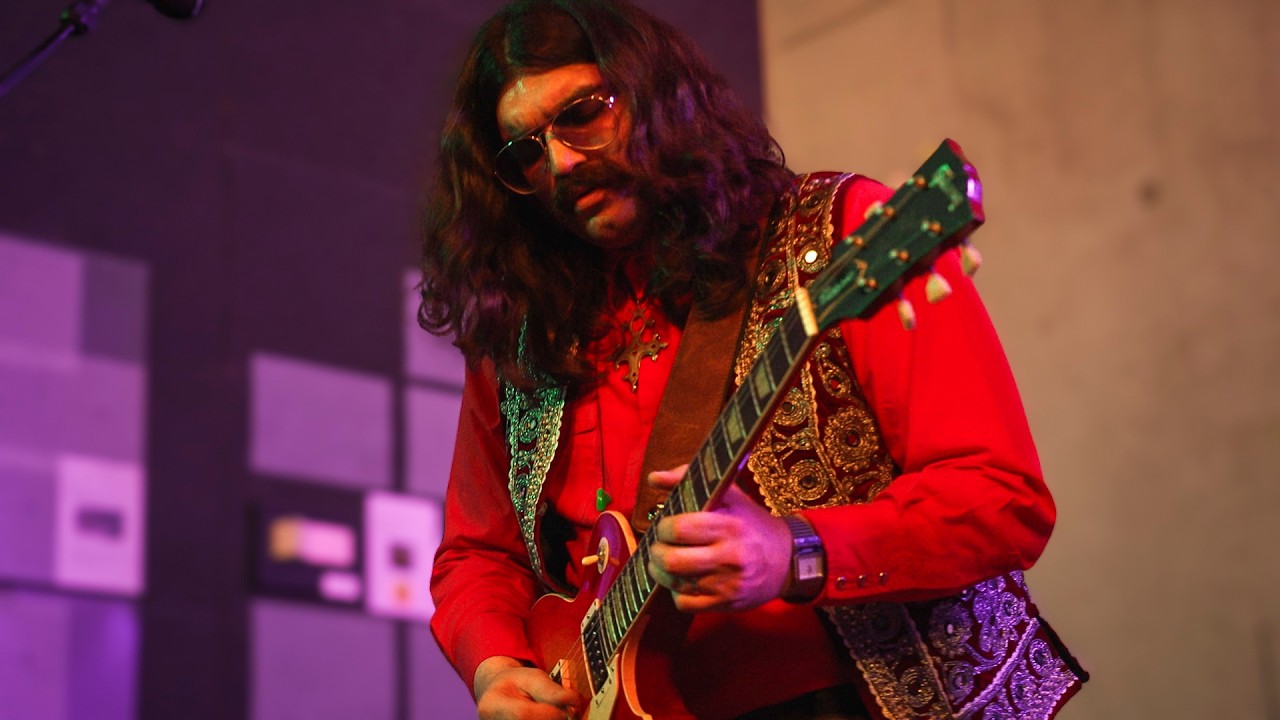
You’ve developed quite a reputation as a Les Paul player. Why did you go for a Gibson Les Paul, as opposed to, say, Hendrix’s favorite, the Strat?
Contrary to what people might think, I’m actually a Strat man – 100 percent. It’s simple. My dad's favorite car that he ever drove was a Vauxhall Vectra Elite model. I was asking him, ‘Dad, why don't you get that car again?’ And I was asking him that while he was sitting in his Mercedes, and he looked at me and simply said, ‘Son, once you go Mercedes, you never go back.’
And I can, hand on my heart, say the Fender Stratocaster is my absolute favorite guitar. But once you get a Les Paul, you can't go back. The Strat is an extension of you. But if you play a Les Paul and then you decide to go back to your Strat, your hands are like butter all over the Strat. It just feels incredible. The Strat for me is the ultimate lead and rhythm guitar – but the Les Paul is a fucking riff machine.
And when you play a ’60s model, there's just something that the Les Paul does that allows me to play in ways that I never knew I could play before.
Jimmy Page recently attended one of your headline shows. What was it like to play in front of him?
I kept forgetting who he was because he was just a dude. But then, every so often, he'd make a face, or he’d make a comment that makes you go, ‘Oh s**t. This is Jimmy Page’
Our sitar player, Rod, is really good friends with Jimmy Page. He met him once by chance, outside of his [Page’s] house. They started talking, and they kind of developed this relationship.
For Rod, Led Zeppelin and Jimmy Page are everything, and so they've been communicating to a point where he's trying to get him to watch us.
Fast-forward all those years, maybe even seven years, and he's finally managed to find some time in his busy schedule to come and see us. It was quite nice because it was the third time that I'd met him. It's quite strange, actually, because he's more like a friend than someone who I really want to impress.
The truth is that, when I got chatting to him for the first time, I kept forgetting who he was because he was just a dude. But then, every so often, he'd make a face, or he’d make a comment that makes you go, ‘Oh shit. This is Jimmy Page.’ And in that moment, I was like, ‘Oh my god, brother. I literally got a poster of this guy behind my door that I just saw two hours before I came to this concert.’
What has been the highlight of Karma Sheen so far?
It's the entire journey – from writing my first ever song on a drum machine to playing in front of Jimmy Page. The only thing is that it’s in tandem with another job – otherwise, I am literally living the dream. I go and play national and international shows. We get a lot of respect from our peers, colleagues and friends. We are carving a very, very unique name for ourselves.
When we did the support tour with WITCH [the legendary Zamrock band from the ’70s], we were looking at people who were like, ‘Who are these guys?’ And every single night, it was like watching a flower blossom.
By the end of it, they are completely bloomed to the idea that who we are and what we're doing is a very unique thing. So I feel like I'm living the dream, and that, in and of itself, is the biggest highlight of Karma Sheen.
- Karma Sheen's latest single, Ishq Kalma, is out now, and the band will be heading over to the States for the year's SXSW in Austin, Texas.

